

Ottoman Imperial Mosque, Istanbul, Turkey – Fine Art Interpretation
The “Ottoman Imperial Mosque, Istanbul, Turkey” is a contemplative fine art work that draws its power not only from architectural grandeur but from centuries of spiritual, cultural, and imperial history embedded within the city of Istanbul itself. This piece reflects the essence of Ottoman sacred architecture at its most refined moment—where engineering, light, ornament, and devotion converge into a unified visual language that continues to define one of the world’s most iconic skylines.
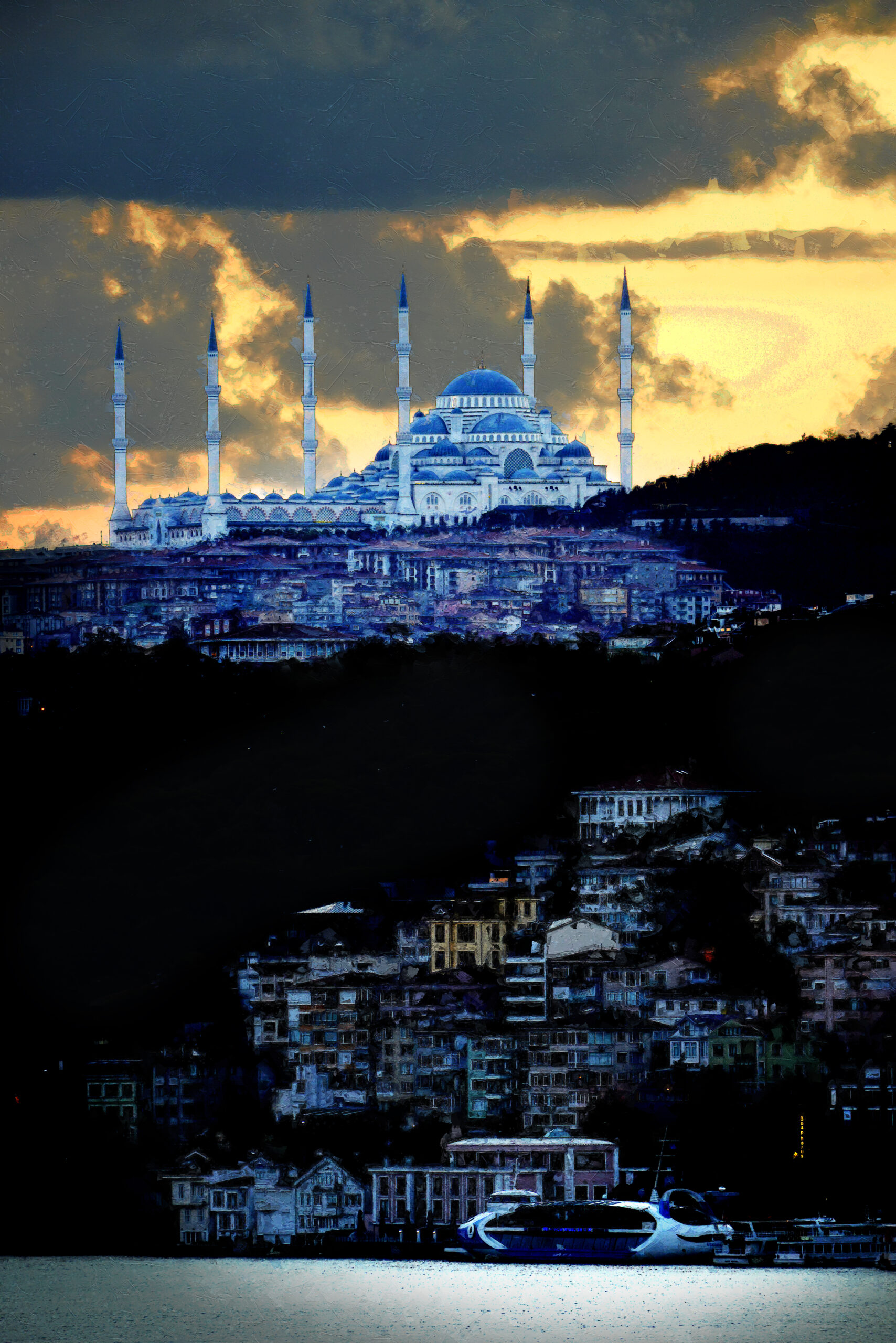
At first glance, the image presents a monumental mosque composition that feels both grounded in earth and lifted toward the heavens. The balance of vast domes, ascending minarets, and intricate façade rhythms creates a sense of visual harmony that is unmistakably Ottoman in spirit. Yet the work is not simply documentary—it is interpretive. It translates architectural reality into atmosphere, mood, and memory, emphasizing not just what these structures are, but what they represent.
The Language of Imperial Architecture
Ottoman imperial mosques, especially those built during the classical period of the 16th and 17th centuries under master architects such as Mimar Sinan, were never intended to be isolated buildings. They were conceived as külliyes—large civic and spiritual complexes that integrated prayer spaces with schools, hospitals, kitchens, libraries, and courtyards. These mosques functioned as both religious centers and social engines, reinforcing the Ottoman vision of order, community, and imperial legitimacy.
In this artwork, that sense of integrated scale is distilled into a single architectural presence. The mosque becomes more than a building; it becomes an entire worldview rendered in stone, geometry, and light. The composition evokes the defining features of Ottoman sacred design: the central dome system, cascading semi-domes, and slender minarets that frame the structure like vertical calligraphy written into the sky.
Historically, this architectural language reached its peak in Istanbul, where Byzantine inheritance and Islamic innovation merged into something entirely new. The great domed silhouette—often compared to Hagia Sophia—became a symbol of continuity and transformation, bridging empires while asserting a distinctly Ottoman identity.
Light, Geometry, and Spiritual Space
One of the most compelling aspects of Ottoman mosque architecture is its manipulation of interior and exterior light. Domes were not simply structural achievements; they were symbolic heavens. Light enters through carefully placed windows and filtered openings, transforming solid surfaces into glowing fields of spiritual atmosphere. This interplay between mass and illumination is central to the emotional impact of the architecture.
In this artwork, light becomes an expressive force. It does not merely reveal form—it defines it. Surfaces appear to dissolve into luminosity, suggesting the transcendence that these spaces were designed to evoke. The viewer is drawn into a moment of quiet elevation, where architecture becomes meditative rather than purely monumental.
The geometry of the composition reinforces this effect. Repeating arches, rhythmic window placements, and the vertical thrust of minarets create a visual cadence that echoes Islamic artistic principles more broadly. In Islamic design, geometric repetition is not decorative excess but symbolic order—an expression of unity within infinity. This principle is clearly present in the structure depicted, where every line contributes to a larger sense of harmony.
The Ottoman Imperial Aesthetic
Ottoman imperial mosques are renowned for their synthesis of grandeur and restraint. Unlike purely ornamental styles, Ottoman design emphasizes controlled elegance—where decoration enhances structure rather than overwhelms it. Materials such as Iznik tiles, marble carvings, calligraphy bands, and stained glass are integrated into the architecture with precision and symbolic intent.
This artwork captures that same sensibility through its visual balance. The mosque is neither overburdened nor minimal; instead, it exists in a state of refined equilibrium. The viewer can sense the presence of intricate detail without needing to isolate every element. This mirrors the experience of standing inside or before an Ottoman mosque in Istanbul, where complexity reveals itself gradually through movement and light.
The imperial character of the architecture also speaks to power—not in a purely political sense, but as a cultural expression of continuity and permanence. These mosques were designed to endure, to project stability across generations. In this piece, that endurance is echoed through the monumentality of form and the stillness of composition.
Istanbul as Living History
Istanbul itself is inseparable from the meaning of this artwork. As the former capital of both the Byzantine and Ottoman empires, the city is a layered archive of civilizations. Mosques rise alongside ancient churches, palaces, and bazaars, creating a visual dialogue between eras. This architectural density gives every structure added significance—it is never just about one building, but about its place within a continuous historical landscape.
The Ottoman Imperial Mosque in this artwork becomes a symbol of that layered identity. It stands not only as a religious site but as a cultural memory encoded in stone. It represents centuries of artisanship, imperial ambition, spiritual devotion, and urban evolution. In Istanbul, mosques are not static relics—they remain active spaces of worship and community, still shaping the rhythm of daily life.
Contemporary Fine Art Interpretation
What distinguishes this work as fine art is its transformation of architectural documentation into emotional experience. Rather than simply presenting a faithful architectural rendering, the piece elevates the subject into a meditative visual field. The viewer is invited to experience the mosque as atmosphere—an interplay of memory, light, and historical resonance.
This approach aligns with a broader tradition in architectural fine art, where structures become vessels for emotional narrative. The Ottoman Imperial Mosque is not portrayed as distant history but as living presence. The viewer senses both its physical mass and its spiritual weight, creating a dual experience of grounding and transcendence.
Conclusion
“Ottoman Imperial Mosque, Istanbul, Turkey” is ultimately a study in harmony—between structure and sky, history and present, material and spiritual form. It captures the essence of Ottoman architectural achievement while reinterpreting it through a contemporary artistic lens.
The result is a work that feels both timeless and immediate. It invites the viewer to pause within the grandeur of empire and the intimacy of devotion, to experience architecture not only as design but as memory made visible. In doing so, it honors one of the most influential architectural traditions in the world while transforming it into a personal, reflective encounter.