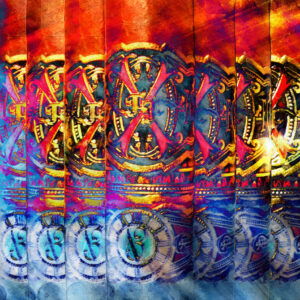
“In the Queen City, the night lights aren’t simply visual — they are the stars of our own urban sky.”Michael John Valentine
Charlotte, North Carolina — affectionately and historically known as the Queen City — is a place where heritage and modernity meet beneath a crown of lights. This nickname, bestowed in honor of Queen Charlotte of Mecklenburg-Strelitz, the wife of King George III, has endured through centuries of change, growth, and reinvention.
“Charlotte Neon at Night,” an original painting on canvas by Michael John Valentine, is more than a graphic portrayal of city lights. It is a sensory portrait of the place where history and contemporary life intersect in luminous, electric harmony.
A City Named for Royalty — A Soul Made by Its People
Charlotte’s designation as the Queen City began in the late 18th century, when colonists honored the consort of Britain’s King George III by naming their settlement Charlotte. Since its incorporation in 1768, the name has remained — even through the city’s embrace of independence and the spirit of the American Revolution.
Today, Charlotte stands among the fastest-growing cities in the United States, a striking blend of bustling urban skyline and Southern warmth. Its population continues to expand, drawing people from across the world to its energy, opportunity, and cultural dynamism. But with all of this growth, Charlotte has retained a distinct character: one rooted in resilience, ambition, and a deep sense of place.
“Charlotte Neon at Night” captures this evolution with a sophistication that bridges the tactile history of the city with its vibrant present.
The Painting: Light as Memory, Color as Experience
At first glance, the painting is a celebration of neon — the glowing hues reflecting off wet pavement at dusk, the layered luminescence of architectural silhouettes against an evening skyline. Yet this work is not simply representational. Through intentional brushwork and an expressive blend of acrylic and gloss, Valentine paints not what Charlotte looks like, but what it feels like.
Neon — in this context — serves as a metaphor for personality. It’s not harsh or garish; rather, it’s warm and inviting, evoking memories of midnight walks, late-night conversations, and the rhythmic heartbeat of a city that never quite sleeps. It’s the glow from storefront signs and late-night diners refracted against the promise that everything — and everyone — in Charlotte is always moving forward.
This painting inhabits that liminal space between reality and memory, between the present moment and the emotional resonance that carries across shared collective memories.
A Historic Metaphor Within Modern Expression
Charlotte’s journey from colonial settlement to modern economic hub is rich with historical texture. The city not only carries royal heritage in its name but also boasts a legacy of civic spirit, from early declarations of independence to becoming a major financial center in the 21st century.
It is this duality of tradition and transformation that Valentine communicates through his palette. Deep, velvety shadows sit beneath warm, glowing highlights, balancing Charlotte’s grounded history with its evolving identity. The painting becomes a metaphor for a city that honors its past while always reaching toward the future — a city that is regal not because of grandeur, but because of character.
Beyond Representation: The Emotional Geography of Place
What makes “Charlotte Neon at Night” distinctive in the broader landscape of urban art is its embrace of experience over documentation. Rather than offering a literal street-by-street skyline, the painting conjures a sense of atmosphere: the hues, the quiet hum of neon, the interplay between stillness and movement.
This is art that doesn’t simply mimic a city’s appearance — it interprets its emotional pulse.
Collectors who experience this work often speak not of what they see in it, but what they remember:
-
the echo of footsteps along a rain-slick sidewalk
-
the soft gust of wind weaving through illuminated facades
-
the fleeting sense of time suspended at the threshold of night
It evokes Charlotte not as a static image, but as a feeling — intimate, evocative, and undeniably alive.
The Queen City’s Place in the American Imagination
Charlotte’s moniker sets it apart from other cities. Although several U.S. cities have earned the “Queen City” nickname, Charlotte’s connection is unique in its direct historical lineage.
In the city’s official seal and flag, the crown appears as a proud emblem — a reminder that this is Charlotte’s identity in both name and spirit.
The crown symbolizes unity, aspiration, and dignity. In Valentine’s painting, that legacy of aspiration transmutes into light: bright, reflective, and unmistakably human.
Why This Painting Matters to the Collector
For the connoisseur of fine art and urban narrative, “Charlotte Neon at Night” is not simply a painting to hang. It’s a piece that invites contemplation, conversation, and emotional connection. It transforms any space into a setting rich with memory, meaning, and visual poetry.
Whether placed in a private collection, executive office, or gallery, it serves not merely as decor — but as a dialogue between viewer and place. It calls forth personal stories, sparks curiosity about Charlotte’s layered history, and celebrates the beauty of moments that might otherwise go unnoticed.
This is why collectors drawn to this work speak of it not only in visual terms, but in visceral ones — because great art doesn’t just show; it feels.
Conclusion: The Queen City in Light
“In the Queen City, the night lights aren’t simply visual — they are the stars of our own urban sky.” In that sentiment lies the power of this painting: it elevates Charlotte from a geographical location to an emotional landscape.
It captures a city whose present is defined by light and energy, and whose past is a legacy of heritage and aspiration. To live with this painting is to live with Charlotte itself — vibrant, luminous, and ever forward.