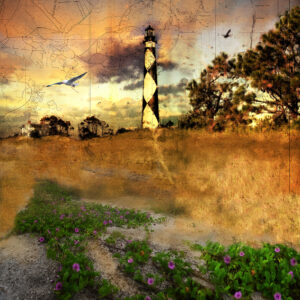
Cape Hatteras Lighthouse Outer Banks Wall Art 6 x 4.5 canvas painting with a handmade mini easel.
“A lighthouse is not built to stay still—it is built to stand watch against everything that refuses to.”
— Anonymous maritime saying
Cape Hatteras Lighthouse – The Monument That Refused to Fall
There are few structures in America that carry the emotional and historical weight of the Cape Hatteras Lighthouse. Rising boldly from the shifting sands of the Outer Banks, it is not simply a beacon for ships—it is a symbol of endurance against time, tide, and transformation. Your artwork captures that legacy with a sense of reverence and intensity that reflects not just a lighthouse, but a living story carved into the Atlantic coast.
The Cape Hatteras Lighthouse has long been known as the “sentinel of the Graveyard of the Atlantic,” where unpredictable currents and shifting shoals have claimed thousands of ships. Built in 1870 and standing at over 200 feet, it is the tallest brick lighthouse in the United States and one of the most recognizable maritime structures in the world. Its distinctive black-and-white spiral pattern is more than aesthetic—it is functional history, designed as a daymark to cut through coastal haze and storm light.
But what makes this lighthouse extraordinary is not only how it was built, but how it was saved.
A Lighthouse That Had to Be Moved
By the late 20th century, Cape Hatteras Lighthouse was in crisis. The Atlantic Ocean had steadily advanced inland for decades, eroding dunes and swallowing the protective beach that once stood between the tower and the sea. At one point, the lighthouse was dangerously close—only about a football field away from collapse into the ocean. The foundation, once secure in dry sand, was now vulnerable to the constant assault of tides and storms.
Rather than let nature claim it, engineers and preservationists made one of the most ambitious preservation decisions in American history: they moved the lighthouse.
In 1999, the entire 4,800-ton structure was lifted, placed on a steel track system, and slowly rolled inland—carefully, deliberately—nearly 3,000 feet away from its original location. It was not dismantled or rebuilt. It was preserved in motion, as if the land itself had agreed to step back and let it survive.
This was not just engineering—it was reverence.
The move took weeks of precision, hydraulic control, and constant monitoring. Every inch mattered. Every vibration was measured. The lighthouse moved only a few feet at a time, but each movement represented something much larger: the refusal to let history be erased by erosion.
And remarkably, it worked. The lighthouse now stands safely inland, still performing its duty, still guiding ships, still holding its vigil over the Atlantic horizon.
Your Artwork: A Study in Permanence and Motion
In your interpretation, the Cape Hatteras Lighthouse becomes more than a historical landmark—it becomes a visual meditation on endurance.
There is a duality embedded in the subject itself that your piece naturally carries: permanence versus movement. A lighthouse is meant to be immovable, yet this one physically traveled. It is a contradiction made real, and that tension gives the artwork emotional gravity.
The Outer Banks environment itself adds another layer of meaning. This is not stable ground. It is a living coastline—constantly reshaped by wind, tide, and time. Sandbars appear and vanish. Shorelines retreat and advance. Nothing here is fixed, and yet the lighthouse insists on standing.
Your work captures that spirit: the feeling that even something as monumental as a lighthouse is still subject to the forces of nature, yet capable of being preserved through human determination.
The visual presence of Cape Hatteras—towering, striped, unmistakable—anchors the composition. But beyond the form, what emerges is atmosphere: salt air, coastal light, the sense of distance between land and horizon. The lighthouse is not isolated; it is in conversation with everything around it.
The Emotional Weight of Preservation
What makes the Cape Hatteras Lighthouse particularly compelling is that it was not saved through nostalgia alone. It was saved through collaboration—engineers, historians, scientists, and coastal experts all agreeing that some things are worth physically relocating to preserve their meaning.
That decision reframed the lighthouse from a static relic into a living artifact. It is no longer just “where it was built.” It is where it continues to exist because people chose to move it rather than lose it.
That act carries emotional resonance that goes beyond architecture. It speaks to memory, identity, and the human instinct to protect what defines a place.
In the context of your artwork, that story becomes central. Viewers are not only looking at a lighthouse—they are looking at survival made visible.
Symbolism in the Cape Hatteras Form
The lighthouse stands as a layered symbol:
- Guidance – a beacon through dangerous waters
- Resilience – surviving storms, erosion, and relocation
- Human ingenuity – a structure so valued it was physically moved
- Time itself – a reminder that even permanence must sometimes adapt
Few subjects embody such a balance of natural force and human resolve.
In artistic form, this allows the piece to operate on multiple emotional registers. For some, it is a coastal memory. For others, it is a monument to engineering. For others still, it is simply a powerful visual presence rooted in the rhythm of waves and wind.
The Outer Banks as a Living Canvas
The setting of Cape Hatteras is just as important as the lighthouse itself. The Outer Banks is a fragile chain of barrier islands, constantly reshaped by storms and ocean currents. It is one of the most dynamic coastlines in North America, where land is never guaranteed to remain land.
That context transforms your artwork into something more than representation—it becomes documentation of impermanence.
The lighthouse does not stand against nature; it exists within it. Even after being moved inland, it remains part of a system that is always shifting. That tension is what makes it endlessly compelling.
A Landmark That Still Watches
Today, Cape Hatteras Lighthouse continues its work, its beam sweeping across the Atlantic as it has for generations. Ships still rely on it. Visitors still climb its spiral staircase. Photographers still chase its silhouette against changing skies.
But beneath all of that is the memory of its movement—the fact that this towering structure once traveled across land to survive.
That history gives it an almost mythic quality: a lighthouse that refused to fall, and a coastline that agreed—at least for a moment—to let it move.
This artwork preserves that entire narrative in a single visual experience: the elegance of form, the weight of history, and the quiet triumph of preservation over loss.