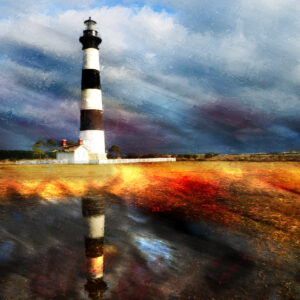
Haceta Head Lighthouse Wild Flowers Oregon Coast Wall Art 6 x 4.5 canvas painting with a handmade mini easel.
“Earth laughs in flowers.” — Ralph Waldo Emerson
Haceta Head Lighthouse & Wildflowers —
In Haceta Head Lighthouse Wild Flowers, Michael John Valentine captures more than a coastal landmark—he preserves a moment where land, light, and life converge in quiet perfection. This is not simply a depiction of the Oregon coastline; it is an emotional translation of place, rendered through layered acrylic technique, atmospheric sensitivity, and a collector-grade commitment to detail.
The lighthouse itself rises as the visual and symbolic anchor of the composition. Heceta Head, one of the most iconic and photographed lighthouses on the Pacific coast, is known for its dramatic perch above steep cliffs and its unwavering presence against the shifting moods of the ocean. In this painting, however, it is not portrayed as an isolated monument. Instead, it is gently woven into a living foreground of wildflowers—an interplay that softens its maritime authority and transforms it into something more poetic, more human.
The wildflowers are the emotional language of the piece. They are not decorative accents placed around the lighthouse; they are equal participants in the story. Their presence suggests seasonal abundance, coastal resilience, and the quiet persistence of nature in environments often defined by wind, salt, and stone. In Valentine’s hands, these flowers become gestures of color and movement—reds, golds, lavenders, and soft whites that appear to breathe against the more structured geometry of the lighthouse tower.
This contrast is essential to the painting’s power. The lighthouse represents permanence: engineered, vertical, deliberate. The wildflowers represent impermanence: organic, scattered, ephemeral. Together, they form a visual dialogue between human intention and natural spontaneity. The result is a balanced tension that gives the artwork its emotional depth. The viewer is drawn not only to the structure of the lighthouse but into the surrounding atmosphere where life quietly asserts itself in every brushstroke.
Valentine’s technique reinforces this duality. Built through layered acrylic overpainting, the surface of the canvas reveals a gradual evolution of form. The underpainting establishes the structural logic of the composition—shoreline, cliff, horizon, and architectural placement. Subsequent layers introduce atmospheric complexity: shifting coastal light, subtle haze over the water, and the soft diffusion of sky meeting land. The final layers bring forward the tactile richness of the wildflowers, where pigment is applied in a way that creates slight dimensionality, allowing light to interact with the surface rather than simply resting on it.
This method is not rushed. It is cumulative, deliberate, and reflective of a studio practice rooted in discipline. Each layer contributes not only visual information but emotional tone. The lighthouse becomes more defined as the painting progresses, not through harsh outlining, but through surrounding contrast. The flowers become more luminous as pigment builds, not through saturation alone, but through the interaction of transparent and opaque layers. This creates an internal glow within the composition that gives the entire piece a sense of atmospheric cohesion.
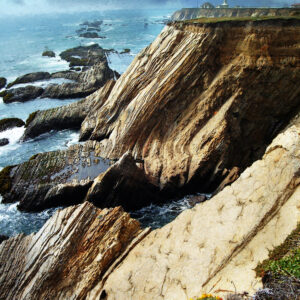
The coastal environment surrounding Haceta Head is inherently dramatic, and Valentine does not soften that reality. Instead, he refines it. The cliffs are suggested rather than over-detailed, allowing the viewer’s eye to complete their ruggedness. The sky is rendered with tonal variation that evokes shifting weather systems—those fleeting moments where fog, sunlight, and ocean mist coexist in a single frame of time. The ocean itself is not a static body of water but a living surface of movement and reflection, hinted at through subtle tonal shifts rather than literal wave depiction.
What distinguishes this work within the broader context of lighthouse art is its emotional restraint. Many coastal paintings rely on spectacle—towering waves, exaggerated skies, or hyper-saturated color palettes. Here, however, the power lies in balance. Nothing is overstated. Everything is intentional. The lighthouse does not dominate the flowers, nor do the flowers obscure the lighthouse. Instead, they coexist in a shared visual rhythm that feels both grounded and contemplative.
This restraint extends to the overall mood of the piece. There is no urgency in the scene. Instead, there is stillness—a suspended moment where the viewer feels invited to pause. It is the kind of coastal silence that exists only when wind slows and light softens, when even the ocean seems to hold its breath. In this space, the lighthouse becomes less of a navigational tool and more of a quiet guardian, and the flowers become less botanical subjects and more emotional signals of presence and renewal.
From a collector’s perspective, Haceta Head Lighthouse Wild Flowers carries the hallmarks of fine studio craftsmanship. It is an original signed work, created through a process that emphasizes both technical layering and conceptual clarity. Each piece is accompanied by a Certificate of Authenticity, reinforcing its status as a one-of-a-kind creation rather than a reproduction or mass-produced decorative print. This distinction is critical in the contemporary art market, where provenance and originality define long-term value.
The artwork also reflects a broader philosophy of place-based storytelling. The Oregon coast is not used here as a generic backdrop but as a specific, lived environment—one shaped by weather, geology, and time. Haceta Head Lighthouse itself is not merely an architectural subject but a cultural landmark, deeply embedded in maritime history and coastal identity. By integrating wildflowers into this setting, the artist introduces an additional layer of meaning: the idea that even the most enduring human structures exist within a larger, evolving natural world.
In interior spaces, this painting functions as both focal point and atmosphere setter. It does not demand attention through scale or intensity, but rather draws the viewer inward through subtle detail and compositional harmony. In a home, office, or curated collection, it introduces a sense of calm continuity—a reminder of coastal permanence balanced by natural change.
Ultimately, Haceta Head Lighthouse Wild Flowers is not just about a lighthouse or a field of flowers. It is about coexistence. It is about how human presence and natural beauty can inhabit the same frame without competition, each enhancing the other’s significance. It is about stillness on a coastline that is otherwise defined by movement. And it is about the quiet power of observation—of noticing how light falls across petals, how stone meets sky, and how even the most familiar landmarks can be re-seen through an artist’s attentive eye.
In this way, the painting becomes more than an image. It becomes an experience of place distilled into color, texture, and light—a collector’s piece not only for its craftsmanship, but for its ability to hold a moment in time that feels both fleeting and eternal.