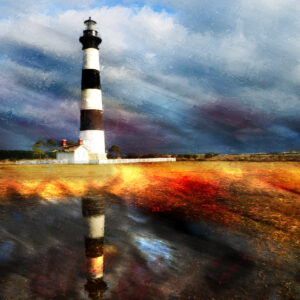
Cape Hatteras Lighthouse OBX is a Gallery Wrapped 6 x 6 canvas painting with a handmade mini easel.
“A lighthouse is not built to tame the sea, but to remind the shore that even the wildest darkness can be measured in light.” — Michael John Valentine
Cape Hatteras Lighthouse – A Monument of Light, Movement, and Enduring Legacy
There are few American coastal landmarks that embody both the poetry and the engineering triumph of human resilience quite like the Cape Hatteras Lighthouse. Rising boldly above the shifting sands of the Outer Banks, this iconic structure stands not only as a navigational aid but as a living testament to endurance against time, tide, and transformation. In this artwork, the lighthouse is not merely depicted—it is interpreted as a symbol of persistence, migration, and the eternal dialogue between land and sea.
The Cape Hatteras Lighthouse, located in Buxton on Hatteras Island, is part of the storied region of North Carolina’s Outer Banks, where Atlantic storms and ocean currents continuously reshape the coastline. Managed within the care of National Park Service, the lighthouse remains one of the most recognizable maritime structures in the United States. Its striking black-and-white spiral pattern cuts through coastal haze like a visual rhythm—an unmistakable signal to mariners navigating one of the most dangerous stretches of water along the Eastern Seaboard.
What makes this lighthouse especially compelling—beyond its height, its history, or its design—is its physical relocation in 1999. In one of the most remarkable feats of preservation engineering ever undertaken, the entire lighthouse was moved nearly 2,900 feet inland to protect it from relentless shoreline erosion. This was not simply a construction project; it was a careful negotiation with nature itself. The structure, weighing thousands of tons, was lifted, transported, and set down again with extraordinary precision, preserving both its integrity and its symbolism.
That act alone transformed the lighthouse from a static monument into a moving narrative—one that echoes the very nature of the Outer Banks themselves. These barrier islands are never still. They breathe, shift, erode, and rebuild. In many ways, the lighthouse belongs to that same rhythm. It is not anchored in permanence, but in adaptation.
In this painting, the lighthouse becomes more than architecture—it becomes presence. The vertical rise of the tower is contrasted with the horizontal pull of sea and sky, creating a tension that mirrors the emotional pull of the coast itself. Light is not treated as a simple illumination source, but as a living force that interacts with atmosphere, memory, and motion. The brushwork suggests wind, salt, and time—those invisible forces that shape every grain of sand around it.
The Cape Hatteras Lighthouse is often called the “Beacon of the Graveyard of the Atlantic,” a reference to the countless ships lost in the treacherous waters nearby. That history is embedded in the emotional weight of the structure. It is not simply a picturesque coastal icon; it is a sentinel standing over centuries of maritime struggle, survival, and passage. Within the composition of this artwork, that legacy is felt in the tonal contrasts—where darkness is not absence, but depth, and light is not decoration, but direction.
There is also something profoundly human in the lighthouse’s survival story. Its relocation was controversial at the time, yet ultimately celebrated as a triumph of preservation over loss. Rather than allowing nature’s erosion to claim it, engineers and preservationists chose movement over surrender. That decision reflects a deeper philosophical truth: that sometimes, preservation does not mean standing still, but knowing when to move in order to endure.
In this way, the lighthouse becomes a metaphor for adaptation in its purest form. It reminds us that strength is not always rigidity; sometimes it is the willingness to shift, to be carried, and to be set down again in a safer place without losing identity. The structure remains the same, yet its context has changed—much like memory itself, which carries the past forward even as it is reshaped by time.
The Outer Banks environment plays an equally important role in this work. The horizon is never just a line; it is a threshold. The sea is never just water; it is motion made visible. The sky is never just atmosphere; it is a vast emotional field that reflects every change below it. Together, they create a setting that is both serene and volatile—an elegant contradiction that defines coastal life.
Within the painting, subtle shifts of color and texture suggest this duality. Warm undertones hint at sunrise or sunset, moments when the lighthouse is most spiritually present—neither fully day nor fully night, but suspended between transitions. Cooler tones suggest the Atlantic’s depth and distance, reinforcing the idea that the lighthouse is both guide and witness.
The viewer is invited not just to observe the lighthouse, but to feel its role in the landscape. It is not isolated, but relational. It belongs to the ocean as much as the ocean surrounds it. It belongs to the wind as much as it resists it. And it belongs to time—not as a victim of it, but as a participant within it.
Ultimately, this artwork is about more than a structure. It is about endurance shaped by motion, beauty defined by impermanence, and light that continues to speak even when the world around it changes. The Cape Hatteras Lighthouse stands as a reminder that legacy is not preserved by resisting change, but by moving with it—carefully, intentionally, and with purpose.
In that sense, the lighthouse is not just a subject. It is a philosophy cast in brick, iron, and light.