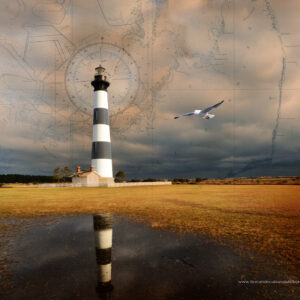
Ocracoke Lighthouse OBX is a Gallery Wrapped 6 x 6 canvas painting with a handmade mini easel.
On Ocracoke’s quiet edge of sea and sky, even the wind seems to pause and listen before it speaks.”
— Maritime saying of the Outer Banks
Ocracoke Lighthouse — A Beacon of Endurance, Memory, and Coastal Silence
Ocracoke Lighthouse stands not as a monument of spectacle, but as a study in restraint, resilience, and timeless coastal identity. Nestled within the protected landscape of Ocracoke Island, it is one of the most quietly powerful navigational beacons along the Outer Banks—an enduring sentinel that has guided mariners through shifting sands, unpredictable tides, and the long, haunting horizon of the Atlantic for more than two centuries.
First illuminated in 1823, the lighthouse is among the oldest operating lights in the United States and the oldest in North Carolina still in service. Its whitewashed cylindrical form rises only modestly from the earth, yet its presence is anything but small. It is a structure defined not by grandeur, but by integrity—by the disciplined repetition of function across generations. Built to serve Ocracoke Inlet, one of the most historically volatile maritime passages on the Eastern Seaboard, the lighthouse was never meant to dominate the landscape. It was meant to belong to it.
That sense of belonging is central to its legend. Ocracoke Inlet has always been a place of transformation, where channels shift, shoals migrate, and water refuses to stay still. Mariners once depended on local pilots—men who knew the invisible language of currents—to guide them safely through these waters. The lighthouse emerged as a fixed answer to an unfixed world, a vertical certainty in a horizontal realm of uncertainty. It remains, even today, a reminder that clarity can exist in places defined by change.
From an artistic perspective, the Ocracoke Lighthouse carries a rare kind of visual poetry. It is not ornate, yet it is deeply expressive. The contrast of its stark white silhouette against the muted blues, grays, and salt-weathered greens of the island creates a composition that feels almost pre-arranged by nature itself. Morning light softens its edges into a dreamlike haze, while evening storms sharpen its profile into something almost mythic. It is a subject that does not simply sit within a painting—it defines the emotional temperature of the entire canvas.
Historically, the lighthouse has also become a quiet witness to some of the most formative narratives of the Outer Banks. Not far from its grounds, the waters once echoed with the final chapter of the pirate Edward “Blackbeard” Teach. Though legend often swirls around the island’s past, what remains consistent is its role as a threshold—between commerce and isolation, safety and peril, civilization and wilderness. The lighthouse, in this context, becomes more than architecture; it becomes a marker of passage between worlds.
The structure itself is remarkably restrained in design. Its conical brick form, later coated in a protective white exterior, reflects early American lighthouse engineering at its most practical. There is no excess, no decorative indulgence—only proportion, balance, and purpose. Even its lantern room feels deliberate, as though every pane of glass was positioned to serve both visibility and endurance. This purity of form is what makes it so compelling for artistic interpretation. It does not demand attention; it earns it slowly, over time.
In my interpretation of the Ocracoke Lighthouse, I sought to capture this duality of permanence and impermanence. The painting becomes less about the structure alone and more about the atmosphere it inhabits. The shifting coastal light, the invisible pressure of wind, and the reflective silence of surrounding waters all play equal roles in shaping its presence. The lighthouse stands as an anchor within a constantly dissolving environment—a visual paradox that defines much of coastal life along the Outer Banks.
The emotional language of this piece is rooted in stillness. Not emptiness, but a deliberate, contemplative stillness—the kind found only in places where land narrows into water and time feels slightly suspended. There is a reason artists and writers return repeatedly to lighthouse imagery: it speaks to guidance without control, strength without aggression, and solitude without loneliness. Ocracoke embodies all of these qualities in their most distilled form.
Today, the lighthouse remains active, though its role has evolved. It no longer carries the same burden of guiding commerce-heavy maritime traffic as it once did, but it continues to serve as both navigational aid and cultural anchor. Visitors who arrive by ferry or boat encounter it not as a distant landmark, but as a grounded presence—quiet, unassuming, yet unmistakably iconic. It stands within a protected historic landscape, preserved not just as infrastructure, but as heritage.
What makes Ocracoke particularly compelling is its resistance to modernization in spirit, even as time has inevitably altered its surroundings. The island has changed, the waters have shifted, and yet the lighthouse remains visually consistent with its earliest days. It is this continuity that gives it emotional weight. In a world increasingly defined by rapid transformation, it offers a counterpoint: endurance through simplicity.
In the broader narrative of American coastal art and maritime history, Ocracoke Lighthouse occupies a rare position. It is neither the tallest nor the most visually dramatic lighthouse along the Eastern Seaboard, yet it is among the most evocative. Its power lies in understatement. It invites viewers—and artists—to slow down, to observe more carefully, and to consider the quiet intelligence of structures built not for spectacle, but for survival.
Ultimately, this painting is not just a depiction of a lighthouse. It is an homage to a way of seeing—one that values silence, balance, and the poetic tension between land and sea. Ocracoke becomes a symbol of guidance not as command, but as presence. A reminder that even in the most shifting environments, there are still points of light that remain steady, unwavering, and true.