Historic Statement
The Rose Island Lighthouse, perched on a rocky outcrop in Narragansett Bay, just offshore of Newport, Rhode Island, stands as an enduring sentinel of America’s maritime legacy. Erected in 1870 atop the remnants of Fort Hamilton, itself a vestige of America’s earliest coastal defenses, Rose Island Light was born of a pivotal moment in New England history when burgeoning steamship traffic demanded reliable navigational beacons. From its first illumination — a fixed red beacon cast out over the bay — through its century-long service guiding vessels into Newport’s bustling harbor, the beacon embodied both utility and the poetry of seafaring life.
Decommissioned in 1970 due to the construction of the nearby Newport (Pell) Bridge — whose lights, modern and towering, rendered the original beacon obsolete — the lighthouse might have faded into ruin. Instead, through the committed stewardship of local citizens and the Rose Island Lighthouse Foundation, it was painstakingly restored and relit by 1993 as a private aid to navigation. Today, it stands not only as a functional beacon but as a meticulously preserved museum of maritime heritage, inviting visitors to step into the living history of coastal America.
Rose Island Lighthouse — Original Painting on Canvas
An Ode to Light, Memory, and Maritime Majesty
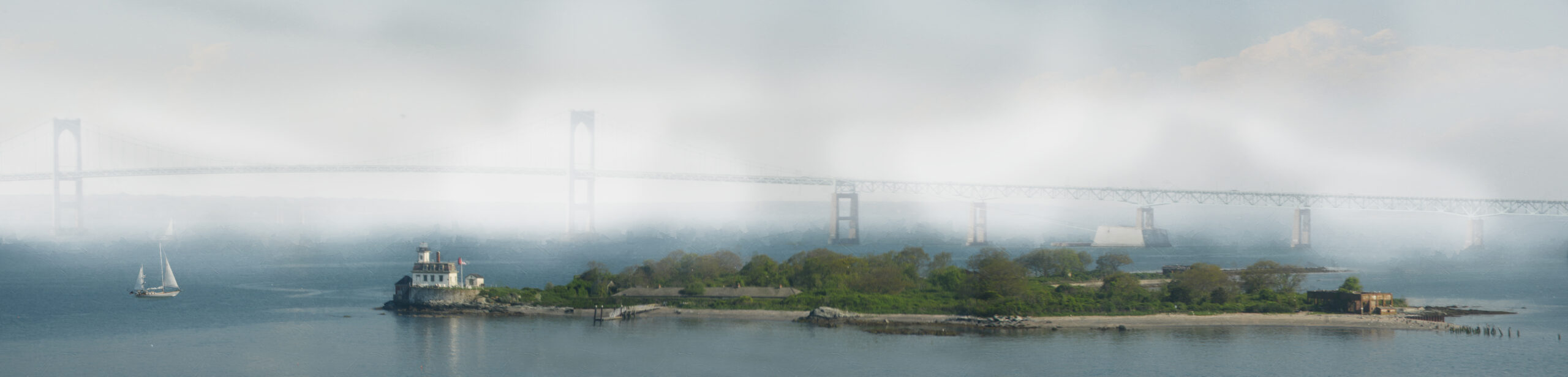
In Rose Island Lighthouse, Newport Rhode Island in the Fog, the artist captures not merely a structure of timber and glass, but a cultural beacon — an edifice woven from steamship lore, Atlantic tempests, human vigilance, and the infinite dance of light upon water. Standing firm against the tides and ever-changing weather of Narragansett Bay, the lighthouse has emerged across centuries as a symbol of steadfastness and hope. Much like the brushwork that animates the canvas, the lighthouse itself has weathered ebb and flow — both literal and historical.
The Lighthouse in Context
Built in the aftermath of the Civil War, this sentinel was commissioned at a moment when America was redefining its horizons — economically, technologically, and spiritually. Steamships plied the waters between Newport, Boston, and New York, and Rhode Island’s strategic maritime position demanded a reliable guide for vessels threading through the fog and shifting tides. Completed in 1870 on the southwest bastion of Fort Hamilton — a fortification begun decades earlier but never fully realized — Rose Island Lighthouse’s first fixed red light shone across Narragansett Bay, a quiet yet commanding presence against an ever-busy seascape.
For more than a century, the lighthouse served with dignity. Its original sixth-order Fresnel lens — a marvel of optical engineering — helped mariners discern the entrance to Newport harbor. Lighthouse keepers — stalwart custodians of flame and fog bell — lived in the keeper’s dwelling attached to the tower, tending both the light and the rhythms of daily life amidst wind and salt. Today, that period of importance is immortalized not simply in history but in art, memory, and preservation.
The Evolution of Meaning
By 1970, advances in navigation and the completion of the Newport Bridge made the original beacon superfluous. Left dormant and at the mercy of time, the lighthouse could have become another forgotten relic. Yet, history had not finished with it. The Rose Island Lighthouse Foundation, a community-led nonprofit, initiated a remarkable act of cultural stewardship. Through volunteer labor, donations, and unyielding dedication, the lighthouse was restored to its original Victorian era charm — a span of decades that mirrored the patience of the tides it once guided. By its relighting in 1993, the lighthouse had found new life not only as a navigational aid but as a museum and living testament to the past.
Today, visitors reach this storied landmark only by water — as it was meant to be approached — and tour its museum rooms, experience firsthand the keeper’s life, or even stay a night within its historic walls. The lighthouse is preserved in the National Register of Historic Places, but its true preservation exists in the intangible heritage it carries: the echo of foghorns, the salt on the wind, the gaze outward toward boundless horizons.
The Painting’s Moment in Time
What makes Rose Island Lighthouse Newport Rhode Island in the Fog an extraordinary work of art is its intimate dialogue with such historical depth. The fog itself — often a poetic symbol for uncertainty, transition, and the obscured future — becomes a collaborator in the composition. Softened edges, gentle gradients of gray and blue, and the ethereal glow of the beacon unify to evoke a moment suspended between sea and sky, past and present. The fog does not conceal the lighthouse; it frames it, deepening its mystery and accentuating its architectural clarity against diffuse light. The painting transforms a historic landmark into a meditation on endurance.
There is an emotional depth embedded in every brushstroke — a nuance that calls to mind the countless mariners who once relied on these waters for livelihood and passage, and the keepers who tended the light through storms and calm alike. Through this painting, the lighthouse is more than a subject; it is a vessel of stories — the whispered exchanges of sailors, the creak of stair treads at dawn, the reassurance of light for souls at sea. With every glance, the viewer is invited to reflect not merely on what once was, but on what continues to be shaped by memory, place, and presence.
Cultivating Legacy Through Art
This work — presented with overpainting and sealed in protective gloss — echoes the lighthouse’s own journey: restored, resilient, radiant. It is an object of beauty and contemplation, destined for discerning collectors who appreciate art that bridges history, environment, and emotion. As with all great landmarks, the Rose Island Lighthouse’s significance lies not only in its physical form, but in what it inspires — reflection on heritage, connection to past narratives, and deep admiration for landscapes that harbor human endeavor.
In Rose Island Lighthouse Newport Rhode Island in the Fog, the sea meets the sky, history converges with artistry, and the beacon — ever luminous — stands as an emblem of perpetual guidance. This painting does not merely depict a scene; it invites you into it.