
“Simplicity is the ultimate sophistication.” — Leonardo da Vinci
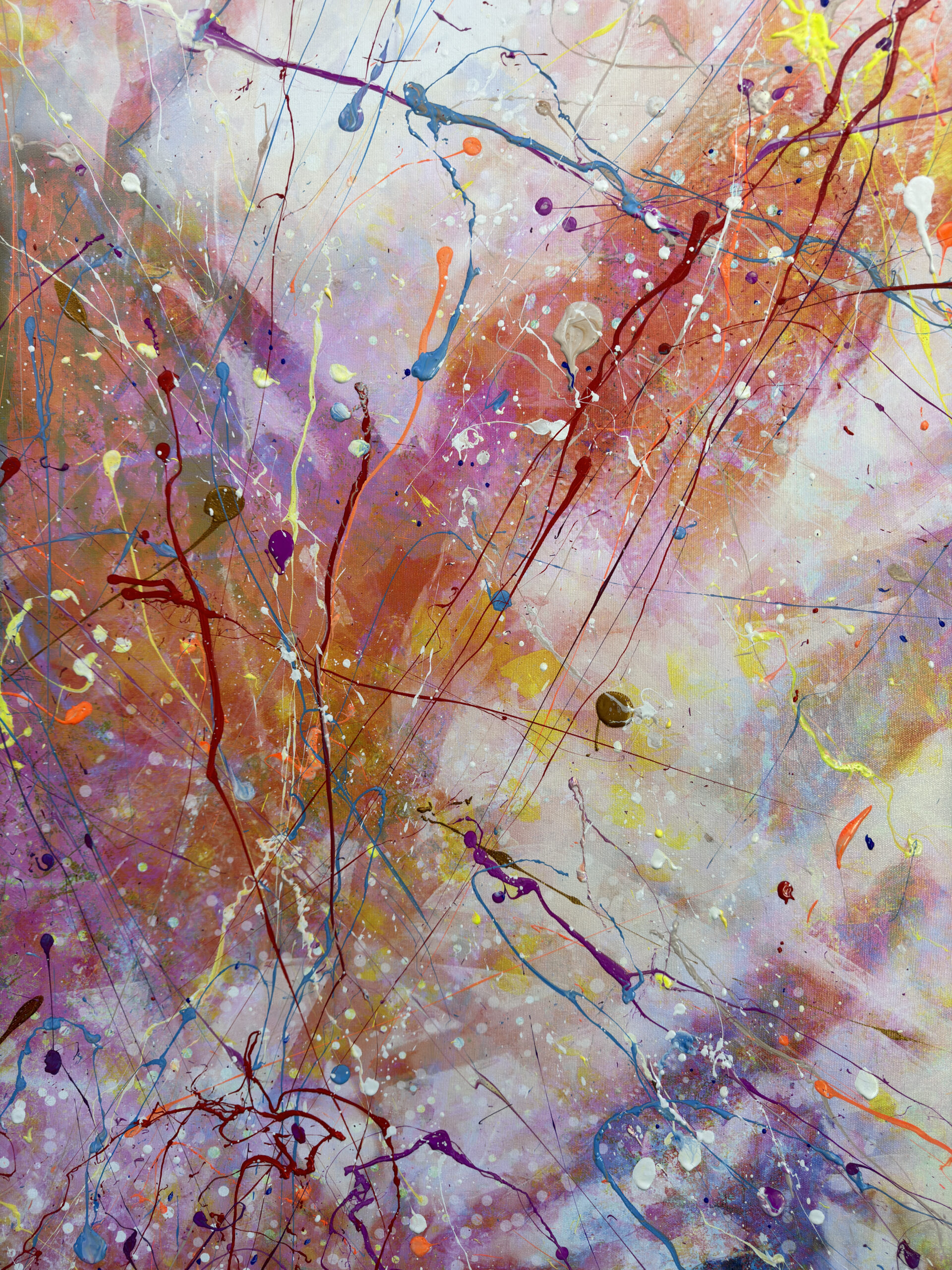
At first glance, Life Line with Painted Suspended Frame by Michael John Valentine appears to be a work of abstract interplay—an expressive composition alive with gesture, tension, and dimensional poise. Yet when viewed through a lens informed by the enduring insights of Leonardo da Vinci, this piece transcends pure aesthetic appreciation and invites a deeper philosophical encounter.
Da Vinci’s declaration that “simplicity is the ultimate sophistication” whispers across centuries and speaks directly to the heart of Valentine’s work. Though layered in material complexity and conceptual intricacy, Life Line resonates through an eloquent visual economy—every mark, every hue, and every engineered spatial decision contributes to a unified artistic statement.
This is not merely a painting; it is an encounter with form, space, and the essential pulse of life.
A Symphony of Depth and Presence
First and foremost, Life Line presents itself as an artifact that defies static interpretation. At 42 × 28 inches, its physical dimensions command the observer’s attention, but it is the suspended canvas within a painted frame that alters the very relationship between artwork and environment. The canvas does not rest flat against the wall—it hovers, suspended by visible hardware that resembles modern sculpture more than traditional framing.
Here, Valentine disrupts expectations. The deep shadow-box frame, artistically splattered with echoes of the painting’s palette, becomes a kinetic bridge between painting and architecture. The frame is no longer a boundary—it is an extension of the piece’s emotional energy. The result is a visual tension that celebrates both image and structure, urging the viewer to acknowledge not just what is depicted, but how it is positioned in space.
The Essence of Gesture and Motion
On close inspection, the surface of Life Line reveals layers of paint that have been overpainted in select areas, each stroke chosen with deliberation. When sealed with a glossy protective finish, these gestures catch and bend light, suggesting movement even in stillness.
Abstract art, at its best, offers a language beyond words—an intuitive lexicon that resonates emotionally, psychologically, and even spiritually. In this work, the lines do more than paint—they trace vectors of life itself. They suggest trajectories, ruptures, and reconciliations within vision and experience. They hint at a narrative without prescribing one.
The artwork’s title, Life Line, nods toward the primal rhythms of being. It evokes the literal pulse drawn on a medical monitor, and also suggests the metaphorical line that weaves through existence—the connections, breaks, and returns that define human experience.
Engineering Meets Expression
Valentine’s inclusion of visible hardware is a purposeful decision. Rather than conceal the mechanics that allow the canvas to float, he highlights them. This juxtaposition—where precision engineering meets expressive abstraction—is nothing short of poetic.
Leonardo da Vinci himself straddled the realms of art and engineering: he dissected cadavers to understand muscle and bone, and sketched machines that centuries later would presage modern inventions. While Valentine does not dissect anatomy, he deconstructs artistic norms, incorporating engineering elements that force the viewer to consider the artwork as both concept and construct.
In doing so, Valentine honors a legacy of artistic innovation rooted in observation and experiment—an ethos that da Vinci championed throughout his notebooks and practical investigations.
The Poetics of Space and Suspension
The deep shadow-box frame is not a passive container but an active participant in the work’s narrative. Its hand-splattered surface extends the canvas’s emotional palette outward, blurring boundaries between figurative space and physical reality.
Instead of being defined by a rigid border, Life Line breathes within its environment. Shadows cast by the suspended canvas interact with light and surface, transforming the wall behind it into an evolving tableau. This approach resonates with da Vinci’s own exploration of sfumato, where forms dissolve and emerge in gradients of light and shadow, dissolving strict edges and inviting deeper perception.
Here, Valentine’s work becomes not just an object to observe, but a dynamic interplay between object, light, and space—an embodiment of refined simplicity within a complex system.
Materiality and Longevity
Sealed under a glossy protectant and signed by the artist, Life Line is crafted as an enduring piece, meant not merely for visual admiration but for physical preservation.
The protective glazing underscores the work’s commitment to longevity—a celebration of craft that aligns with da Vinci’s meticulous approach to materials and technique. Though centuries apart in origin, both artists reflect a reverence for process and an understanding that art’s true sophistication lies not only in final form, but in the care with which it is conceived and preserved.
A Collector’s Experience
More than a painting, Life Line with Painted Suspended Frame is a collector’s statement—a work that rewards contemplation. It invites dialogue about perception, presence, and the artistic process. Its suspended form challenges conventional display, its gestural surface engages the imagination, and its construction bridges the conceptual and the tactile.
This is the rare work that transforms a space and captivates the mind—not through ornament, but through refined essence. Here, Valentine distills his creative vision into something that resonates deeply and quietly, reflecting da Vinci’s own assertion that simplicity—a distilled essence of thought and form—is the apex of sophistication.
In Life Line, the viewer encounters not just paint on canvas, but an invitation to see: to engage with simplicity and complexity together, to follow the subtle currents of form and frame, and to experience the profound resonance of art that exists not only in what it shows, but in how it exists.
One of One in studio
Optional sizes with this link