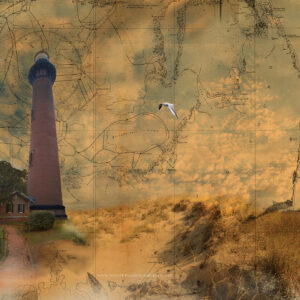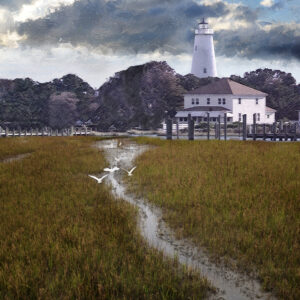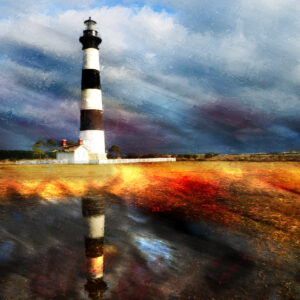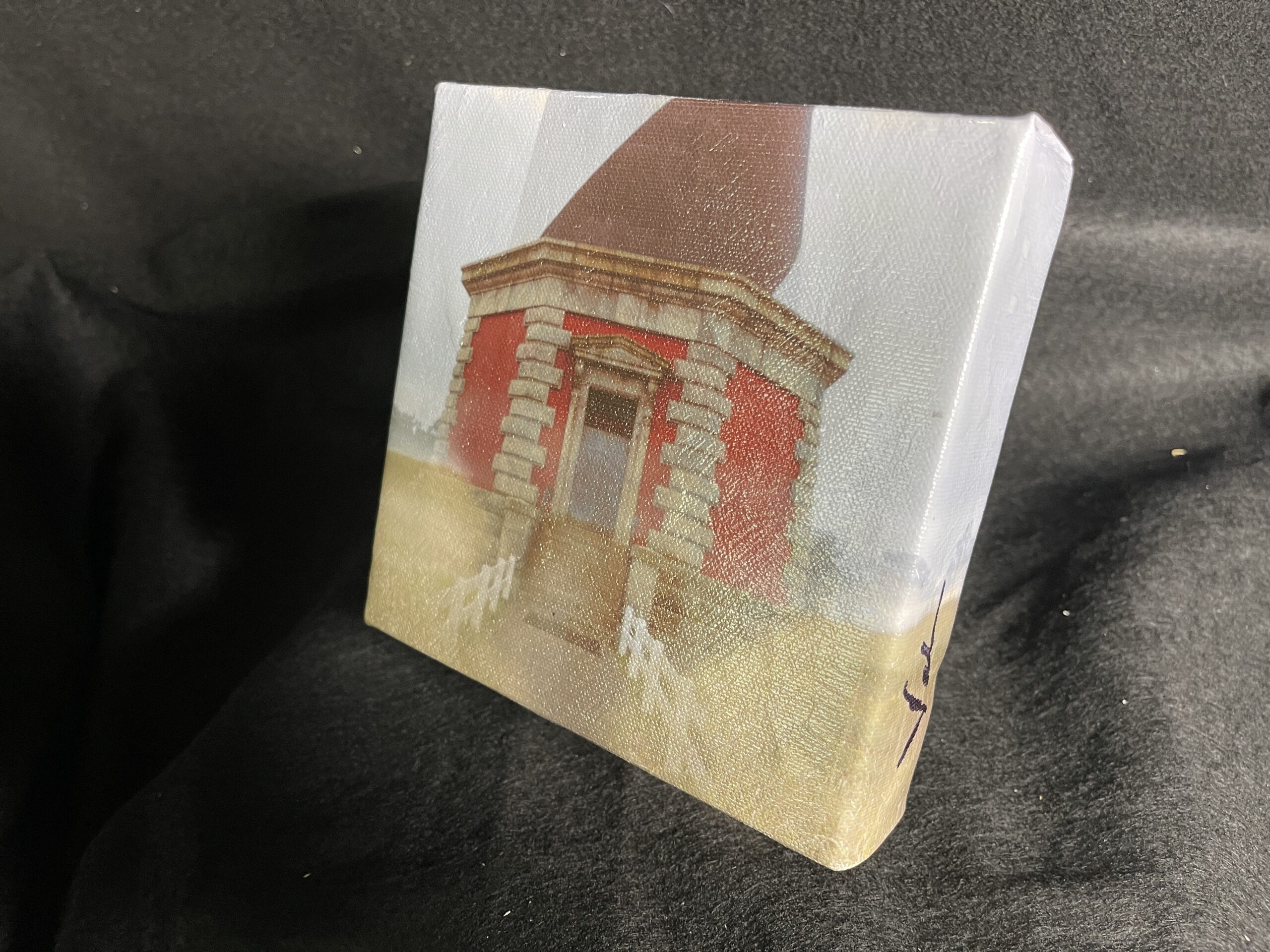

Cape Hatteras Lighthouse Outer Banks is a Gallery Wrapped 6 x 6 canvas painting with a handmade mini easel.
“Hatteras light… the worst light in the world.” — U.S. Navy Lt. David D. Porter, 1851
Cape Hatteras Lighthouse — A Monument of Storm, Survival, and Sovereign Light
There are places along the American coastline that feel less like geography and more like memory—compressed into wind, salt, and time. The Cape Hatteras Lighthouse stands as one of those rare thresholds where nature and human determination collide in a continuous act of survival. In this painting, the subject is not simply a lighthouse—it is endurance made visible, history made vertical, and light turned into legacy.
The Cape Hatteras Lighthouse rises from the Outer Banks of North Carolina like a sentinel carved out of resolve. Known as the tallest brick lighthouse in the United States, it has watched over one of the most dangerous stretches of Atlantic waters for more than a century. These waters—long referred to as the “Graveyard of the Atlantic”—are infamous for shifting shoals, violent currents, and shipwrecks that have claimed thousands of vessels. The lighthouse exists because the sea demanded a counterweight to its unpredictability.
What makes Cape Hatteras extraordinary is not only its height or design, but its relationship with impermanence. Few structures on the American coast have been asked to survive so much, for so long, against so many forces. Built between 1868 and 1870 and first lit in 1870, the lighthouse was engineered as both warning and reassurance—a human promise carved into brick that mariners would not be left alone in the dark. Its bold black-and-white spiral daymark became instantly recognizable, a visual language understood by sailors long before modern navigation.
But the story of Cape Hatteras is not static. It is movement—both literal and symbolic. By the late 20th century, the Atlantic Ocean had advanced dangerously close to its base, eroding the very land it stood upon. In 1999, in one of the most ambitious preservation efforts in American architectural history, the entire lighthouse was relocated approximately 2,900 feet inland. A structure weighing thousands of tons was lifted, carried, and set down again—without losing its identity, its function, or its dignity. It was not abandonment. It was adaptation.
This act alone transforms the lighthouse into something far greater than a navigational aid. It becomes a metaphor for resilience under pressure. For continuity in the face of change. For the idea that heritage is not preserved by freezing it in time, but by allowing it to move forward without losing its essence.
In this painting, that tension is central. The lighthouse is rendered not as a fixed monument, but as a living presence within atmosphere. The sky becomes active, layered with coastal energy—where storms feel imminent even in calm. The sea is not passive; it presses inward, reminding the viewer that beauty and danger often share the same horizon. Light is not merely emitted from the lantern room; it is negotiated between structure and storm, between clarity and obscurity.
The emotional weight of Cape Hatteras lies in this duality. It is both protector and survivor. It guides others while constantly being tested itself. That paradox is what makes it one of the most compelling architectural icons in the United States: it does not stand above nature, but within it, responding to it, enduring it.
From an artistic perspective, the lighthouse is a study in contrast. The strict geometry of its cylindrical form against the chaos of ocean and sky creates a natural composition of tension and release. The alternating bands of black and white function not just as identification, but as rhythm—like a visual heartbeat against the shifting backdrop of the Atlantic. In this work, those stripes become more than paint; they become identity markers, repeating through time like a coded language of survival.
The surrounding landscape of the Outer Banks adds another layer of meaning. These barrier islands are constantly reshaped by wind and water, never fully stable, never fully predictable. To paint Cape Hatteras is to acknowledge that nothing in its environment is permanent—not even land itself. And yet, the lighthouse persists. It adjusts. It is moved when necessary. It is restored when needed. It is respected because it refuses to disappear.
This painting captures that sense of persistence as elegance rather than struggle. There is dignity in its posture, even as the environment around it suggests volatility. The structure becomes a visual anchor—something the eye returns to again and again, much like mariners once returned to its beam in the dark.
Historically, Cape Hatteras has been described in stark terms. In the mid-19th century, naval officers criticized it as inadequate, even “the worst light in the world,” reflecting the frustration of sailors who depended on it for survival. And yet, that critique only deepens its legacy. Because what followed was not abandonment, but reinvention—height increases, technological improvements, reconstruction, and ultimately relocation. Few landmarks embody the American impulse to rebuild more completely than this lighthouse.
In the context of this artwork, that transformation becomes central to its emotional resonance. The painting is not simply documenting a structure; it is honoring a process. The process of adaptation. The process of endurance. The process of standing firm while everything around you shifts.
Light itself becomes symbolic here. It is guidance, but also presence. It is warning, but also welcome. It is what allows ships to pass safely, and what allows memory to persist visually long after the moment has passed. The lighthouse does not just shine outward—it defines space around itself. It gives meaning to darkness.
Ultimately, this work invites the viewer to consider what it means to remain standing. The Cape Hatteras Lighthouse is not perfect because it is unchanging. It is powerful because it has changed without losing its identity. It has been tested by storms, threatened by erosion, dismantled from one location and reborn in another—yet it remains unmistakably itself.
In that sense, it mirrors the most enduring works of art. Pieces that do not resist time, but move with it. Works that carry memory rather than resist it. Works that understand that survival is not the absence of change, but the mastery of it.
This painting seeks to preserve that truth in visual form: a lighthouse not frozen in history, but alive within it—still watching, still guiding, still standing at the edge of everything that refuses to stay still.