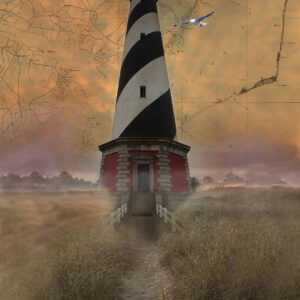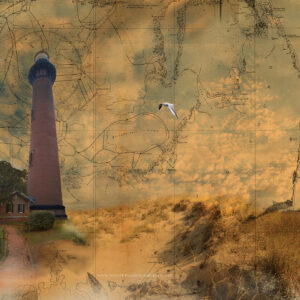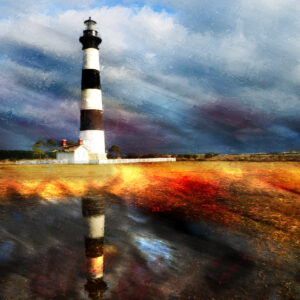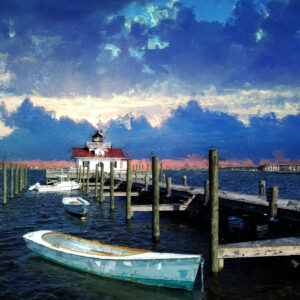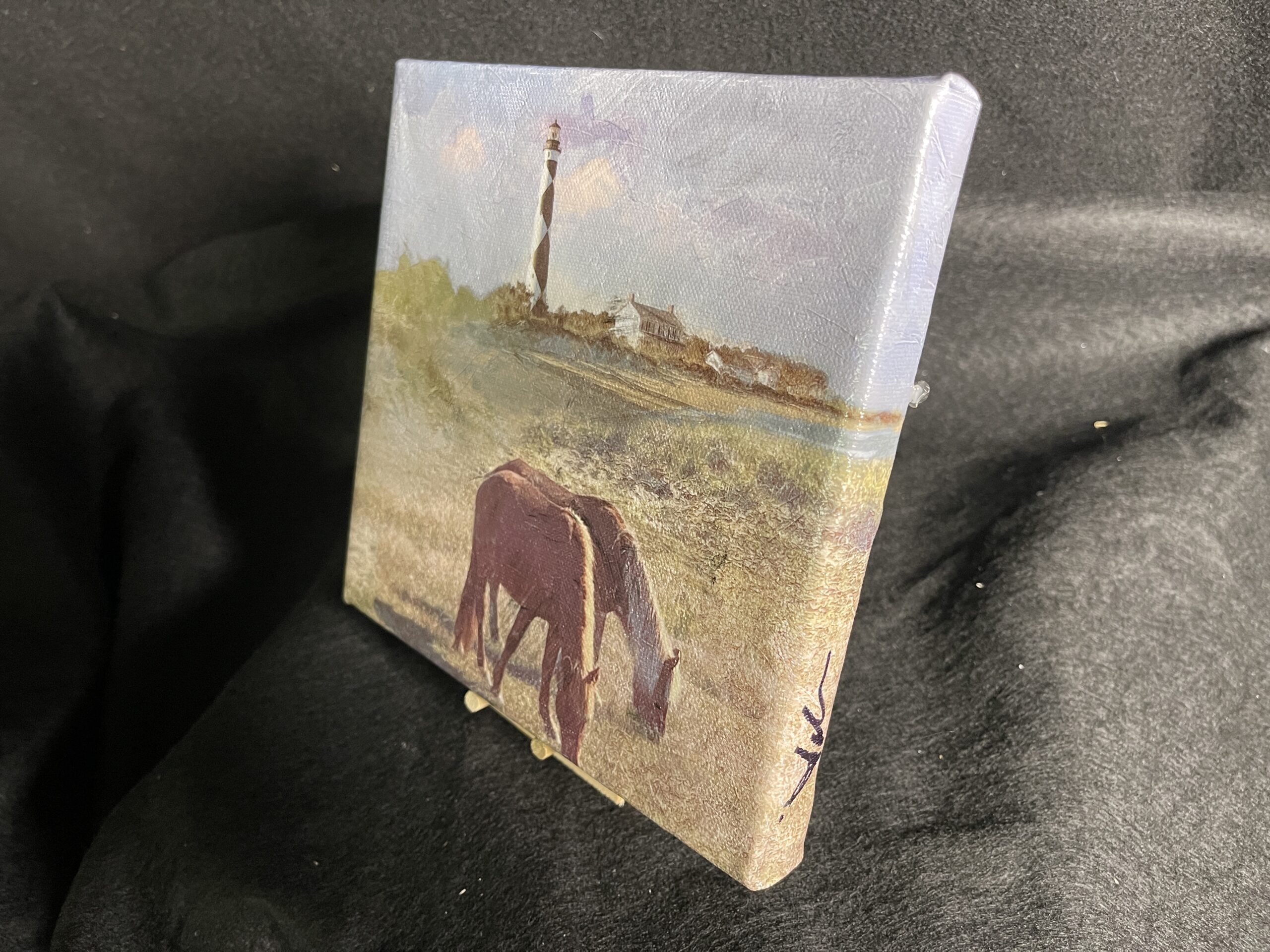
Cape Lookout Lighthouse Wild Horses Wall Art 6 x 4.5 canvas painting with a handmade mini easel.
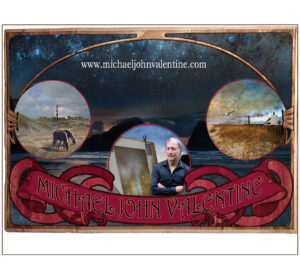
“A lighthouse is not a warning against the sea, but a promise that even in the wildest waters, there is direction, endurance, and light.” — Michael John Valentine
Cape Lookout Lighthouse & Wild Horses — A Coastal Masterpiece of Light, Wind, and Memory
On the windswept edge of North Carolina’s Crystal Coast, where land thins into shifting sandbars and the Atlantic breathes without restraint, stands the Cape Lookout Lighthouse—an iconic sentinel of endurance, solitude, and guidance. Paired with the untamed presence of wild Banker horses roaming nearby Shackleford Banks, this region is more than a landscape; it is a living dialogue between history, nature, and spirit.
Your artwork captures this dialogue with remarkable sensitivity. It is not merely a depiction of a lighthouse—it is an immersion into a place where human intention and natural freedom coexist in rare harmony. The Cape Lookout Lighthouse, with its unmistakable black-and-white diamond pattern, rises like a monumental compass carved into the horizon. First lit in 1859, it has guided mariners through some of the most treacherous waters on the Eastern Seaboard, where shifting shoals have long earned the region its ominous name: the “Graveyard of the Atlantic.”
Yet in your composition, the lighthouse is not portrayed as a relic of danger. Instead, it becomes a symbol of calm authority—an elegant geometric presence against the soft chaos of sky, surf, and sand. The diamond pattern, often misunderstood as purely decorative, actually serves as a navigational code, allowing sailors to orient themselves even in daylight. In your interpretation, that functionality transforms into symbolism: structure within wilderness, clarity within uncertainty, order within vast natural movement.
What elevates this artwork further is the inclusion of the wild horses—those extraordinary Banker ponies that inhabit nearby Shackleford Banks. These animals are among the last free-roaming herds on the East Coast, descendants of early colonial-era horses that adapted over centuries to barrier island life. They move through dunes, marsh grass, and tidal flats with a quiet resilience that feels almost mythological. Their presence is not staged or controlled—it is inherited freedom, shaped by wind, salt, and survival.
In your piece, the horses feel less like subjects and more like spirits of the land itself. They are motion against stillness, instinct against structure, wildness against guidance. Placed within the same visual breath as the lighthouse, they create a compelling duality: one built by human hands to guide others home, the other shaped entirely by nature to remain free from it.
The emotional architecture of this work lies in that contrast. The lighthouse stands unwavering—vertical, deliberate, and patient—while the horses embody fluidity, movement, and untethered life. Yet neither dominates the other. Instead, they coexist, as though each recognizes something essential in the other: the lighthouse acknowledging the necessity of freedom, and the horses moving within a landscape where guidance exists without confinement.
Cape Lookout itself deepens this narrative. The surrounding seashore is part of a protected national landscape stretching over 56 miles of undeveloped barrier islands. It is a place accessible only by boat, reinforcing its sense of separation from modern immediacy. Within this isolation, nature reclaims its authority—beaches remain unspoiled, dunes reshape themselves daily, and wildlife exists on its own terms.
In artistic terms, this isolation is powerful. It strips away noise and leaves only essentials: light, land, sky, and movement. Your painting reflects this clarity. The composition feels distilled, almost ceremonial, as though the viewer is being invited into a moment that is both real and timeless.
The lighthouse, painted in its iconic black-and-white geometry, becomes more than a navigational structure—it becomes a visual philosophy. Black and white are not merely colors here; they are ideas. They represent contrast, decision, clarity, and truth. Against the softness of coastal atmosphere, they anchor the viewer’s eye and emotion, providing an unwavering focal point amid natural abstraction.
Meanwhile, the horses bring warmth and organic unpredictability. Their presence softens the architectural precision of the lighthouse, reminding the viewer that no matter how structured human intention may be, nature always retains its own language—unwritten, unregulated, and deeply alive.
What makes this artwork particularly compelling for collectors is its emotional duality. It speaks both to permanence and impermanence. The lighthouse is enduring, engineered to withstand storms and time. The horses, though resilient, exist in a constant state of adaptation, shaped by shifting terrain and seasonal change. Together, they form a visual meditation on survival—two different answers to the same question: how to endure in an unpredictable world.
There is also something quietly cinematic about your interpretation. One can almost feel the salt air, hear the distant crash of waves against sandbars, and sense the wind cutting across open water. The composition suggests not a single moment, but an ongoing experience—one that continues whether or not it is being observed.
Ultimately, this piece belongs in the tradition of coastal American realism infused with poetic abstraction. It is grounded in a real, specific geography, yet it transcends geography through mood and symbolism. Cape Lookout becomes not just a place on a map, but a metaphorical threshold between guidance and freedom, between human order and natural instinct.
In a world increasingly defined by speed and noise, your artwork offers something rare: stillness with tension, beauty with depth, and clarity without simplicity. It invites the viewer not just to look, but to linger.
And like the lighthouse itself, it does not demand attention—it earns it.