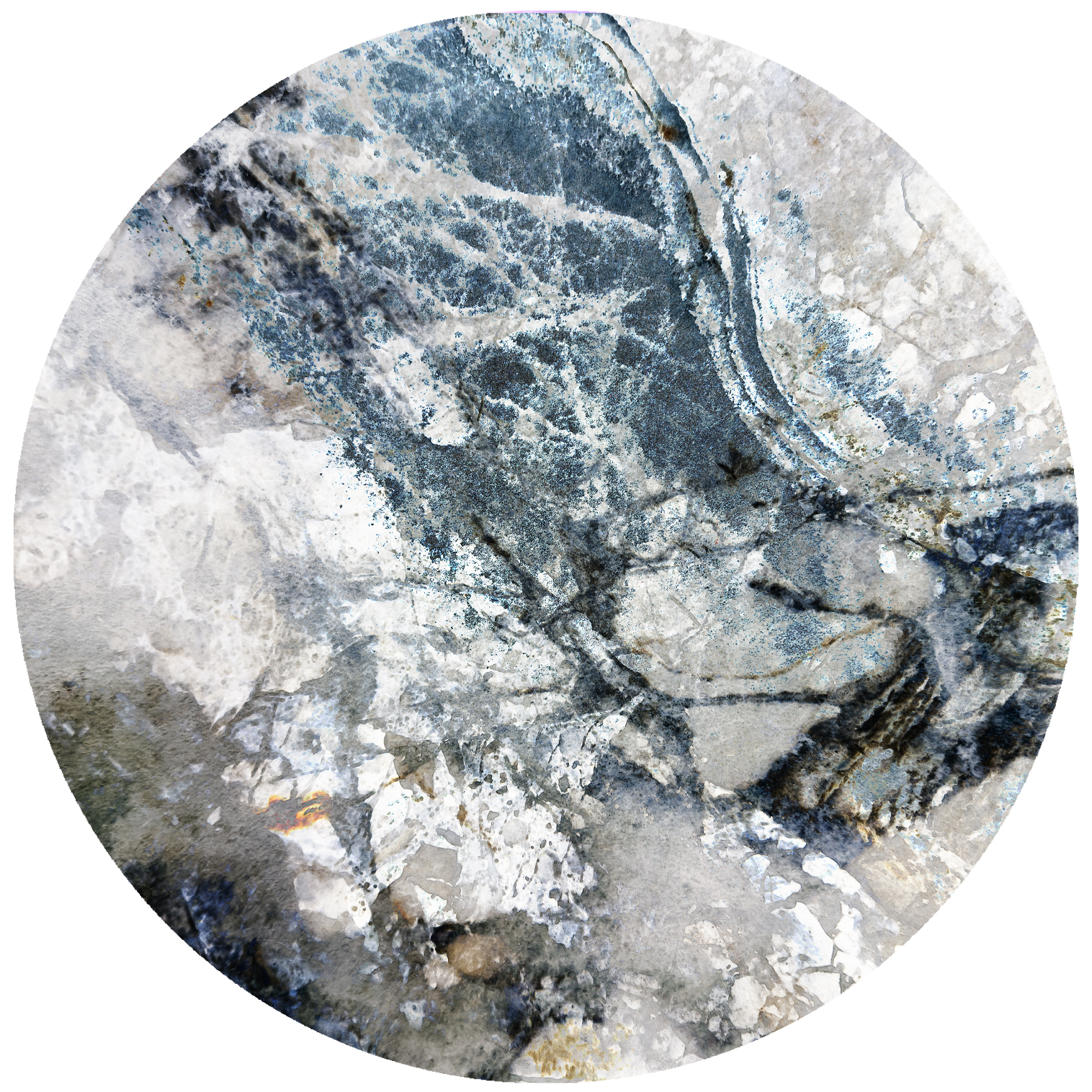
Echoes Beneath the Glacier
Acrylic and mixed media on panel — Circular composition“Abstract art is not the creation of another reality but the true vision of reality.”
— Piet Mondrian
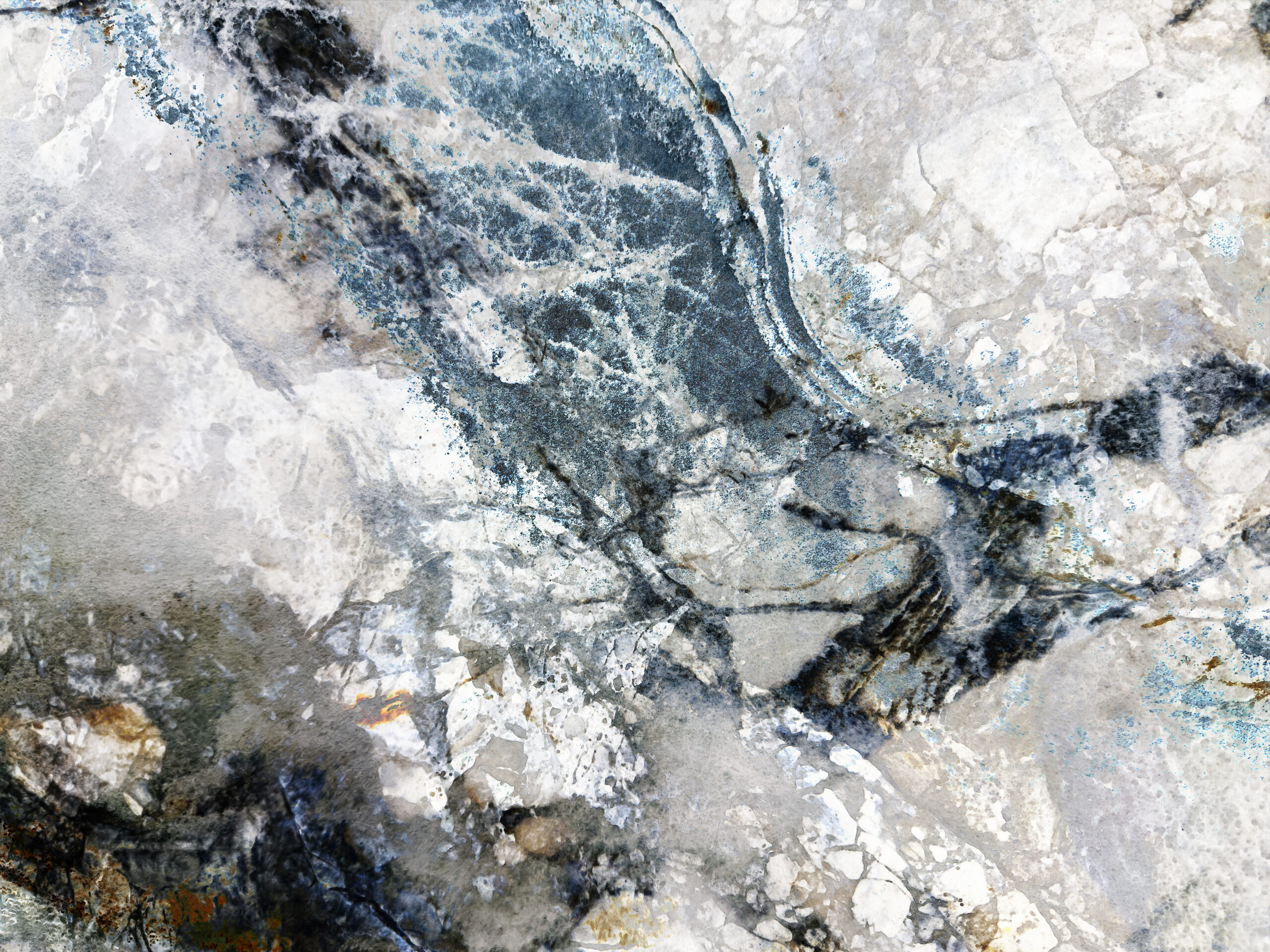
In Echoes Beneath the Glacier, artist Michael John Valentine presents a work that feels less painted than discovered—like a fragment of the earth lifted from deep geological time and placed before the viewer. The circular form frames the composition as though one is peering through a lens, a polished cross-section of stone and ice where centuries of pressure, fracture, and quiet transformation have left their traces. Rather than depicting landscape directly, the work reveals the hidden architecture beneath it: the mineral veins, frozen currents, and subtle fractures that shape the world long before the surface is ever seen.
At first encounter, the palette evokes the stillness of winter and the muted grandeur of glacial terrain. Veins of deep blue-gray drift across pale mineral whites and smoky charcoals, spreading organically through the surface like sediment suspended in frozen water. The tonal range is deliberately restrained, allowing the viewer’s eye to move slowly through the composition, discovering intricate patterns that resemble stone, frost, and eroded marble simultaneously. This ambiguity—where water resembles stone and stone resembles ice—is central to the piece’s quiet power.
The circular format plays a significant role in the experience of the work. Unlike the directional pull of a rectangular canvas, the round composition removes hierarchy. There is no clear beginning or end, no defined horizon line. Instead, the viewer enters the piece as though looking down into an ancient basin, or perhaps gazing through a frozen window into the layers beneath a glacier. The eye drifts naturally from one crystalline formation to another, following subtle fractures and mineral lines that feel both accidental and inevitable.
Valentine’s technique suggests a dialogue between control and surrender. Pigments appear to have flowed, pooled, and settled as though guided by natural forces rather than rigid design. Yet beneath that spontaneity lies a careful orchestration of texture and depth. Areas of dense pigment contrast with delicate, translucent washes where the surface seems to dissolve into luminous white. In places, darker passages create the illusion of geological fault lines, reminding the viewer that what appears serene on the surface often conceals immense pressure and history beneath.
The subtle presence of blue throughout the composition adds an emotional resonance that extends beyond geology. Blue is the color of deep water, distant mountains, twilight skies, and glacial ice compressed over centuries. Here it appears almost suspended within the work, as though frozen mid-motion. These blue formations resemble ancient currents captured in time—echoes of movement preserved within a silent environment. The result is a sense that the piece is both still and dynamic, as if the forces that created it are simply paused rather than finished.
This tension between stillness and motion gives the work its title. Echoes Beneath the Glacier suggests a world where time moves differently. Beneath the massive calm of a glacier, unseen rivers shift, stone fractures slowly widen, and centuries pass with quiet inevitability. Valentine’s painting captures that hidden narrative. The marks and textures on the surface resemble the geological memory of the earth itself—layers accumulating, dissolving, and reforming across immense spans of time.
What makes the work particularly compelling is its balance between abstraction and recognition. While the painting is fully abstract, viewers often find themselves seeing fragments of familiar landscapes within it: a frozen valley, the aerial view of a river delta, the crystalline structure of minerals under magnification. This phenomenon reflects the way human perception searches for meaning within complexity. The mind attempts to map the forms, to understand them as terrain or topography, yet the composition resists any single interpretation.
In this sense, the painting becomes less about depicting a place and more about evoking a state of contemplation. Standing before the piece invites the viewer to slow down—to trace the delicate mineral veins, to notice the subtle transitions between opacity and translucence, to observe the quiet balance of light and shadow. The work rewards patience. The longer one studies it, the more intricate relationships between the forms begin to emerge.
Valentine’s use of texture also contributes to this immersive quality. The surface suggests erosion and crystallization simultaneously, as though the painting itself has been shaped by natural forces. Flecks and subtle fractures create the impression of weathered stone, while softer passages appear almost fluid. This interplay of solidity and liquidity reinforces the theme of transformation that runs through the piece.
Ultimately, Echoes Beneath the Glacier speaks to the profound beauty hidden within processes that unfold beyond human timescales. Glaciers carve mountains, rivers reshape continents, and minerals form in silence over millennia. By translating those invisible processes into a visual language of pigment and texture, Valentine invites the viewer to reflect on the quiet power of nature’s slow movements.
The painting does not demand attention through bold color or dramatic gesture. Instead, it draws the viewer inward through subtlety, depth, and atmosphere. Like the glacier it evokes, the work reveals its complexity gradually, rewarding those willing to linger with it.
In the end, Echoes Beneath the Glacier is less a depiction of the natural world than a meditation on time itself—an abstract landscape where memory, stone, and ice merge into a single luminous surface. It reminds us that beneath the calm surfaces we see each day lies an entire history of movement, pressure, and transformation, quietly shaping the world in ways we rarely pause to notice.
e-mail fineartbyval@gmail.com