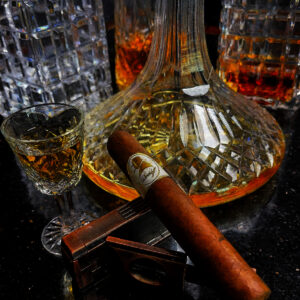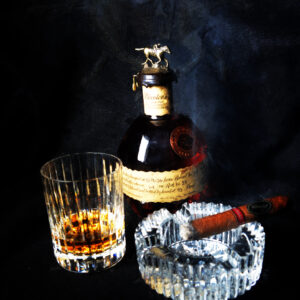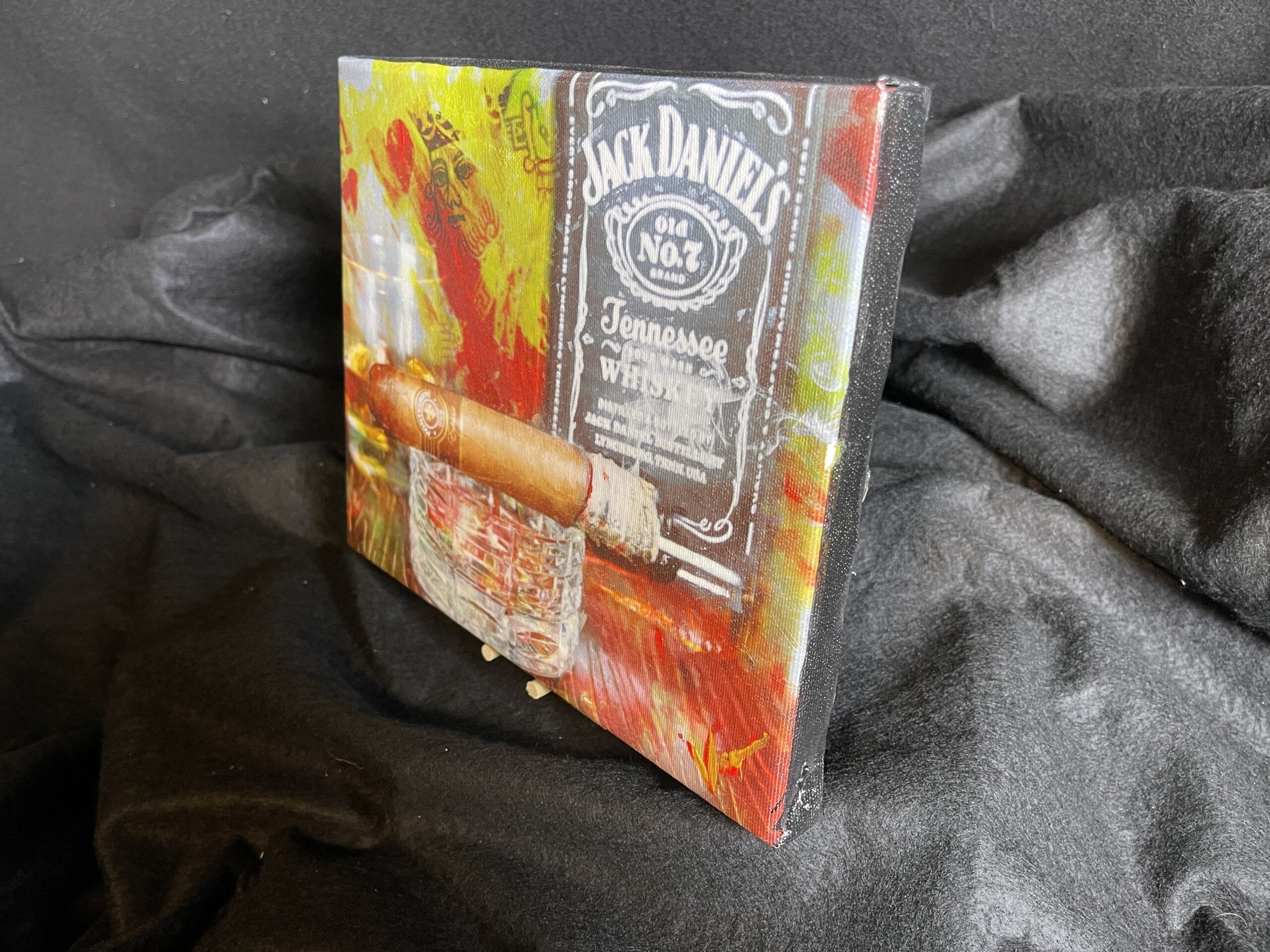
Jack Daniel’s Bourbon and Montecristo Cigar Painting 8 x 10 Gallery Wrapped Canvas with Mini Easel
“Every day we make it, we’ll make it the best we can.” — Jack Daniel’s Distillery motto
A simple line, but it captures the philosophy behind one of the most iconic names in American whiskey: consistency, craftsmanship, and pride in every barrel.
Jack Daniel’s Bourbon & Montecristo Cigars — 8×10 Gallery Wrapped Canvas
A Collector’s Study in Smoke, Spirit, and Southern Elegance
There are pairings that feel accidental, and then there are pairings that feel inevitable. Jack Daniel’s and a Montecristo cigar belong firmly in the latter category—two icons born from different traditions, yet bound by the same devotion to ritual, patience, and uncompromising character. This 8×10 gallery wrapped canvas captures that union not as a simple still life, but as a curated moment of atmosphere, memory, and masculine elegance distilled into visual form.
At first glance, the composition draws you into a familiar world: the unmistakable silhouette of a Jack Daniel’s bottle resting with quiet authority beside the refined presence of a Montecristo cigar. But this is not advertising imagery—it is interpretation. It is the translation of sensory experience into visual poetry. The glow, the texture, the subtle interplay of shadow and warmth all work together to evoke something deeper than consumption: it evokes ritual.
Jack Daniel’s itself is more than a whiskey—it is a cultural artifact. Born in Lynchburg, Tennessee, the brand carries with it a legacy rooted in American craftsmanship and independence. Its identity is inseparable from the slow, deliberate process of charcoal mellowing, a method that gives it its distinct smoothness and signature character. In this painting, that legacy is not simply referenced; it is felt. The bottle becomes a symbol of time—of oak barrels aging in silence, of patience rewarded, of tradition preserved in amber liquid.
The Montecristo cigar, by contrast, introduces an entirely different kind of heritage. Originating in the storied cigar houses of Cuba and later becoming a global benchmark for premium cigars, Montecristo represents refinement, discipline, and the art of slowing down. In the context of this artwork, the cigar is not merely an object—it is an invitation. An invitation to pause, to reflect, and to engage in the kind of deliberate experience that modern life rarely allows.
Together, these two elements form a dialogue. Whiskey and tobacco. Fire and oak. Boldness and nuance. The painting does not force their relationship—it allows it to exist naturally, as it does in real life, in lounges, studies, and private moments where time seems to stretch just a little longer than usual.
What elevates this piece beyond thematic novelty is its atmosphere. The lighting is not harsh or artificial; it is intimate. It behaves like memory—soft around the edges, warm at the center, slightly nostalgic in tone. There is a cinematic quality to it, as though the viewer has walked into a scene already in progress, interrupted only briefly by their own presence.
The gallery-wrapped format enhances that immersion. With the image extending seamlessly around the edges, there is no visual “exit.” The artwork refuses to confine itself to a flat plane. Instead, it becomes an object in space, something that holds presence even when viewed from the side. It is designed not just to be seen, but to be encountered.
In a contemporary setting, this piece works as both statement and anchor. Whether placed in a private bar, a study lined with books, a tasting room, or a modern living space seeking character, it immediately defines its environment. It suggests taste without pretense, luxury without excess, and tradition without rigidity.
Collectors are often drawn to works that carry narrative weight, and this painting delivers that in layers. On one level, it is about brand mythology—two of the most recognizable names in their respective worlds. On another, it is about sensory memory—the taste of aged whiskey, the aroma of a freshly cut cigar, the quiet satisfaction of an unhurried moment. And on its deepest level, it is about identity: the curated rituals that people build around objects that matter to them.
The brushwork and composition reinforce this idea of controlled indulgence. Nothing feels chaotic or accidental. Every highlight appears intentional, every shadow placed to guide the eye rather than overwhelm it. There is discipline in the execution, mirroring the discipline behind both whiskey-making and cigar craftsmanship.
What makes this artwork particularly compelling is its refusal to rush the viewer. Much like the subjects it portrays, it asks for time. It rewards lingering observation. The longer you look, the more subtle details emerge—the tonal shifts in the glass, the texture implied in the cigar wrap, the quiet depth in the surrounding space that holds everything together.
Ultimately, this 8×10 gallery wrapped canvas is not just a depiction of objects—it is a distilled experience. It captures a mood that exists somewhere between nostalgia and indulgence, between craftsmanship and culture. It is a tribute to the rituals that define quiet luxury and the objects that become part of those rituals over time.
It does not shout. It does not compete. It simply exists—confident, composed, and timeless.