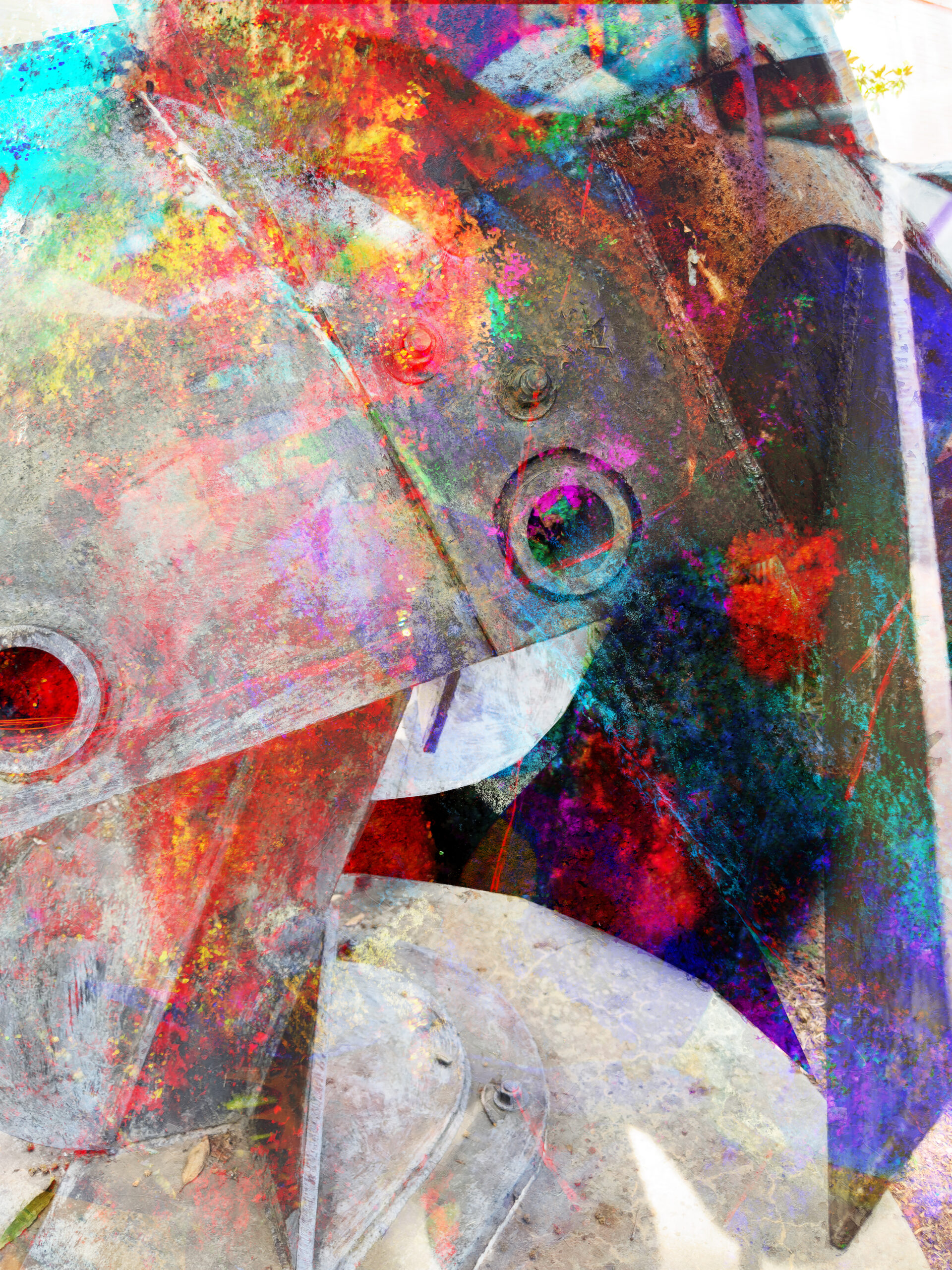
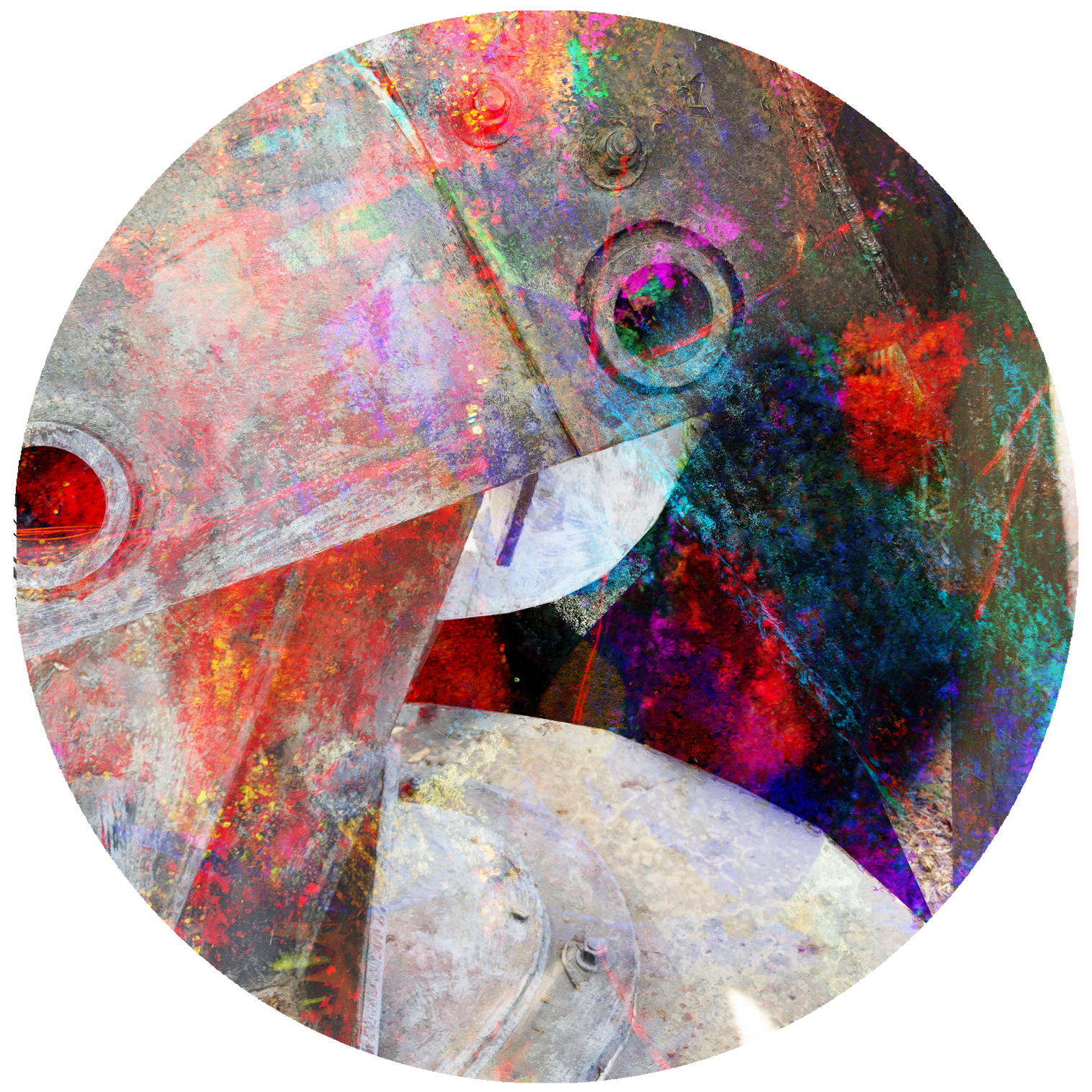
A single robotic eye swivels, catching reflections of a chaotic, neon-lit world. Its gaze is unwavering, almost human. Silence dominates. A whisper of metal and thought:
ROBOT
(soft, mechanical)
“I see beyond the frame… into what you fear to feel.”
From the moment one encounters Eye Robot Abstract Photography, there is a sense of both awe and unease, a tension hovering between human familiarity and technological abstraction. Michael John Valentine’s mastery over overpainting and selective enhancement elevates this work from mere digital reproduction into a tactile, almost sentient presence. The painting’s layers are deliberate; the brush strokes, sealed under glossy protectant, command a presence that oscillates between the organic and the mechanized.
Valentine’s approach here embodies the philosophy that art is not simply to be observed but to be experienced. The robot’s eye—a central motif—does more than anchor the composition; it interrogates the viewer, reflecting not the external world, but internal landscapes of thought and emotion. The eye, often a symbol of consciousness, surveillance, and perception, becomes a nexus where humanity and machine converge, suggesting both harmony and tension.
The use of selective overpainting adds an almost cinematic dimension to the piece. Just as in film, where lighting and focus guide the audience’s emotional journey, Valentine manipulates texture, shadow, and color to draw the gaze into an imagined narrative. One cannot help but imagine this robotic sentinel moving silently through hallways of light, scanning environments not just for data, but for meaning. Every stroke, every contour, has been considered with a craftsman’s precision, ensuring that the final product is more than visual—it is an immersive dialogue between artist, medium, and observer.
In terms of color, Eye Robot is both restrained and daring. Metallic greys and muted blues anchor the piece, evoking a cold, technological undercurrent. Yet, within this digital palette, Valentine allows vibrant bursts—flares of neon, hints of electric magentas—that pierce the calculated surfaces, reminding us that even within artificial intelligence, unpredictability, and artistry emerge. These colors are not merely decorative; they function narratively, punctuating moments where the mechanical and organic intersect.
Texture plays an equally vital role. The brush strokes, though subtle, create a dimensionality that draws viewers in, encouraging them to move closer, to examine the interplay between painted surface and the suggestion of polished metal or digital reflection. There is a tension here between flatness and depth, stillness and motion, evoking the duality of human perception versus mechanized observation. It is a meditation on the act of seeing itself, where each observer’s interpretation transforms the robotic gaze into a mirror of their consciousness.
Valentine’s composition demonstrates his uncanny ability to manipulate negative space. The areas surrounding the eye are as telling as the focal point itself. Shadows and light coalesce to suggest movement beyond the frame, implying an unseen environment where this mechanical observer exists. The voids, dark and unpopulated, act as narrative pause points—spaces for viewers to project their imagination. This is a hallmark of Valentine’s work: intentional ambiguity that invites personal interpretation while maintaining the integrity of a cohesive visual story.
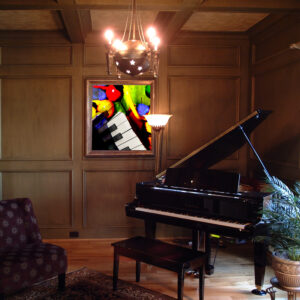
Furthermore, the physical presentation of Eye Robot Abstract Photography underscores its premium, collector-focused intent. The work arrives rolled and sealed in a heavy-duty tube, ensuring preservation of the delicate textures and brushwork. Whether presented as a matte matted print, a glossy canvas, or a peel-and-stick decal, each format honors the tactile quality of the overpainting, allowing collectors to choose a display method that resonates with their space and vision. This attention to presentation transforms viewing into ritual—unboxing becomes a prelude to contemplation, a moment of anticipation before the gaze meets the robotic eye.
Conceptually, the piece situates itself at the intersection of existential inquiry and aesthetic exploration. The robotic eye challenges the anthropocentric perspective, asking viewers to reconsider what it means to perceive, to know, to exist. It draws on a lineage of science fiction and speculative visual culture while remaining firmly rooted in the physicality of brushwork, acrylic, and canvas. There is a tension that is at once thrilling and reflective: technology rendered with human emotion, precision paired with chaos.
Eye Robot also reflects broader contemporary concerns about surveillance, artificial intelligence, and the shifting boundaries between human and machine. Yet, rather than presenting these themes as dystopian warnings, Valentine transforms them into visual poetry. The piece does not dictate fear; it invites introspection. Observers are drawn into the philosophical question of agency: who watches whom, and how does observation shape reality? The eye, mechanical yet almost soulful, functions as both subject and mirror, offering an experience that is intellectually rigorous and emotionally resonant.
Collectors will find in Eye Robot a work that balances immediate visual impact with lasting interpretive depth. Each viewing uncovers new subtleties: a nuanced color shift, a faint overpainted line, a reflection that transforms depending on ambient lighting. It is this enduring capacity for discovery that defines luxury art—where the object is not static but dynamic, offering a lifetime of engagement.
Finally, this work exemplifies Valentine’s unique signature: the convergence of meticulous craftsmanship, conceptual sophistication, and emotional accessibility. Eye Robot Abstract Photography is not merely decoration; it is an artifact of contemplation, a meditation on perception in the digital age. It embodies the tension between observation and awareness, inviting collectors to reconsider the act of seeing itself. In the presence of this piece, the viewer is both participant and witness, challenged to engage, interpret, and reflect.