“I wanted to capture Istanbul not as a postcard, but as a feeling—the mystery of the city after dark, when the lights, shadows, and timeless presence of Süleymaniye seem to bring centuries of history into a single moment.”
— Michael John Valentine
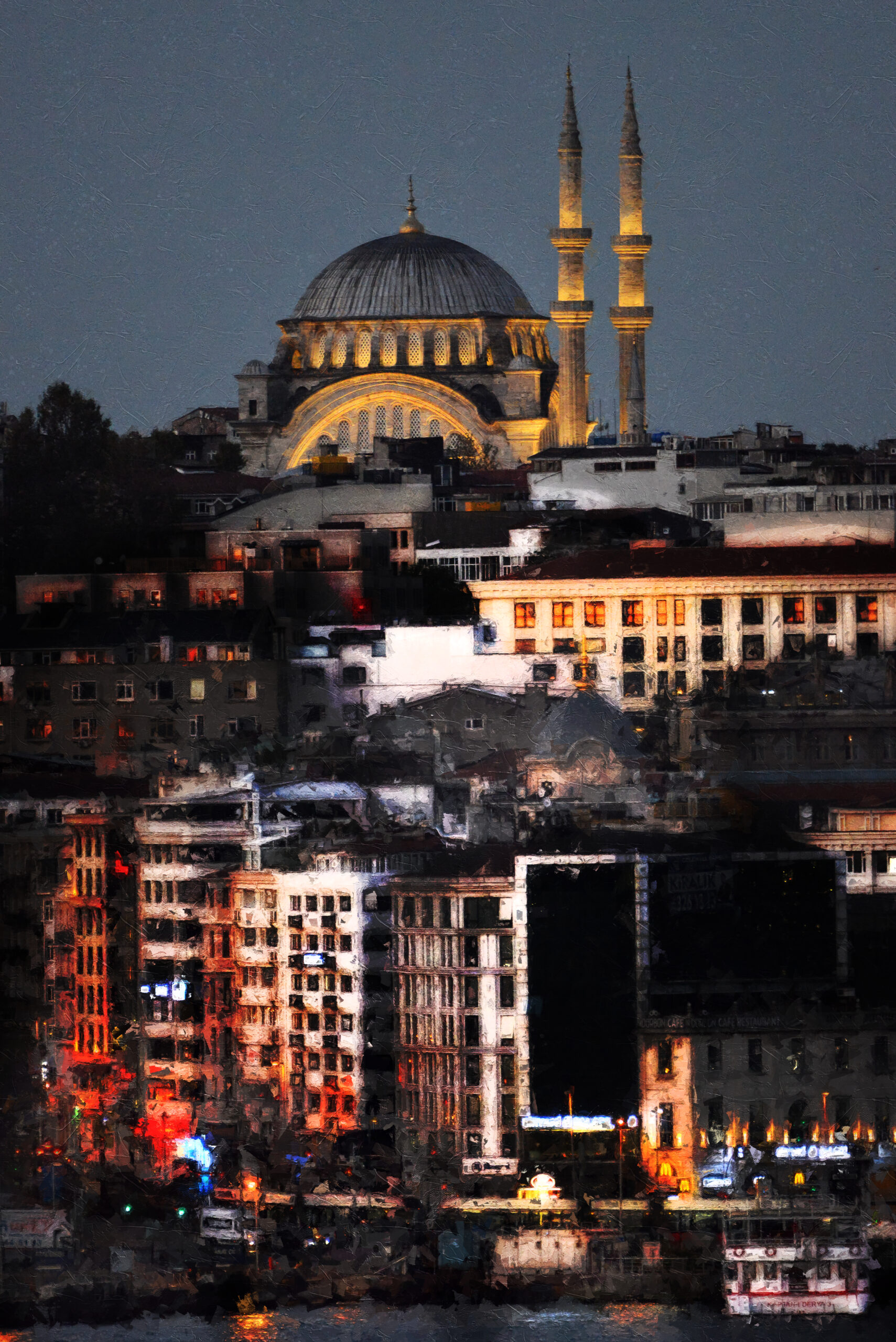
Süleymaniye: A Night in Istanbul
There are certain places in the world that seem to reveal themselves only after the sun goes down. Istanbul is one of them. During the day, the city is alive with movement—the ferries crossing the Bosphorus, the calls of vendors, the endless stream of people moving through its streets and historic neighborhoods. But at night, Istanbul becomes something different. The pace slows, the shadows deepen, and centuries of history seem to emerge from the darkness.
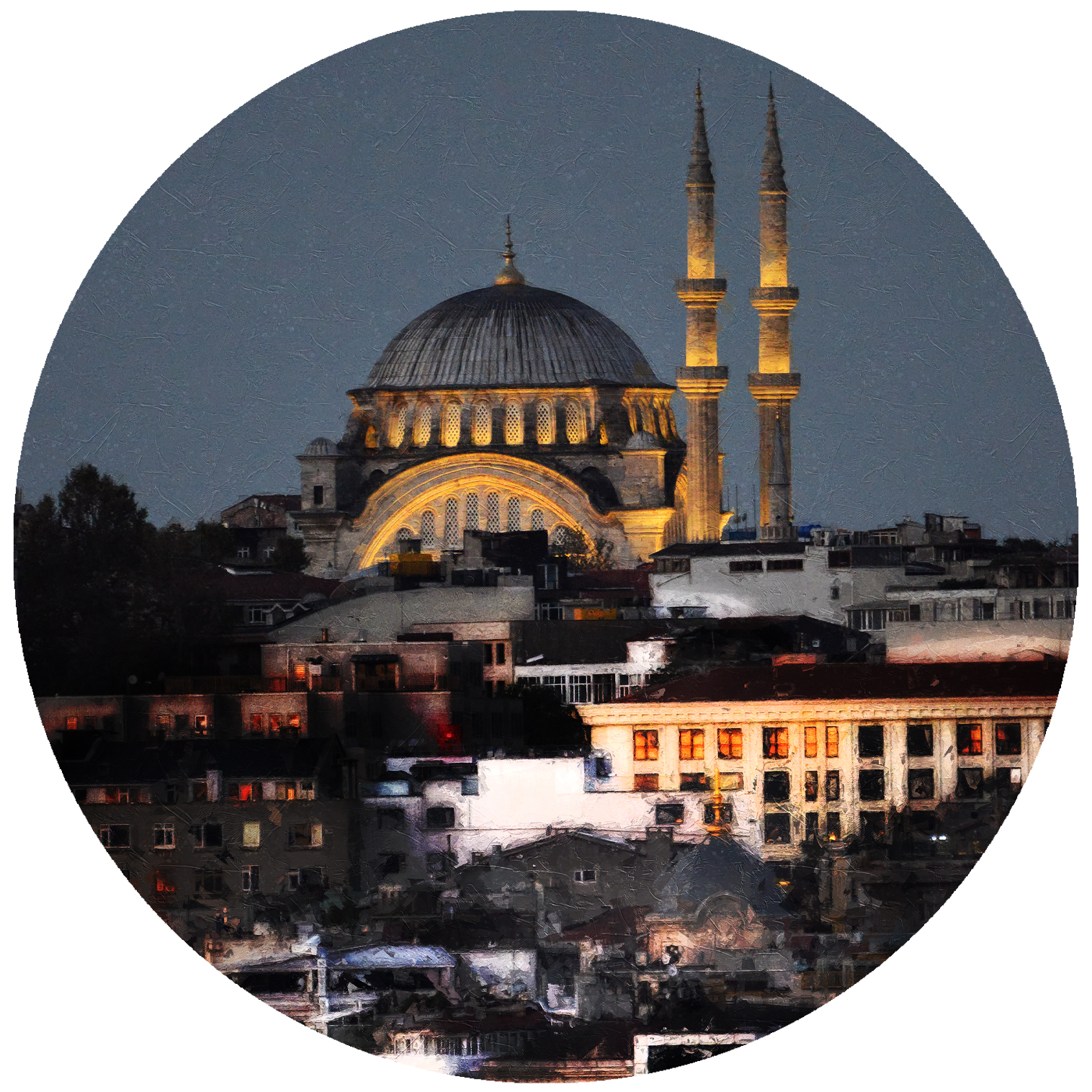
“Süleymaniye: A Night in Istanbul” was created from that feeling—the atmosphere of Istanbul after sunset, when the city becomes less about what is immediately visible and more about what is suggested.
At the heart of the work is the magnificent Süleymaniye Mosque, one of Istanbul’s most recognizable landmarks. Rising above the historic skyline, the mosque was commissioned by Sultan Süleyman the Magnificent and designed by the great Ottoman architect Mimar Sinan. Completed in the 16th century, it has stood above Istanbul for centuries, witnessing the changing city below it. Yet this artwork is not intended to be a literal architectural portrait. Instead, Süleymaniye becomes a presence within the composition—a symbol of Istanbul’s history, spirituality, architecture, and enduring character.
Night changes everything.
The familiar forms of the city become softened by darkness, while lights begin to punctuate the landscape. Windows glow. Streets take on a different character. The silhouettes of buildings and domes appear to merge with the evening sky. The result is an Istanbul that feels both contemporary and timeless.
That contrast is central to the work.
Istanbul has always been a city suspended between worlds. It occupies two continents, Europe and Asia, divided and connected by the Bosphorus. Its history carries the influences of Byzantium, Constantinople, and the Ottoman Empire, while the modern city continues to evolve around those layers of the past. Walking through Istanbul, it is possible to encounter a centuries-old mosque, a modern café, a crowded street, and a quiet courtyard within the same journey.
“Süleymaniye: A Night in Istanbul” attempts to capture that same sense of discovery.
Rather than presenting every architectural detail with photographic precision, I wanted the painting to communicate the emotional experience of being there. The architecture becomes part of the mood. The darkness creates mystery. The illuminated areas draw the eye through the composition, encouraging the viewer to look deeper and imagine what exists beyond the immediate scene.
There is also something inherently cinematic about Istanbul at night. The city seems to possess its own stage lighting. The minarets rise dramatically against the sky. The domes catch whatever available light remains. The streets below become ribbons of movement and reflection. Somewhere in the distance, the Bosphorus continues its ancient passage between two continents.
For me, this is where the painting moves beyond travel imagery.
It becomes a memory.
Many people visit Istanbul and remember individual places—the Blue Mosque, Hagia Sophia, the Grand Bazaar, the Galata Tower, the Bosphorus. But what often remains longest is the feeling of the city itself. It is the sound of footsteps on stone streets. The evening air. The glow of the buildings after dark. The unexpected view that appears around a corner. The sensation that you are standing in a place where history is not confined to museums but is still part of everyday life.
Süleymaniye represents that continuity.
The mosque has survived empires, political change, wars, modernization, and generations of Istanbul residents. Yet it remains an active part of the city rather than simply a monument to its past. Its presence in the painting therefore becomes a reminder that some things endure even as everything around them changes.
I also wanted the darkness to play an important role in the composition. Darkness is often misunderstood as an absence of information, but in art it can actually create possibility. It allows the imagination to participate. Not every street needs to be visible. Not every building needs to be identified. Not every detail needs to be explained.
Sometimes the suggestion of a place is more powerful than the complete picture.
That is particularly true of Istanbul.
The city has always inspired artists, photographers, writers, travelers, and dreamers because it offers an almost endless supply of visual and historical contrasts. Its skyline alone can tell stories that span centuries. Süleymaniye: A Night in Istanbul is my interpretation of one small moment within that much larger story.
The work is meant to evoke the experience of looking across Istanbul as evening settles over the city and realizing that you are witnessing something far older than the moment itself.
The lights may belong to the present.
The architecture belongs to the past.
But the feeling belongs to both.
“Süleymaniye: A Night in Istanbul” is ultimately an invitation to slow down and look. To imagine the sounds and movement beyond the frame. To consider the generations that have walked these same streets and looked toward the same skyline. And to experience Istanbul not simply as a destination, but as a city of atmosphere, mystery, memory, and extraordinary endurance.
This is Istanbul after dark—a city where history does not disappear when night arrives.
It simply becomes more mysterious.