“Every good painter paints what he is.” — Jackson Pollock
Collector’s Narrative — Raining in Charlotte
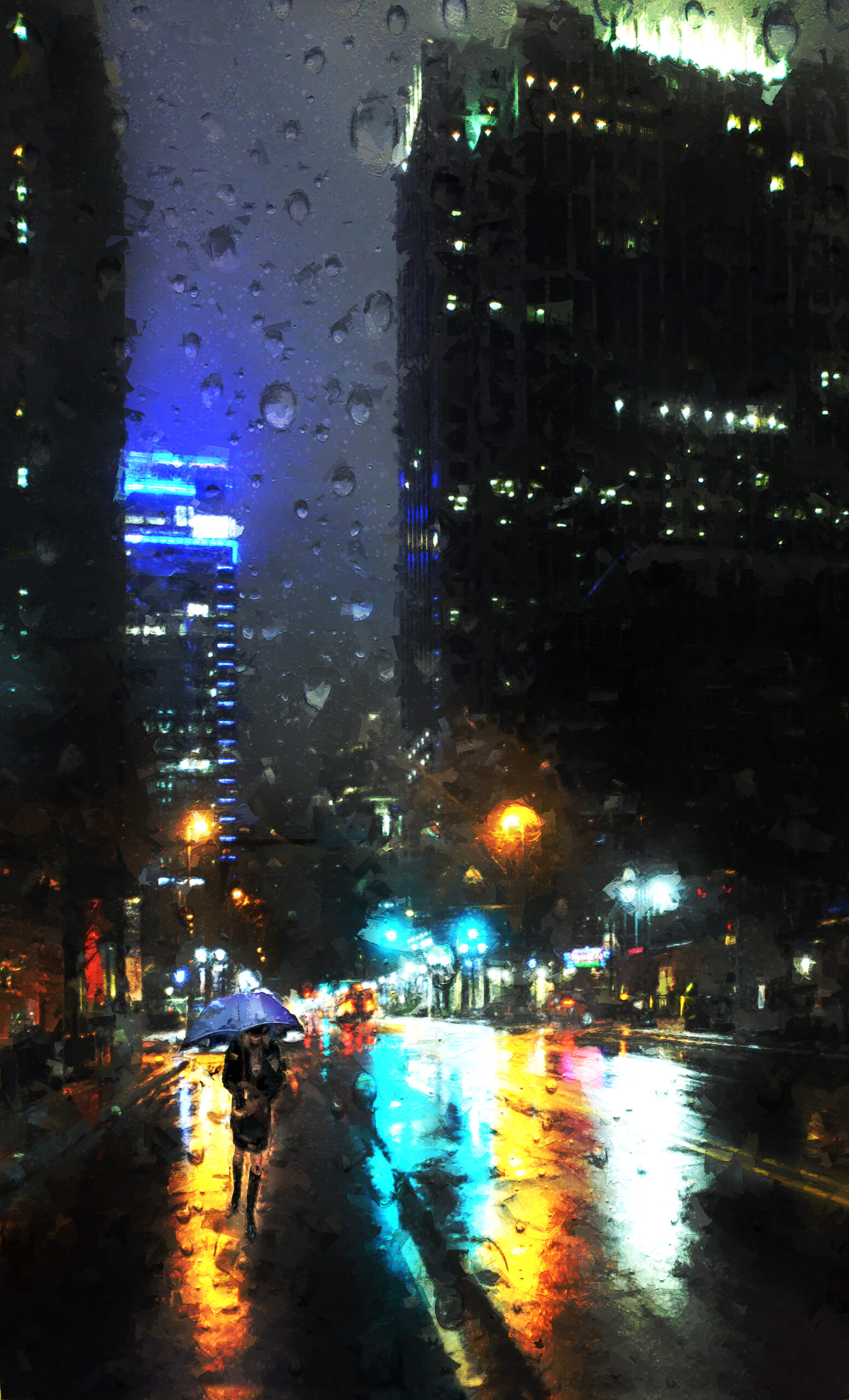
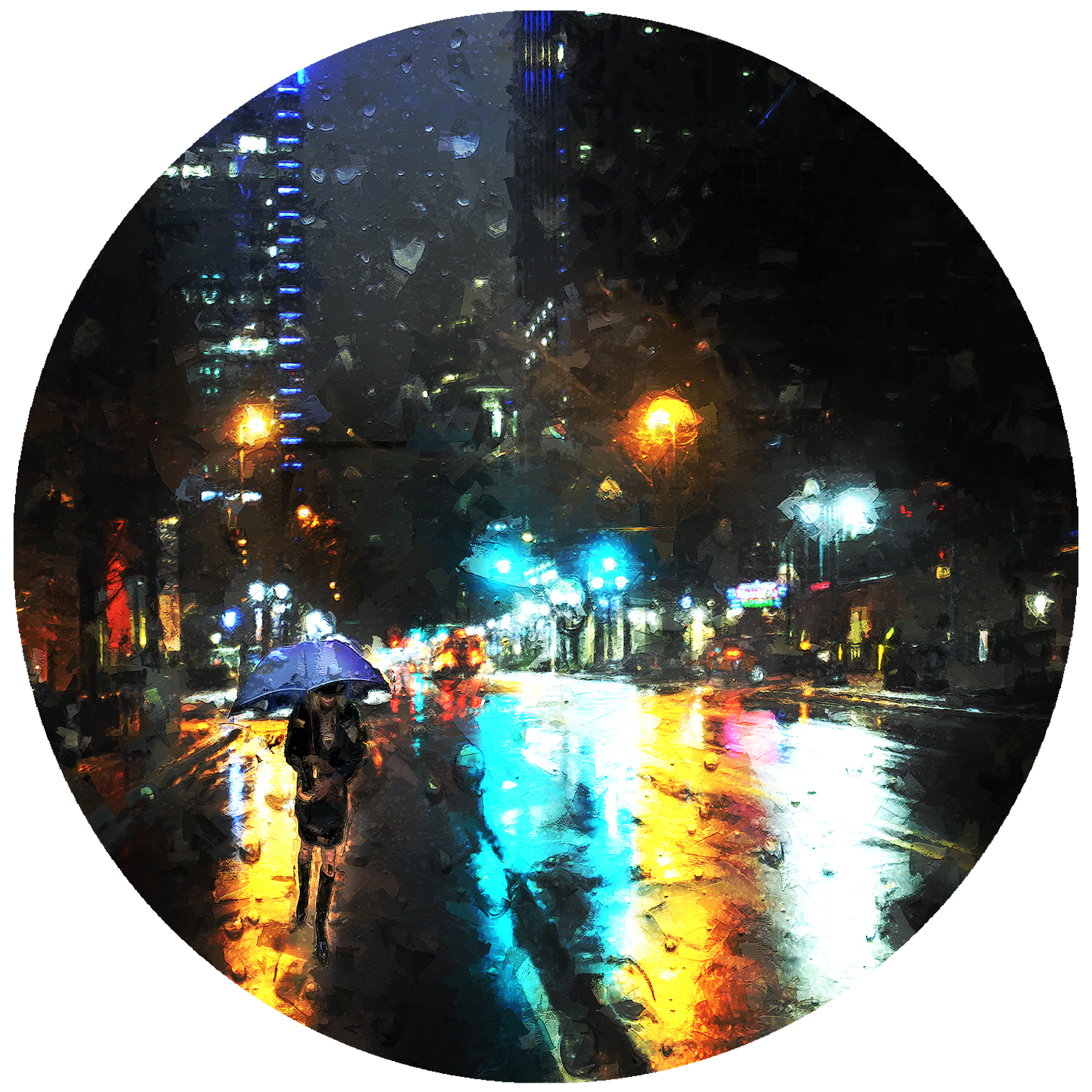
Abstract Modern Wall Art Titled Raining in Charlotte is more than a visual object — it stands as a testament to the evocative synergy between city ethos and the artist’s refined mixed‑media technique. Crafted by Michael John Valentine, a seasoned creator with over five decades of artistic evolution, this work occupies a rare space in contemporary abstraction where photography and painterly intervention converge to form a singular aesthetic experience.
I. Genesis: The Confluence of Vision and Place
At its core, Raining in Charlotte is a translation — an interpretation of Charlotte’s atmospheric character through a medium that straddles representation and pure abstraction. Beginning with the artist’s photographic eye, the city is not merely documented; it is distilled. Valentine’s process initiates with layered photographic imagery — moments captured through his lens in real weather, real light, and real urban rhythm — and progresses into a reimagined impression infused with contemporary painterly interventions.
Where many urban landscapes lean toward static vistas or literal depictions of landmarks, Valentine’s composition channels the sensational essence of a city in rain: the reflective glow of streetlights, the dynamic motion of falling droplets, and the visceral memory of humidity and pace. The final canvas operates less as a literal map and more as an atmospheric imprint — a sensorial snapshot that resonates with emotional and visual depth.
II. Technique: Photography Meets the Gesture of Paint
Valentine’s signature approach — blending analog photographic foundations with deliberate acrylic overpainting — reveals a dialogue between control and spontaneity. Beginning from photographic layers, the piece anchors itself in recognizable form and place. However, as paint meets surface, those forms begin to disassemble, recombine, and recontextualize. A gloss sealant captures this interplay with a protective finish that both preserves and intensifies surface vibrations.
This methodology aligns in spirit with Jackson Pollock’s belief in abstract expression as an extension of the self: “Every good painter paints what he is.” Even when abstracted, energy and intent are embedded in gestural marks and compositional decisions — a notion that resonates deeply with Valentine’s hybrid practice.
In Raining in Charlotte, the overpainted strokes and accents aren’t superficial embellishments. Instead, they become conduits for emotional cadence, echoing city rain’s rhythmic pulse. The tactile surface — visible in close view — invites a slow, reverent encounter. Each glazing layer and pigment nuance contributes to an immersive visual grammar that rewards sustained viewing, much like one would savor the shifting reflections on a wet urban street at dusk.
III. Composition and Emotional Architecture
Though ostensibly abstract, the work’s structural rhythm suggests an urban choreography. Vertical swaths and cascading marks evoke rain’s gravity, while interstitial spaces — lighter surfaces, gentle hues — offer relief and spatial depth. This balance creates tension between motion and stillness: as though the viewer stands within a storm’s breath, sensing the world’s pulse in suspended droplets.
The implied motion — like electrons in a field — is not chaotic. It is orchestrated. Valentine’s painterly choices shape an emotional topology: the tension between the crystalline clarity of city lights and the fluid uncertainty of falling rain. The composition unfolds like a visual poem, unbound by literal description yet deeply resonant with the viewer’s own memories of rainy urban evenings.
IV. The Object and Its Presence in Space
Raining in Charlotte commands a presence without overwhelming. Its panoramic proportion is ideal for contemplative spaces — lofts with high ceilings, curated galleries, or refined residential interiors. The unstretched, rolled delivery format speaks to Valentine’s commitment to collector freedom: the work invites custom framing decisions, permitting collectors to integrate architectural sensibilities and personal taste into the final presentation.
Framed, the piece becomes a focal anchor. The viewer’s eye is drawn across the surface; light plays differently across its glossy sealant depending on viewing angle and ambient illumination. This is not static decor — it is an evolving presence, responsive to space, light, and human engagement.
V. Authorship, Provenance, and Collectibility
Michael John Valentine’s pedigree informs this work’s cultural and collector significance. Trained from a young age and holding a Bachelor of Fine and Professional Arts, Valentine’s journey from darkroom photography to mixed‑media abstraction embodies both technical mastery and conceptual sophistication. His studio presence in North Carolina and the personal hand applied to each work — no outsourcing, no algorithmic generative process — ensures authenticity and artistic integrity.
Each overpainted canvas arrives with a Certificate of Authenticity, signed by the artist. This provenance is paramount in luxury art collecting, serving both as a guarantee of originality and as a narrative lineage that bolsters the piece’s desirability in discerning circles.
VI. Poetics and the Collector’s Experience
To live with Raining in Charlotte is to embrace a narrative of tension and release. Rain becomes metaphor — cleansing yet unpredictable, soothing yet insistent. Charlotte — a city of economic dynamism and cultural flux — serves as a muse for mood, motion, and memory. In this context, the work transcends decorative function to become a reflective interface between external environment and internal resonance.
Collectors attuned to atmosphere — those who value emotional presence over literal depiction — will find in this work a companion for still mornings, social gatherings, or quiet evenings. The canvas invites conversation: not only about technique, but about how place and feeling intertwine in our lived experience.
VII. Legacy Through the Lens of Abstraction
In the lineage of abstract modern art, Raining in Charlotte stands at an intersection: photography’s fidelity meets painterly intuition; urban narrative converges with elemental gesture. Here, the legacy of artists like Pollock — who challenged the viewer to confront the painting’s own life and energy — finds an echo, yet translated through a contemporary voice that speaks to place, memory, and personal perception.
Ultimately, owning Raining in Charlotte is to claim a moment of visual poetry — a work that holds both the immediacy of mood and the depth of artistic intention. It is an investment in atmosphere, emotion, and dialogue — a piece that rewards the eye, enriches the space, and deepens the collector’s connection to the evolving narrative of contemporary abstract art.