


“Abstracts allows man to see with his mind what he cannot see physically with his eyes. Abstract art enables the artist to perceive beyond the tangible, to extract the infinite out of the finite.”
— Arshile Gorky
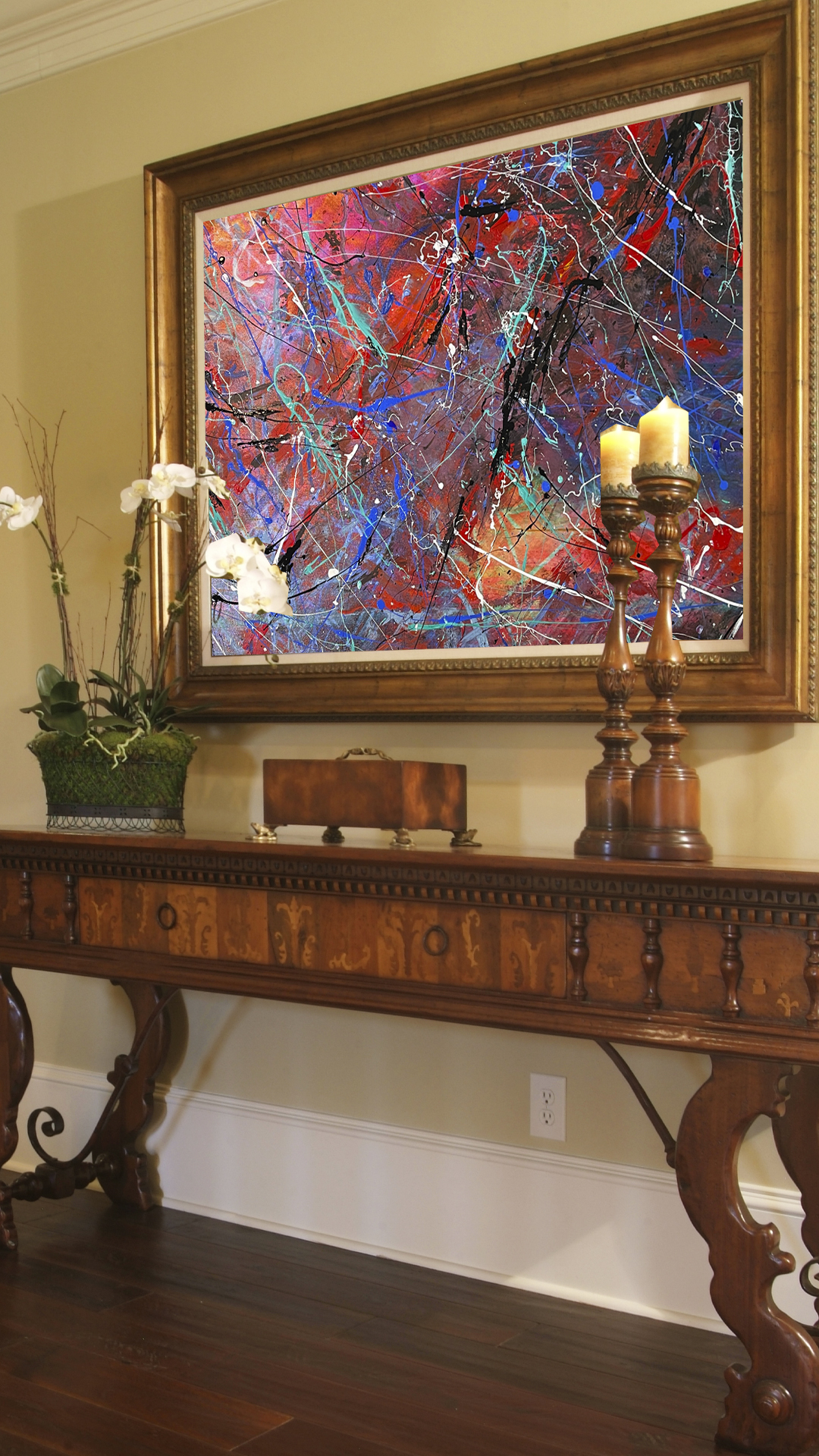
This quotation from Arshile Gorky, a foundational voice in 20th‑century abstraction, offers an elegant doorway into Waiting On You — a contemporary abstract painting that stands as a testament to the enduring power of visual language unconstrained by representational form. In aligning Gorky’s poetic insight with Valentine’s work, we begin to apprehend the subtle tensions and emotional textures that elevate this canvas from decoration to profound artistic communication.
Waiting On You — A Contemporary Statement in Abstract Art
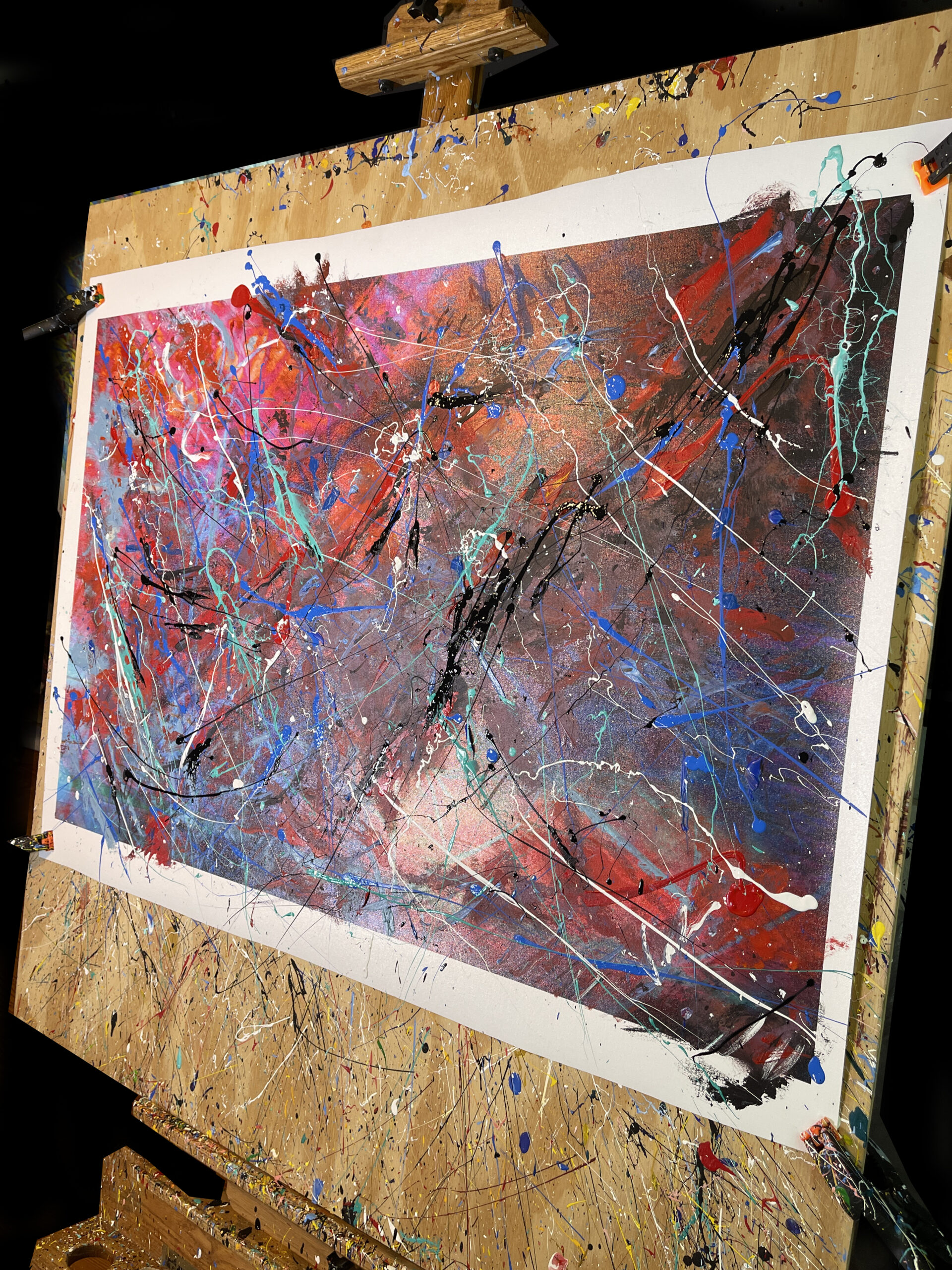
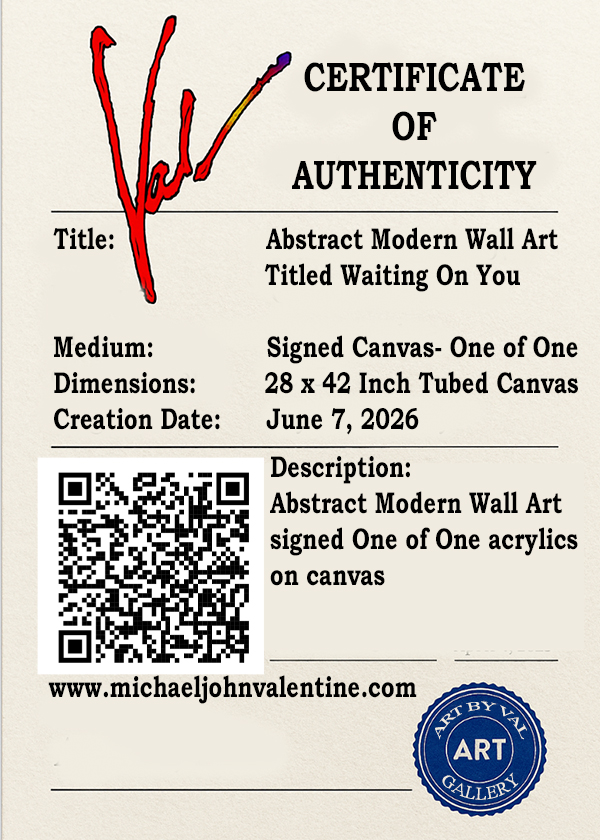
At first glance, Waiting On You presents itself as a sophisticated interplay of gesture, color, and surface — an original acrylic on canvas finished with selective overpainting and sealed with a glossy protectant. This piece, offered as a 28 × 42‑inch original by Michael John Valentine, arrives rolled in a protective tube and is intended to be stretched or framed by the collector, echoing time‑honored traditions of art handling and presentation that emphasize the unique objecthood of the work itself.
What distinguishes this painting in the realm of modern abstract work is how it navigates between intention and openness. The title Waiting On You is not merely a label — it is an invocation. It beckons the viewer into an experiential exchange, one in which meaning is not prescribed but co‑created between artist and observer. Unlike narrative art that reveals all at once, this painting cultivates a question rather than an answer, inviting repeated contemplations and evolving interpretations over time.
While the specific palette and forms shift with the viewer’s perspective and environment, the work’s essence lies in its capacity to elicit emotional resonance without depicting anything literal. This ability to communicate beyond representation aligns directly with Gorky’s meditation on abstraction as a means “to perceive beyond the tangible.”
Contextualizing within Art History
To appreciate Waiting On You fully, it helps to situate it within the larger lineage of abstract art. Throughout the 20th and 21st centuries, abstraction has been a language of liberation — from the formal constraints of academic realism to the expressive freedoms of inner life, emotion, and perceptual experience.
Artists such as Wassily Kandinsky saw abstraction as a spiritual language, a means of conveying inner truths without the intermediary of recognizable form. Others like Piet Mondrian pursued purity of form and harmony through carefully balanced compositional structures. Meanwhile, the gestural abstractions of Jackson Pollock and the color fields of Mark Rothko explored rhythm, scale, and mood in ways that invited immersive, emotional engagement.
In the broad sweep of abstract art’s evolution, Valentine’s work sits at the intersection of gesture, surface, and atmosphere — honoring the legacy of modern masters while speaking with a distinctly contemporary voice. His paintings acknowledge abstraction’s rich history without being tethered by it, inviting viewers to participate in the continuing evolution of what abstraction can be.
Emotional Resonance and Viewer Engagement
Where Waiting On You becomes especially compelling is in its capacity to act as a mirror of emotional states. The title itself suggests expectation, anticipation, yearning — states that every viewer will bring to the canvas from their own lived experience.
This is the essential brilliance of abstraction: its ability to hold space for personal projection while resisting specific interpretation. The work does not tell you what to see; it encourages you to discover what you feel.
In this sense, the painting becomes an ongoing conversation — between form and feeling, presence and perception, artwork and inhabitant.
For the Discerning Collector
Acquiring Waiting On You means investing in a unique artistic presence — one that transcends mere decoration and enters the realm of personal and cultural expression. At a price of $1,895 (for this original, signed and glaze‑sealed canvas), it represents both a meaningful aesthetic acquisition and a thoughtful engagement with abstract art’s enduring power.
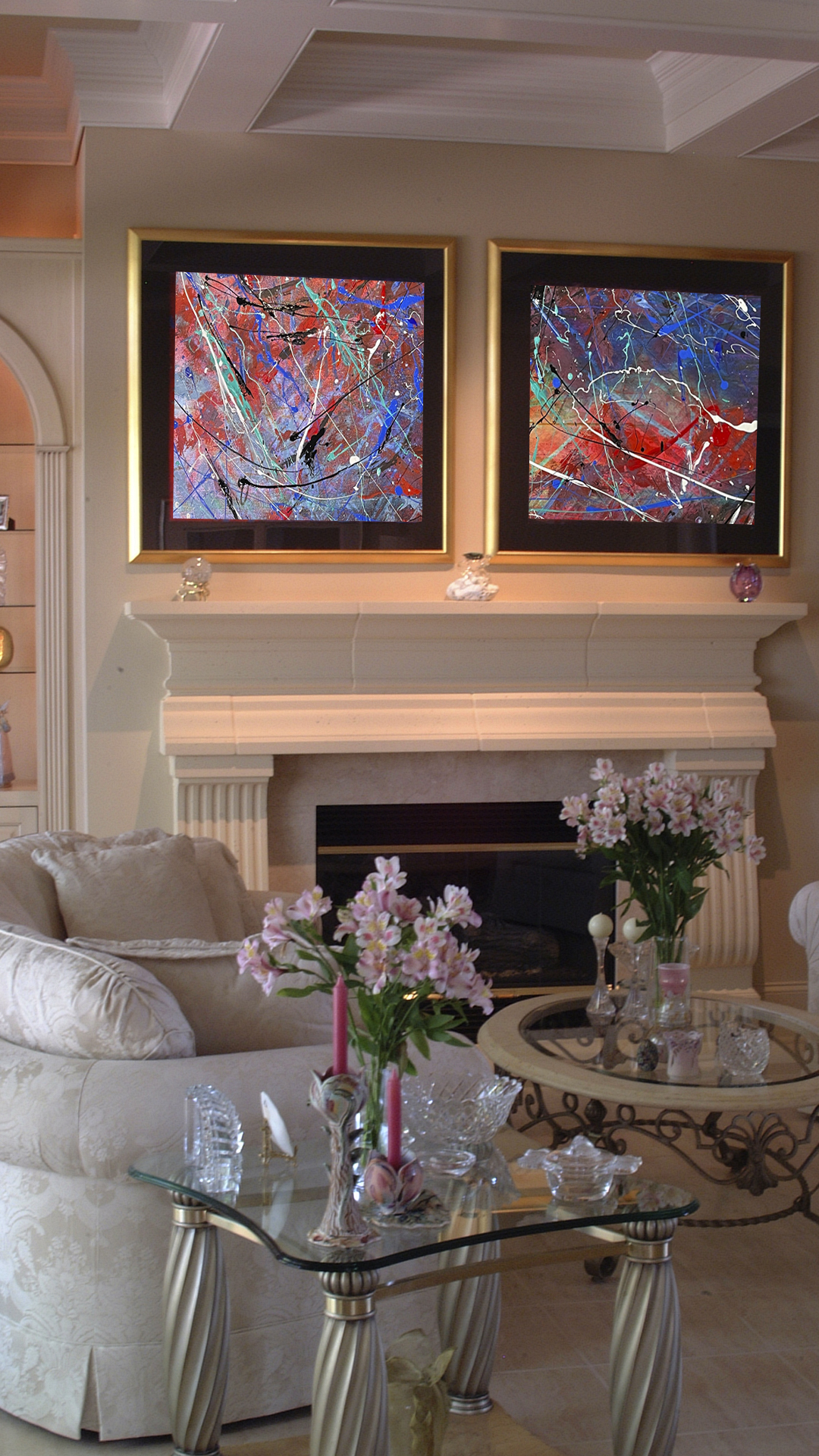
This piece is suitable for a variety of refined spaces — from a modern residential interior to a professionally curated office or gallery wall. It communicates not through explicit imagery but through the intensity of silence and suggestion — a hallmark of mature abstract work.
A Final Reflection
Gorky’s reflection on abstraction reframes the viewer’s expectation: abstraction is not absence — it is invitation. It is an opening of perceptual doors that cannot be seen with the eye alone.
Waiting On You stands firmly in this tradition. It does not simply hang on a wall — it inhabits the space around it and invites viewers into an act of attentive presence. For the discerning art lover or collector, this work is more than a visual object; it is an enduring conversation-piece, a meditative companion, and a testament to abstraction’s timeless ability to express the inexpressible.
One in studio