A Chapter Written in Light
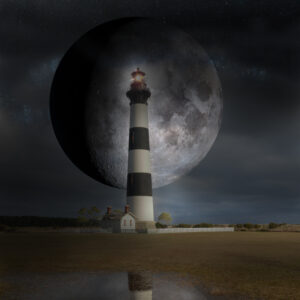
The page opens to a horizon.
Before the eye adjusts, before the mind settles, there is light—measured, intentional, rising from the sand as if the land itself decided to speak. The lighthouse stands not as an interruption, but as a sentence already in progress, written long before the reader arrived. Its spiral bands move upward like a story unfolding, guiding attention patiently, never rushing the eye.
Turn the page.
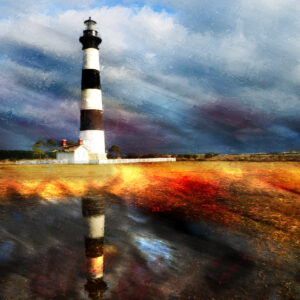
Wind slips into the margins. Salt lingers between the lines. The dunes shift subtly, edited by time the way great books are revised—never erased, only refined. The lighthouse remains constant, a recurring chapter the sea returns to again and again. It does not demand attention; it earns it.
Turn again.
Light becomes language. It travels outward, across water and memory, carrying meaning without explanation. The sky softens, layered with atmosphere and restraint, each tonal decision placed with the care of a well-chosen word. Texture builds quietly—overpainting and depth echoing the way stories gain weight through rereading rather than volume.
Another page.
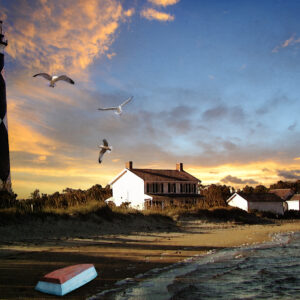
History reveals itself not as spectacle, but as presence. Storms once pressed hard against these walls. Ships trusted this light without ever seeing its keeper. Generations passed, guided by a single promise: that the light would be there when the rest of the world disappeared. Black and white become more than contrast—they become rhythm, cadence, the steady pacing of a narrative that refuses to hurry.
The chapter does not end.
It pauses.
The lighthouse remains at the edge of the continent, where land gives way to ocean and certainty yields to faith. This artwork is not an image of a place—it is a preserved passage. A moment when light chose permanence, and the coast chose to remember.
Some chapters are read once.
Others are returned to for a lifetime.
This is one written in light and remembered for it’s place on your walls.