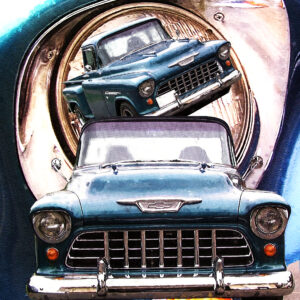
Crimson Sovereign: The Elegance of a Bygone Era”
The History Behind the Machine
The automobile captured in this painting evokes the golden age of grand touring—an era when cars were not merely transportation, but declarations of identity, artistry, and mechanical mastery. Judging by its elongated hood, sweeping fenders, upright grille, exposed wire wheels, and flowing convertible silhouette, this automobile reflects the spirit of late 1920s to early 1930s European luxury motoring—an age dominated by marques such as Bentley, Bugatti, Alfa Romeo, and Hispano-Suiza.
During this period, automobiles were largely coach-built. A manufacturer would supply the chassis and engine, and a master coachbuilder would craft the body to the client’s taste. Ownership was not about convenience—it was about patronage of craftsmanship. Each car was as unique as a tailored Savile Row suit.
The long hood signified power. Beneath it, one would typically find an inline-six or straight-eight engine—mechanical marvels of their day. These engines were engineered not only for speed, but for endurance. The era birthed endurance racing legends at Le Mans and Mille Miglia, and the technology of those racing circuits filtered into grand touring road cars.
The upright chrome grille was a badge of nobility. In the 1930s, grille design was branding. It was how the world recognized you from a distance. That gleaming vertical face was as important as a family crest. The sweeping front fenders, rolling almost like waves over the wheels, were expressions of the Art Deco movement—function elevated by form.
Whitewall tires and wire-spoke wheels represented both luxury and performance. The open-top configuration, complete with folded soft top and low windscreen, speaks of leisurely countryside drives—perhaps along the French Riviera or through the English countryside. These automobiles were often owned by aristocrats, industrial magnates, or celebrities of the era.
Importantly, this was the era before mass production homogenized identity. Cars were mechanical poetry. They required engagement: double-clutching, manual choke adjustments, hand-throttle management. Driving was an art form in itself.
This vehicle embodies that chapter of history—where elegance met engineering, and where speed carried the scent of leather, petrol, and possibility.
“Crimson Sovereign: The Elegance of a Bygone Era”
In this commanding composition, the automobile is not simply depicted—it is resurrected. The painting surges with emotional velocity, capturing not just a machine, but an era.
The car, rendered in a commanding crimson, dominates the canvas like a monarch reclaiming its throne. The red is not flat; it pulses. It breathes. Layers of textured pigment create movement across its body panels, giving the illusion that the engine still hums beneath the hood. The surface treatment—rich with scratches, abrasions, and expressive brushwork—suggests both memory and myth. This is not a sterile showroom portrait. This is history alive.
The elongated hood slices across the composition like an arrow, guiding the viewer’s eye from grille to cockpit. The upright chrome grille glows against the saturated chaos of the background, becoming a focal point of authority. It stands firm, vertical, resolute—contrasted against the swirling atmosphere around it.
And what an atmosphere it is.
The background is an explosion of impressionistic abstraction. Trees dissolve into fiery ambers and deep violets. The environment feels less geographical and more emotional—an echo of nostalgia. Light filters through in golden bursts, bathing the car in theatrical illumination. The effect is cinematic. One can almost hear gravel under tires and distant laughter carried on warm air.
The convertible top, folded back, reveals a cream-toned interior that offers quiet contrast to the exterior drama. This soft interior hue acts as a visual exhale amidst the saturated reds and golds. It invites the viewer inward. The windshield, delicately rendered, catches highlights that suggest motion or memory—perhaps a flash of sun as the car rounds a bend.
The whitewall tires anchor the composition. Their circular geometry provides structural balance to the fluid brushwork surrounding them. The wheels are meticulously detailed yet softened by texture, reinforcing the theme of time’s passage.
What makes this piece extraordinary is the tension between precision and abstraction. The vehicle itself is recognizable, tangible, historically grounded. The environment, however, feels dreamlike—almost turbulent. It is as if the past is fighting to remain vivid against the erosion of time. Scratches and layered pigment mimic patina, reinforcing the idea that memory is imperfect yet powerful.
Color theory plays a critical role in the emotional impact. The dominant reds symbolize power, passion, legacy. Surrounding golds and yellows create warmth—suggesting late afternoon light, perhaps the final glow of an era nearing its twilight. Blues and purples in the shadows add depth and contrast, ensuring the painting avoids sentimentality and instead embraces complexity.
This artwork does not romanticize the past without acknowledging its texture. It celebrates craftsmanship—not just of the automobile, but of the painter’s hand. Every stroke feels intentional. Every abrasion feels earned.
From a collector’s perspective, “Crimson Sovereign” functions as both statement and conversation piece. It embodies masculinity and elegance without aggression. It commands space. Hung in a study, gallery, executive office, or private garage, it speaks of discernment—of someone who appreciates legacy over trend.
The piece also transcends automotive interest. Even those unfamiliar with vintage motoring can feel its gravitas. It is about aspiration. It is about the human desire to build something beautiful, powerful, and enduring.
There is movement in this canvas—even in stillness. The diagonal composition gives it forward momentum. The car feels poised to drive out of the frame and into the viewer’s world. It bridges time. It reminds us that luxury once meant craftsmanship, patience, and individuality.
In today’s era of digital precision and disposable design, this painting feels defiant. It honors a time when metal was shaped by hand, when leather was stitched with pride, and when engines were tuned by ear.
“Crimson Sovereign” is more than automotive art. It is a tribute to mastery—both mechanical and artistic. It celebrates an age when ownership was personal and objects were built to last generations.
This painting does not whisper. It declares.
It declares that elegance never truly fades.
It declares that craftsmanship never loses value.
It declares that history, when honored properly, becomes immortal.
And in this immortal moment, beneath a blaze of painterly light, the Sovereign waits—forever ready for the road.