
Heceta Head Lighthouse
-
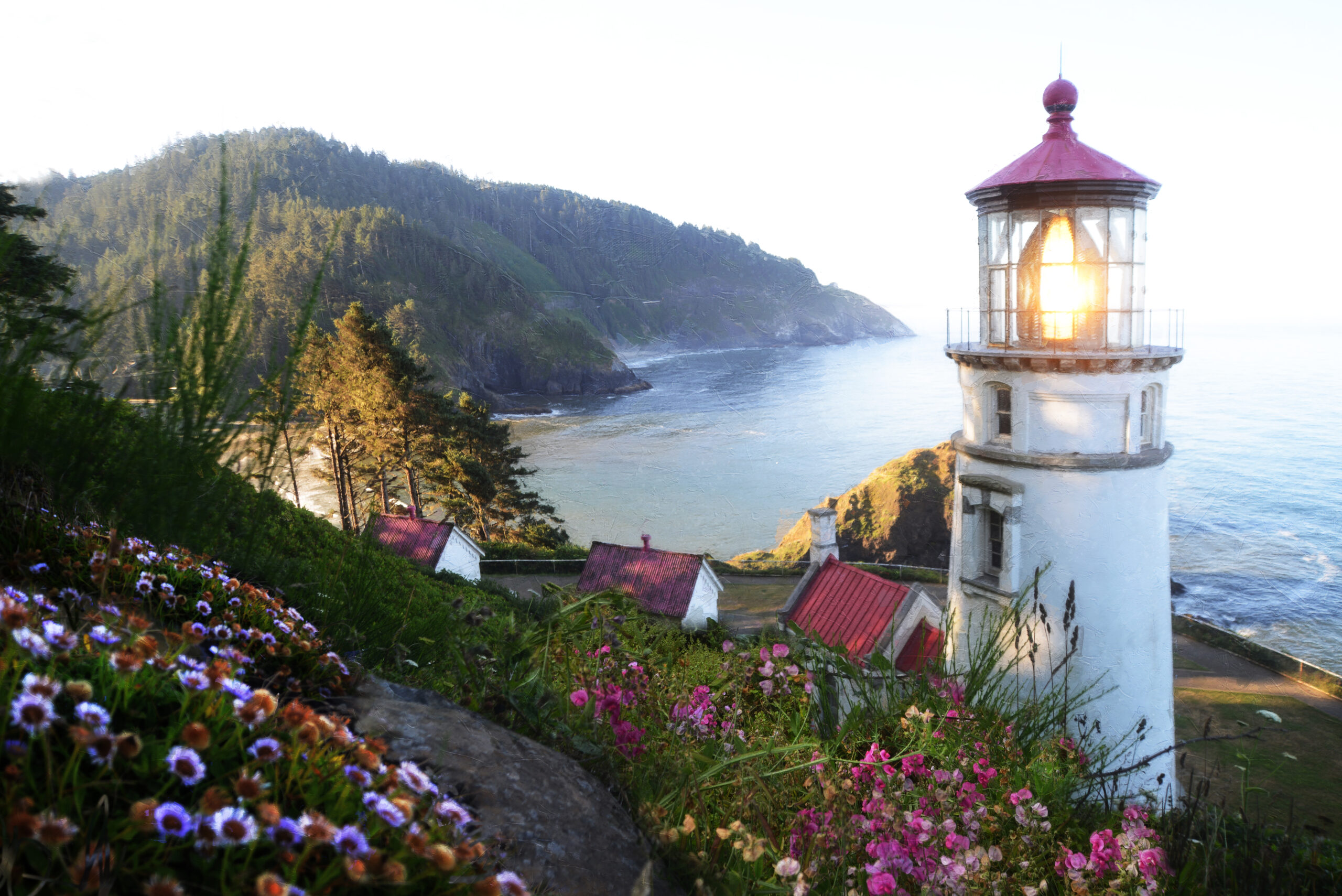
Heceta Head Lighthouse sits perched on a bluff roughly 1,000 feet above the Pacific Ocean, 12 miles north of Florence on the Oregon coast — its 56-foot tower crowned by a powerful beam visible for 21 nautical miles, making it “the strongest light on the Oregon coast.”
-
The headland gets its name from the Spanish Basque explorer Bruno de Heceta, who explored the Pacific Northwest coast under the Spanish crown in 1775.
-
Construction of the light station began in 1892; the lighthouse was first lit in 1894. The location was deliberately chosen to bridge a 90-mile gap between other lighthouses, providing a crucial navigational beacon along a rugged, often-fog-shrouded coastline.
-
Over the decades, the lightkeeping buildings, natural surroundings, and coastline have witnessed dramatic shifts — from isolated maritime outpost to beloved historic landmark — giving the subject depth, gravitas, and a sense of enduring legacy.
This layered history adds resonance to any artistic depiction: the bluff’s lofty isolation, the white tower against coastal storms, the beacon sweeping across dark waters — all combine into a symbol of resilience, guidance, and timeless coastal beauty.
On the Painting: Atmosphere, Color & Texture
Michael John Valentine’s depiction of Heceta Head Lighthouse isn’t just a faithful rendering — it’s an emotional evocation. Here’s how that plays out in the artwork (and what a collector should appreciate):
-
Atmosphere & Mood: The painting evokes the dramatic tension of the Pacific coast — perhaps a twilight or dawn hour, when the sky carries muted, brooding tones; when cliffs meet ocean spray; when the lighthouse stands as solitary sentinel. Given Valentine’s interest in “Lighthouse Art” for both East Coast and West Coast lights, there’s a palpable longing for that remote majesty.
-
Color Palette: Expect a harmonious blend of coastal grays, sea-blues, deep greens (for the rugged vegetation/cliffs), and crisp whites or creams for the lighthouse tower. Subtle touches — maybe the warm glow of a lantern, or the soft highlight on a cliff — hint at light against dark, calm against wild. This palette gives the canvas emotional depth, evoking serenity but also respect for nature’s power.
-
Texture & Technique: According to the artist’s description, the process includes “overpainting with acrylics, signing with acrylics on the front, and a final glazing to protect the canvas.” The glazing implies a refined finish that catches light — ideal for collectors who appreciate surface sheen and subtle reflection under exhibition lighting. The visible texture of brush strokes and sealant gives each piece a unique, hand-crafted quality: no two canvases are identical even if they share composition.
-
Impression of Place & Time: The painting doesn’t just show a lighthouse — it captures a moment in the continuum of the coast’s history, as if the viewer hears distant gull calls, feels the salty wind, senses the timeless rhythm of the waves. The dramatic cliff-top vantage evokes both awe and solitude, a silent testament to the power of nature and human perseverance.
Provenance & Authenticity — Collector Worthiness
-
The artwork comes with a “Certificate of Lighthouse Authenticity” issued by Michael John Valentine himself — a mark that underscores the work as more than decorative print: it’s a collectible, signed, original painting.
-
The piece is part of a curated “Lighthouse Art” collection, in which the artist draws on personal affinity (born on the Island of Bermuda, with a childhood view of a lighthouse) and decades of practice.
-
In terms of editions and sizes: the work is offered in a wide range — from small decals and matted prints to large overpainted signed canvases (e.g., 18 × 24, 28 × 42, 38 × 56). This variation makes the work accessible both to those seeking an affordable print and to serious collectors investing in large-format statement pieces.
-
Given Valentine’s established history (with multiple lighthouse works, a dedicated “Lighthouse Art” category, and a clearly described process) the piece carries credible provenance — key for future resale or display in a curated collection.
Emotional & Symbolic Resonance — Why This Painting Matters
For a collector, this painting offers more than a coastal scene. It is:
-
A bridge between past and present — grounding contemporary art in maritime, exploration, and navigational history.
-
A testament to craftsmanship and place — the cliffs of Oregon, the sea’s vastness, the beacon’s lonely duty — all conveyed with texture, tone, and brushwork.
-
A statement of taste — for someone who values exclusivity, stories embedded in objects, and emotional depth over mass-produced décor.
-
An anchor for memory or aspiration — whether one has visited Oregon’s coast and felt its majesty, or simply imagines the roar of waves and the salty air: owning this painting is owning a fragment of that mythic coastline.
For a collector with a luxury-focused mindset (as I know you are), this piece stands as a small but potent relic of the natural world’s drama, human endeavor, and timeless beauty.