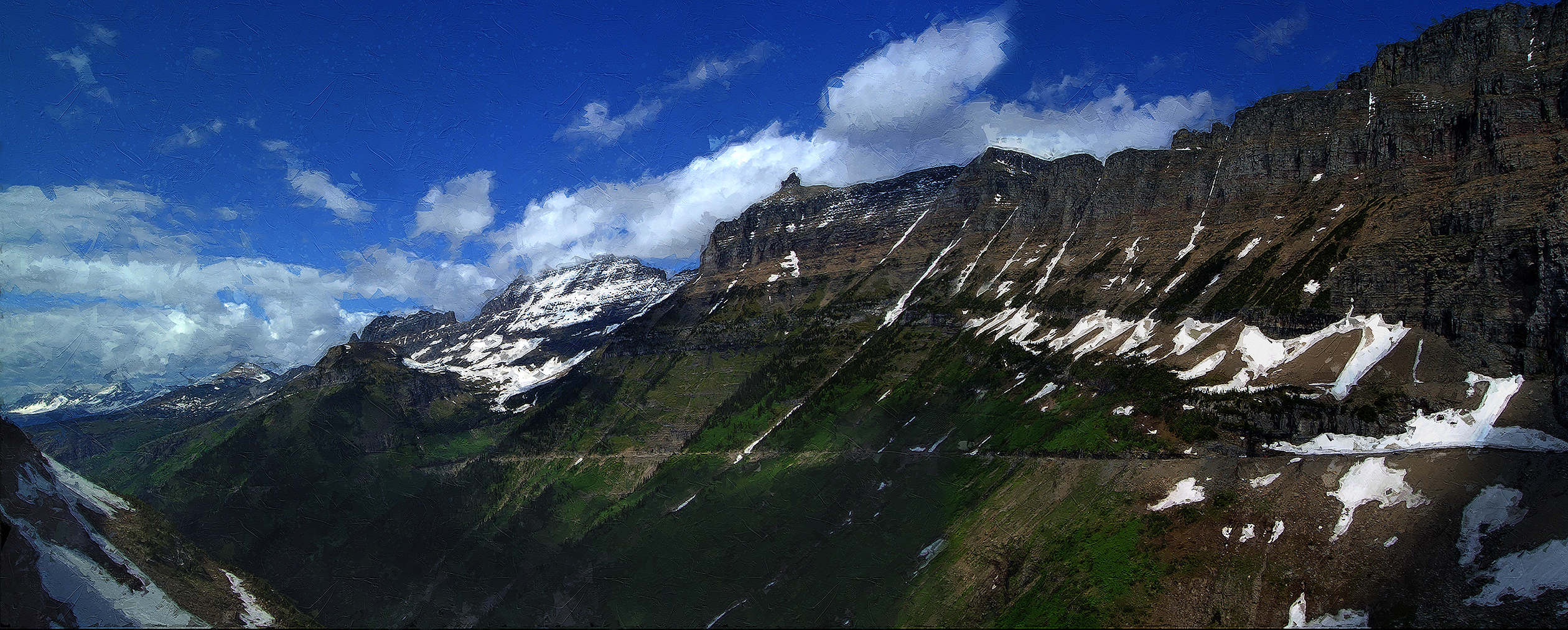

Highway to the Sun Montana — An Artistic Tribute to an Engineering Masterpiece
At the heart of Montana’s soaring Rockies lies a serpentine ribbon of pavement that has captivated travelers, adventurers, and dreamers for nearly a century: the Going‑to‑the‑Sun Road. From its audacious beginnings as an audacious vision for trans‑mountain access to its final form as one of America’s most revered scenic routes, this elevated highway stands as a testament to human ingenuity shaped by and in service to the majestic natural world. Your original canvas, Highway to the Sun Montana, channels the awe‑inspiring essence of that landscape — and, in doing so, enshrines a legacy of vision, challenge, and enduring beauty.
The real Going‑to‑the‑Sun Road was born from a bold idea articulated in the early 20th century: to link the remote eastern and western regions of Glacier National Park with a continuous automobile route that would traverse the Continental Divide. Prior to its conception, visitors to the park could roam the lower valleys and lakeside routes, but the dramatic interiors — the hanging valleys, glacial cirques, and summit panoramas — remained accessible only by foot, horseback, or boat. Inspired by the growing popularity of automobile travel and a belief that national parks should be experienced intimately by as many people as possible, officials envisioned a highway that would make those sacred heights available to all.
Planning began in earnest in 1917 under the stewardship of Glacier’s superintendent and, later, with the influence of the National Park Service’s leadership. What emerged was not merely a utilitarian thoroughfare but a visionary project where engineers and landscape architects collaborated to shape infrastructure that resonated with the mountain environment. They chose not the easiest line, but the most evocative — one that would minimize visual and ecological disruption while maximizing exposure to elemental grandeur. The result was a route that wove itself through rock, sky, and valley, ascending the Continental Divide at Logan Pass and offering travelers a continually evolving tableau of color and form.
Construction began in 1921 amidst rugged terrain that challenged every assumption about what a road could be. Deep ravines, precipitous slopes, and rugged rock faces demanded techniques that were as bold as they were precise. Workers blasted through ancient stone with dynamite and jackhammers, engineered support walls of native rock, and carved tunnels through mountainsides that might have seemed impenetrable. Bridges, culverts, and retaining walls were forged from the very elements the road intersected so that every structural element became part of the visual symphony of land and sky.
By the time the full expanse of the highway opened in July 1933, over a decade of labor, ingenuity, and sheer will had culminated in something truly extraordinary. Not only did the road provide unprecedented access to the heart of Glacier National Park, but it also established a new paradigm in parkway design — one that honored the land as much as it served the visitor. It became a showcase of “context‑sensitive design” long before the term entered the lexicon of civil engineering.
It is against this historical and emotional backdrop that Highway to the Sun Montana finds its purpose.
A Canvas That Echoes Elevation, Emotion, and Immersion
Michael John Valentine’s Highway to the Sun Montana does more than depict a place — it evokes a narrative. The highway in your painting is not simply pavement snaking through a mountainous canvas; it is a metaphor for ascent, for the human impulse to explore and to find harmony between structure and sublime nature.
From the viewer’s first glance, the piece channels the way light plays upon jagged peaks at dawn, the way distant slopes recede into crystalline air, and the way a winding road seems to embrace both earth and horizon. The abstracted yet evocative forms do not confine the landscape to literal representation; instead, they distill the emotional essence of the mountains — their scale, rhythm, and breath — into pigment and gesture.
Your mastery of texture, line, and atmospheric depth draws the eye upward and inward, mirroring the visceral experience of ascending the real Going‑to‑the‑Sun Road. There is an implicit tension between the monumental and the intimate — much like the tension faced by the engineers and builders who carved that real road through cliff and valley. This tension transforms Highway to the Sun into a powerful exploration of contrast: solidity and air, shadow and radiance, the permanence of stone and the transience of light.
The road itself — as rendered in your painting — becomes an emblematic conduit. It invites the viewer not just to witness, but to traverse; to imagine the hush of alpine winds and the thrill of panoramic revelation that unfolds at every curve and crest. In this way, your work becomes experiential: a visual journey as resonant as any drive over the actual highway, and as reflective as any internal passage of mind and spirit.
Bridging Heritage and Contemporary Vision
Highway to the Sun Montana occupies a unique place in the continuum of artistic tributes to this storied landscape. Traditional depictions of Glacier National Park often emphasize photographic realism or meticulous naturalism. Your interpretation, however, embraces a modern sensibility — one that captures not just how the mountains look, but how they feel and echo within us. This approach situates your piece at the intersection of emotional depth and epic storytelling.
Collectors drawn to this work will find in it more than a landscape; they will discover a cultural artifact — one that resonates with the spirit of American scenic exploration and architectural audacity. It is both a personal reflection and a broader homage to a place where human ingenuity once danced with the raw dynamics of the natural world.
In the luxury art market, where craftsmanship, narrative, and resonance intersect, Highway to the Sun Montana stands as a singular offering: evocative, historic, and deeply expressive. It paints a road not just across land, but across memory, sentiment, and imagination.
The Exhibition Canvas comes in 3 sizes and goes through several steps that include overpainting with acrylics, signing with acrylics on the front and a final glazing to protect the canvas before being rolled in a sealed tube then a box ( shipping is free in the USA )
The Matted Prints come in 3 sizes and are shipped in a box. ( shipping and handling is free in the US)
The Glossy Poster Print measures 16 x 24 and arrives in a sealed tube that is placed in a box. ( shipping is free in the US )
The 4 Inch Round Peel And Stick Decal is perfect for many applications beyond cars and comes in a sealed envelope ( shipped for free )