Juneau, Alaska — Fishing Boats & Seaplane
Original Mixed-Media Canvas by Michael John Valentine
56″ × 40″ Signed, Glazed & Gallery Wrapped — One-of-a-Kind Work Available In-Studio
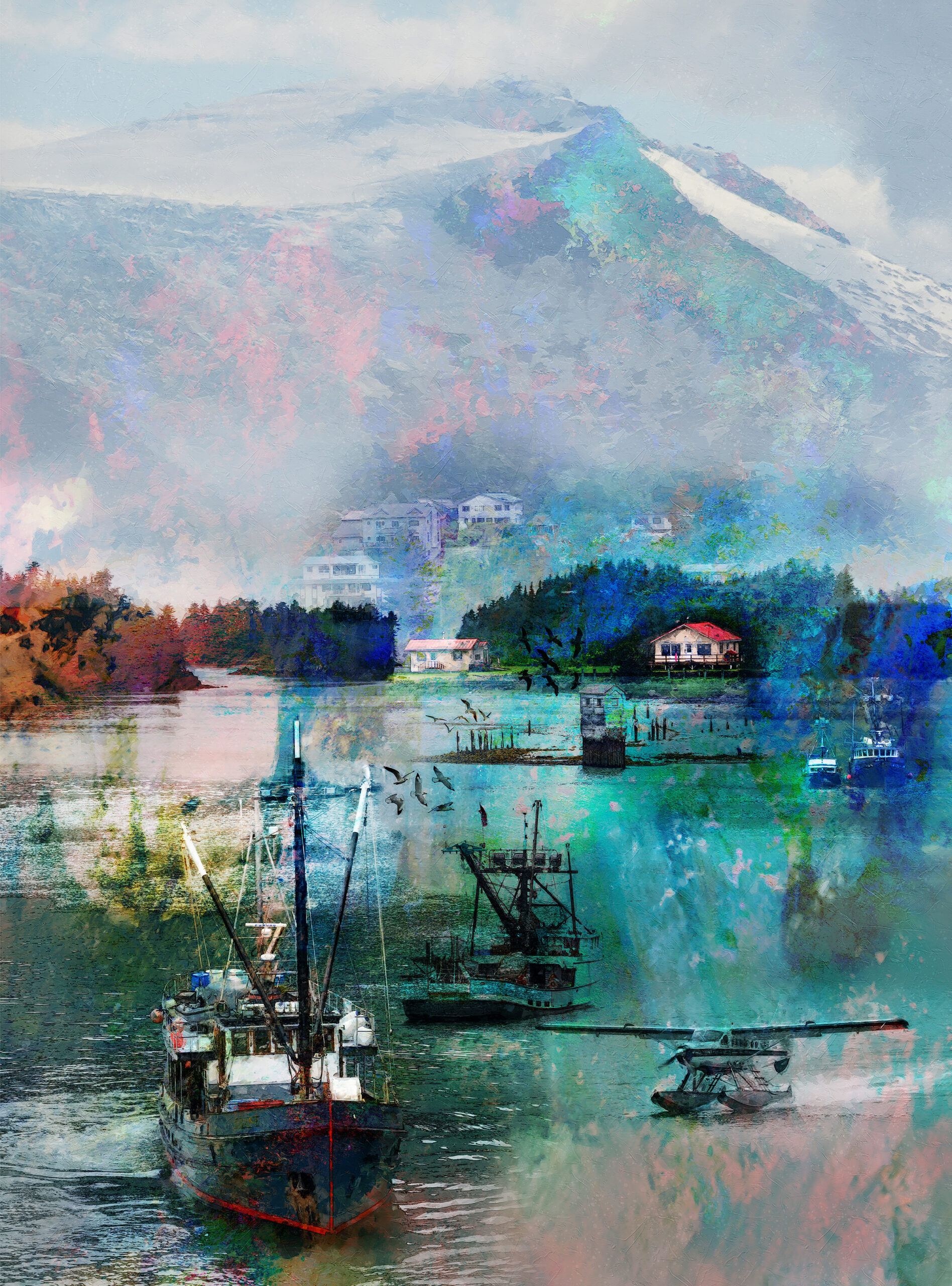
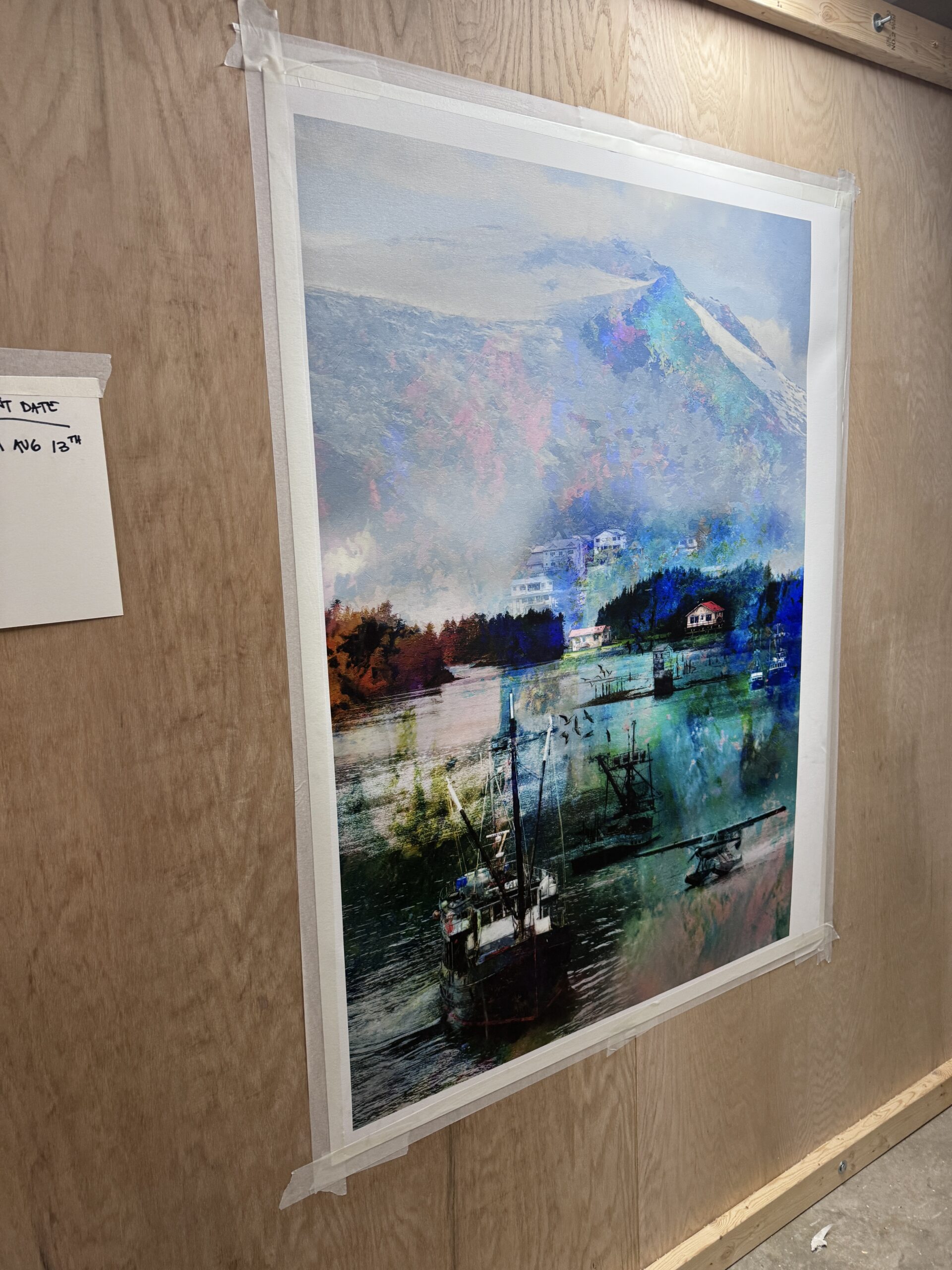
An invitation to wander the edge of wilderness and human endeavor, Juneau, Alaska — Fishing Boats & Seaplane is not merely a painting — it is a visual odyssey. Rendered on a monumental 56″ × 40″ gallery-wrapped canvas, this original work by Michael John Valentine merges rugged northern beauty with nuanced narrative depth, inviting viewers into the living rhythm of Southeast Alaska’s coastal life.
Explorer quote (John Muir, Alaska explorer and naturalist):“A new world is opened… a world of ice with new-made mountains standing vast and solemn in the blue distance.”
Muir’s writings helped reveal southeastern Alaska’s glaciers, waterways, and wilderness to the world, encouraging travelers to journey north and experience the spiritual power of the landscape firsthand.
Collector’s Narrative — Juneau, Alaska with Fishing Boats and Seaplane
In this monumental composition, Juneau is not merely depicted — it is rediscovered. The painting captures a frontier city suspended between water, wilderness, and sky, where the rhythms of industry and nature coexist in quiet equilibrium. Fishing boats rest on the water like patient instruments of livelihood, while the seaplane suggests motion, exploration, and the enduring human urge to reach the unreachable.
Juneau itself was born from exploration — founded after gold discoveries in 1880 by prospectors seeking opportunity along Alaska’s rugged southeastern coast. That spirit of discovery still defines the region, and this work channels that energy into paint, transforming geography into atmosphere and memory.
The composition immediately immerses the viewer in scale and stillness. The water occupies a reflective middle ground, acting as both mirror and passageway. Fishing vessels, rendered with deliberate texture and tonal contrast, serve as anchors within the scene — symbols of continuity in a place where weather, light, and tide are constantly changing. Their presence grounds the painting in human experience, reminding collectors that survival in Alaska has always depended on cooperation between people and environment.
Above the harbor, the seaplane becomes the emotional fulcrum of the work. It introduces narrative tension — a suggestion of arrival or departure. In Alaska, aircraft are not luxuries but lifelines, connecting remote landscapes and communities separated by mountains and glaciers. The plane’s placement subtly divides the composition between sea and sky, industry and wilderness, permanence and motion.
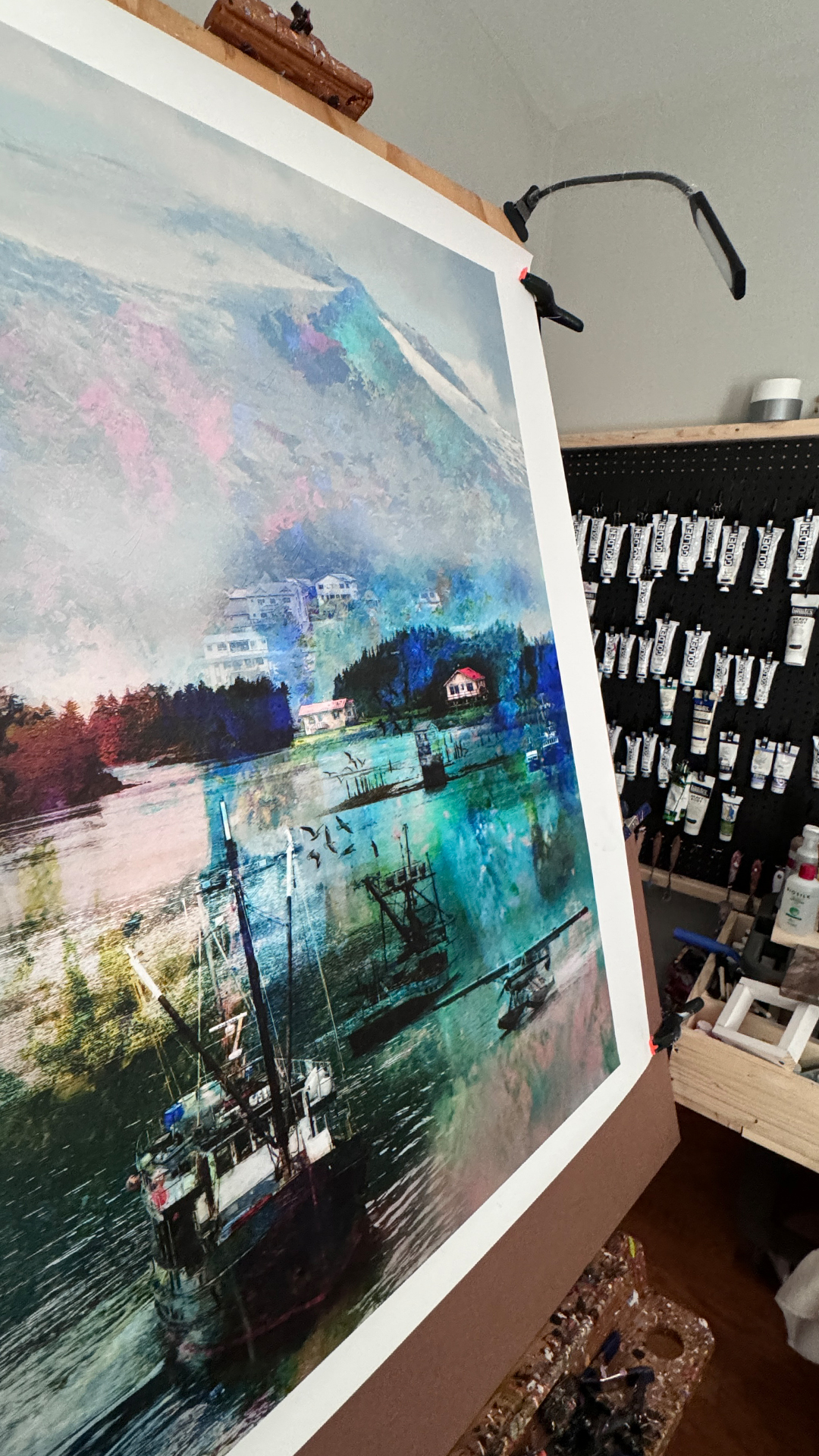
Your painterly approach transforms these elements into something experiential rather than documentary. The brushwork is confident but atmospheric, allowing forms to emerge through layered color rather than rigid outline. This technique mirrors the coastal climate itself — mist softens mountains, reflections dissolve edges, and distance becomes emotional rather than physical.
Color plays a defining role in the painting’s authority. Cool blues and slate-greens dominate the environment, evoking glacial water and northern air. Against this restrained palette, the fishing boats introduce measured warmth and structure. This balance creates visual harmony while reinforcing the idea that humanity in Alaska exists within nature, not above it.
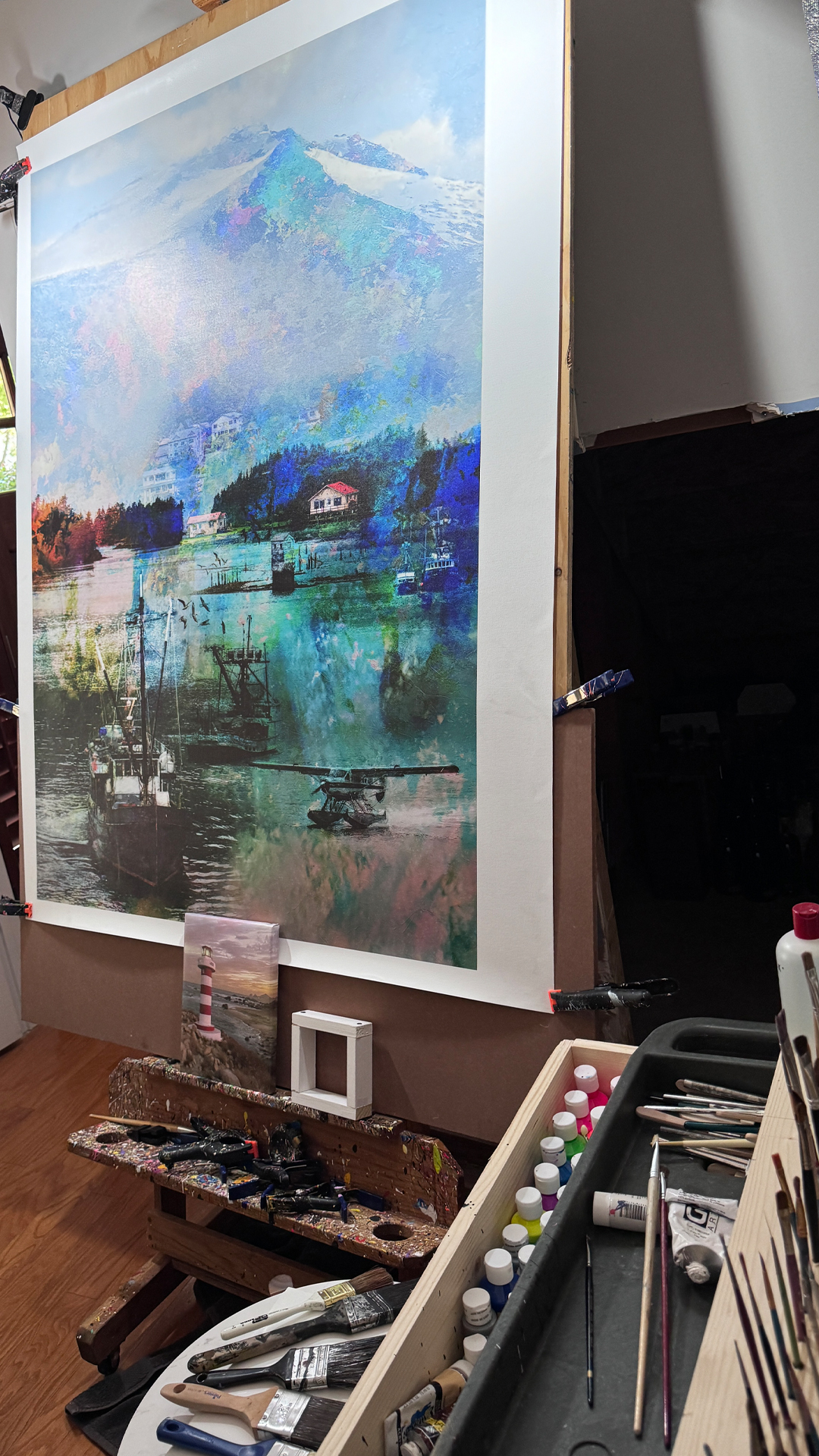
Collectors will recognize how the scale of the canvas reinforces the subject matter. At 56 × 40 inches, the work approaches environmental painting — something that surrounds the viewer rather than simply hanging before them. Standing in front of it recalls looking across Gastineau Channel, where mountains rise abruptly from the sea and clouds drift slowly across the horizon.
The painting also resonates historically. Southeast Alaska was one of the last frontiers of American exploration in the nineteenth century, drawing missionaries, geologists, and adventurers who sought to understand glaciers, wildlife, and mineral wealth. Figures like explorer-geologist Bernard Hubbard later helped bring images of Alaska’s glaciers to the wider world through lectures and expeditions. The presence of the seaplane subtly connects those early expeditions to modern exploration — different tools, same curiosity.
Yet the emotional center of the painting remains quiet. There is no storm, no dramatic human action, no spectacle demanding attention. Instead, the work celebrates patience — the patience of fishermen, the patience of mountains shaped by ice, and the patience required to truly see a place like Juneau.
This restraint is what gives the painting its collector-level sophistication. Rather than dramatizing Alaska, the work honors its stillness. The viewer senses cold air, distant engines, and the soft movement of water against hulls. The painting becomes less about a location and more about presence — about standing at the edge of wilderness where civilization feels temporary.
The seaplane ultimately symbolizes perspective. From above, Juneau appears small against forests, fjords, and glaciers — a reminder that exploration is as much about humility as discovery. This idea echoes John Muir’s belief that wilderness journeys were spiritual experiences, capable of reshaping how people understand themselves and the world.
As a collectible artwork, this piece functions on multiple levels. It is a landscape, a historical reflection, and a meditation on exploration. It invites viewers to imagine arriving by water, departing by air, or simply standing still at the harbor’s edge.
In the end, the painting captures something rare: Alaska not as spectacle, but as memory in the making. The fishing boats suggest tradition, the seaplane suggests possibility, and the vast environment surrounding them suggests eternity.
Like Juneau itself — born from discovery yet defined by wilderness — the painting lives between worlds.
And in that space, exploration continues.