The Vision — Raw Waterfall Power & Emotional Resonance
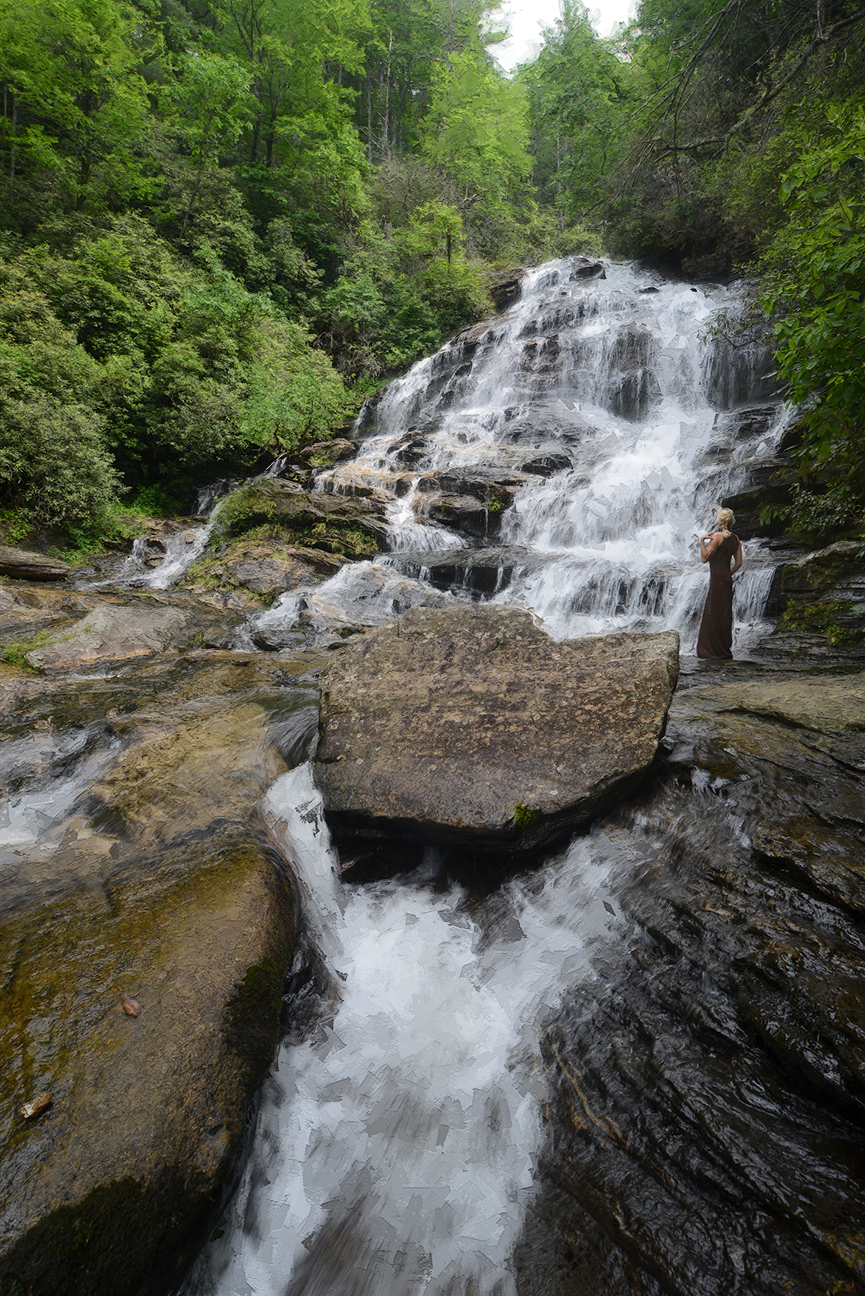
Imagine standing at the brink of a roaring cascade. Water crashes and surges with a feral energy, spray mingling with mist, whispers of ancient stone and time-worn earth echoing in your soul. In Lady At The Waterfalls, Valentine channels this primal force — the waterfall is not merely background, but a living, breathing presence. The figure (the “Lady”) becomes part of that elemental drama: not passive, but intimate with the natural force, as though drawn into the very pulse of the water’s energy.
There is a tension between calm human form and chaotic nature. That duality — serenity entwined with power — invites the viewer to feel both peace and awe: the tranquility of a human silhouette, and the unstoppable might of cascading water. It evokes a sense of humility before nature: a moment captured between human fragility and elemental force.
What the Piece Is — Materials, Process, and Authenticity
-
Medium & Options: The work is offered in multiple formats — from small decals and glossy poster prints to full exhibition-size canvases. The highest tier is the overpainted, signed canvas.
-
Overpainting & Finishing Process: According to the description, the “Exhibition Canvas” goes through “several steps that include overpainting with acrylics, signing with acrylics on the front and a final glazing to protect the canvas before being rolled in a sealed tube then a box.” This means after an initial base (possibly photographic or printed reproduction), the artist applies additional acrylic layers — brush strokes, texture, glazing — resulting in a unique, tactile surface. Each overpainted canvas carries subtle variations; no two are exactly the same.
-
Certificate of Authenticity (COA): The site displays a “Certificate Of Authenticity for artist Michael John Valentine of Lake Norman North Carolina.” The COA is presumably meant to certify the work as genuine.
On COA — Strengths and Cautions
Having a COA can be a useful signal of authenticity — but it should not be taken at face value. The broader art community notes that valid COAs should include detailed, verifiable documentation: the exact title of the work, medium, dimensions, date, edition number (if applicable), and contact information for the signer or issuing authority.
However, many COAs — especially ones issued by individual artists or small studios — may not meet rigorous “provenance” standards. As one collector in an online discussion put it:
“Without provenance … a signature is more easily faked than the painting.”
In short: A COA from the original artist — while better than nothing — does not guarantee long-term resale value or verification unless accompanied by a traceable chain of ownership (provenance) or third-party authentication.
Small-Studio Handcrafted Art vs Mass-Produced Decor
One of the most compelling aspects of Lady At The Waterfalls is that — according to the artist’s own statement — it is “100% Authentic starting with original photography, acrylics, glazing all handmade in house without the use of AI.”
Here’s why that matters:
What small-studio handcrafted art brings:
-
Unique surface texture & brushwork — The overpainting and glazing add real brush strokes and depth, which a purely printed mass-produced piece cannot replicate.
-
Artistic intent & human touch — Choices about color, overpainting, glazing, finishing reflect the artist’s hand, mood, and vision. Each piece becomes a one-of-a-kind interpretation.
-
Potential for longevity and value — Because of authentic materials and personal execution, these works have a better chance of enduring both physically and as collectible art (assuming proper documentation and provenance).
What mass-produced decor often lacks — and why quality matters
-
Mass-produced art often uses lower-quality materials, flat printing, lack of texture, and inexpensive canvases/frames — limiting both durability and aesthetic depth.
-
Without individual signature, overpainting, or unique finishing, mass-produced works remain “decor” — often indistinguishable from generic prints — and hold little if any collectible value.
-
In the absence of clear provenance or authentic artist documentation, “certificates” issued can be meaningless or easily forged.
Historical & Artistic Context (Why Waterfalls in Art Matter)
Waterfalls have long held a powerful place in art history: they’re symbols of nature’s force, transience, sublime beauty, and human reverence for wilderness.
By situating a human figure within or beside such a natural spectacle — as Valentine does — the painting enters a long tradition: the human being not dominant over nature, but immersed in it. The emotional weight heightens: it’s not just landscape, but a meditation on humanity’s place within elemental forces.
Though Lady At The Waterfalls is not tied to a specific real-world waterfall (as far as the site indicates), the emotional punch draws on that timeless motif: water as a symbol of power, renewal, danger, peace — all at once.
Who This Piece Is For — And Why It Resonates
-
Collectors & connoisseurs: If you value authenticity, handcrafted detail, and uniqueness — not a mass-produced print — this work offers real artisan value.
-
Lovers of nature’s drama: The painting channels raw natural energy and human vulnerability. It’s not just decoration — it’s a statement piece, evocative and moody.
-
Interior spaces seeking character: In a home, office, or gallery — especially one aligned with rustic, natural, or dramatic aesthetic — this piece can serve as a focal point, stirring emotion and conversation.
-
Patrons of small-studio artistry: Supporting an individual artist or small gallery fosters artistic integrity, encourages creative risk, and values craftsmanship over mass output.
More Than Decor: A Statement
Lady At The Waterfalls stands as more than wall decoration. It’s a crafted interplay of human and elemental forces — waterfall power captured in acrylic, on canvas, by a living artist. Through overpainting, glazing, and hand-finishing, each canvas becomes its own object, imbued with intentionality and craftsmanship often absent from mass-produced art.
Yet, as with any art offering a “Certificate of Authenticity,” due diligence matters: request full COA documentation, verify provenance if possible, and treat the piece as the collectible it aspires to be — not merely a print on the wall.