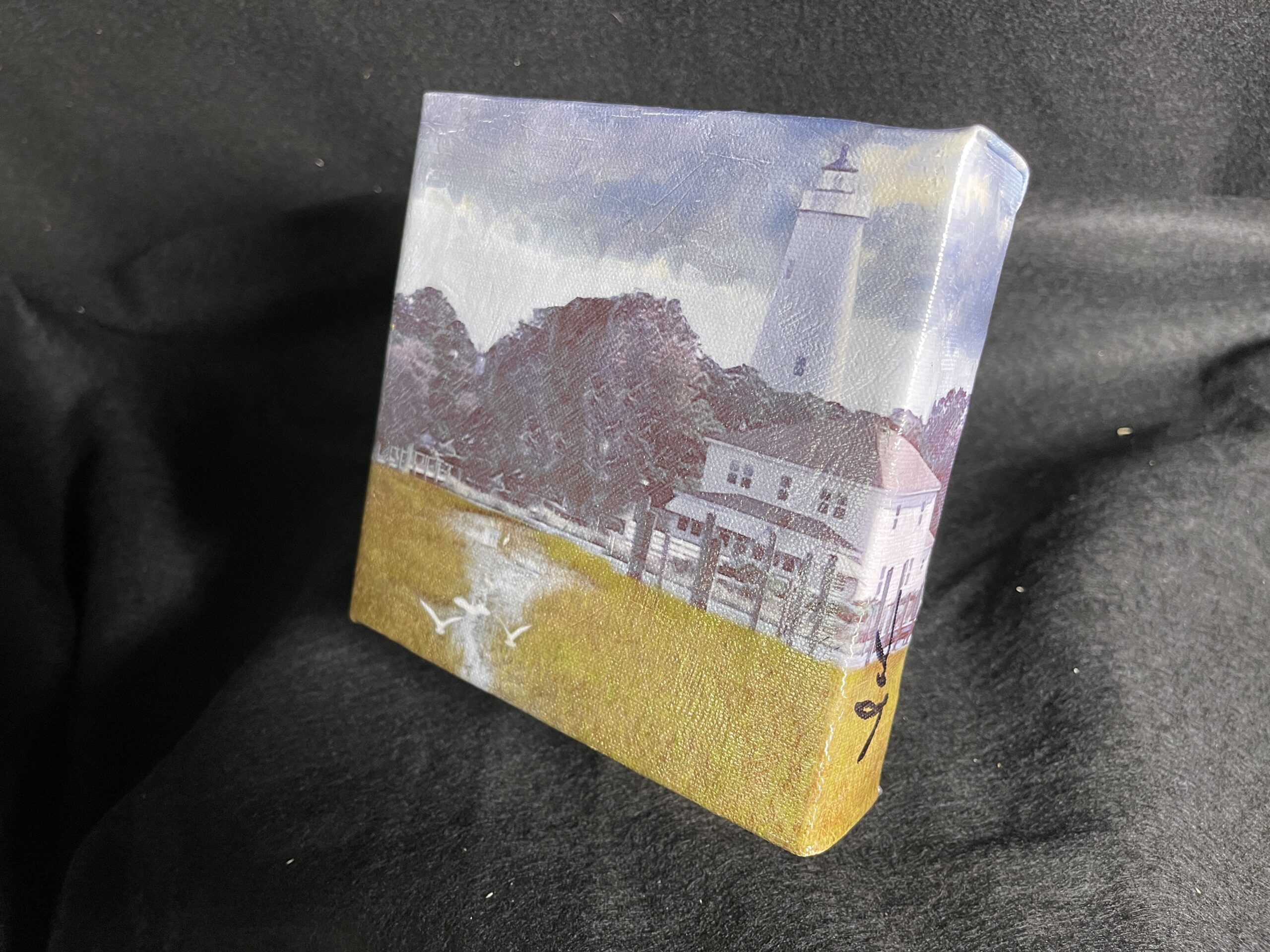

“A lighthouse is more than a structure—it is a promise carved in stone, guiding every traveler home through the shifting tides of time.” — Michael John Valentine
Ocracoke Island Lighthouse — A Study in Light, Legacy, and Enduring Coastal Spirit
The Ocracoke Island Lighthouse stands as one of the most quietly powerful symbols along the Outer Banks of North Carolina. Unlike the towering, dramatic coastal sentinels that often dominate postcards and travel brochures, Ocracoke is modest in scale yet monumental in presence. Its whitewashed brick tower, rising only 75 feet, carries something far greater than its physical height: centuries of maritime history, resilience against shifting sands, and an enduring connection between land, sea, and human navigation.
This painting is a tribute not only to the lighthouse itself, but to the atmosphere that surrounds it—the hush of salt air, the slow rhythm of island life, and the timeless conversation between light and water that has defined Ocracoke Inlet for generations.
Built in 1823, Ocracoke Lighthouse is recognized as the oldest operating lighthouse in North Carolina and one of the oldest continuously functioning beacons in the United States. Its origins trace back to the necessity of guiding ships safely through one of the most unpredictable inlets on the Atlantic coast. Ocracoke Inlet has long been a shifting, living channel—constantly reshaped by storms, tides, and the restless movement of barrier islands. Mariners once relied on local pilots and early warning lights to navigate these waters, where sandbars could appear overnight and redefine entire passages.
In this painting, that sense of instability is not treated as chaos, but as poetry. The lighthouse becomes an anchor within motion—a fixed point of clarity amid a coastline that refuses to remain still. The composition reflects this tension: the firm geometry of the tower set against fluid skies and evolving coastal atmosphere, suggesting both permanence and transformation existing in the same breath.
Ocracoke itself carries a deep cultural weight. It is an island shaped by isolation and access, reached only by ferry, where time seems to slow as soon as the mainland disappears behind the waterline. This separation has preserved not only its natural beauty but also its identity—quiet villages, unspoiled beaches, and a strong sense of continuity with the past. The lighthouse, standing just outside the village, mirrors this ethos. It does not demand attention; it earns it slowly, through presence and endurance.
Historically, the lighthouse has witnessed centuries of maritime evolution. From wooden sailing ships navigating colonial trade routes to modern vessels guided by advanced technology, Ocracoke Light has remained constant. Even as its role has shifted from essential navigation aid to historical landmark, its symbolic importance has only deepened. It now serves as a reminder of human ingenuity in the face of natural unpredictability, and of the quiet courage required to live alongside the sea.
In the artwork, light is treated as the central language. The beacon is not merely depicted as illumination but as a living force—spreading outward like memory across water and sky. The surrounding environment responds to it: the shoreline softens, the horizon opens, and the air itself seems to carry a faint glow. This interplay between structure and atmosphere reflects the lighthouse’s true function—not just to warn or guide, but to transform uncertainty into direction.
The surrounding landscape is equally important. The marsh grasses, shifting sands, and low coastal vegetation evoke the fragile balance of the Outer Banks ecosystem. Nothing here is static. Even the ground beneath the lighthouse is part of a larger conversation between land and sea, constantly negotiated by tides and storms. In this way, the painting becomes more than a depiction of place—it becomes a meditation on impermanence and endurance.
There is also an emotional undercurrent to Ocracoke Light that resonates beyond geography. Lighthouses have always carried symbolic meaning: solitude, guidance, vigilance, and hope. Yet Ocracoke’s particular character adds something more intimate. It is not grand or imposing; it is humble, weathered, and deeply human in scale. It feels less like a monument and more like a companion to the coastline—steady, patient, and quietly watchful.
That emotional restraint is reflected in the artistic approach. Rather than overwhelming detail, the focus is on atmosphere, tonal harmony, and the suggestion of movement within stillness. The goal is not to replicate the lighthouse as a photograph might, but to interpret its essence—the feeling of standing before it at dusk, when the day’s heat fades into cool coastal wind, and the first stars begin to emerge above the Atlantic horizon.
Ocracoke Island Lighthouse also carries the weight of stories—some documented, others passed through generations of island memory. Tales of storms, shipwrecks, and lighthouse keepers who lived in rhythm with the tides give the structure a human dimension that transcends its architecture. It becomes not just a beacon for ships, but a witness to lives lived at the edge of land and sea.
In this sense, the painting is as much about memory as it is about place. It invites the viewer to consider what remains when time passes through a landscape: what endures, what fades, and what is continuously renewed by nature itself.
Ultimately, Ocracoke Island Lighthouse stands as a quiet declaration that even in the most changeable environments, there are points of light that persist. They do not resist change—they guide through it. And in that guidance lies their true beauty.
This artwork seeks to capture that enduring truth: that light, once lit, becomes more than illumination. It becomes legacy.