The Cape of Good Hope, South Africa Lighthouse — A Masterwork of Place, Light, and Legacy
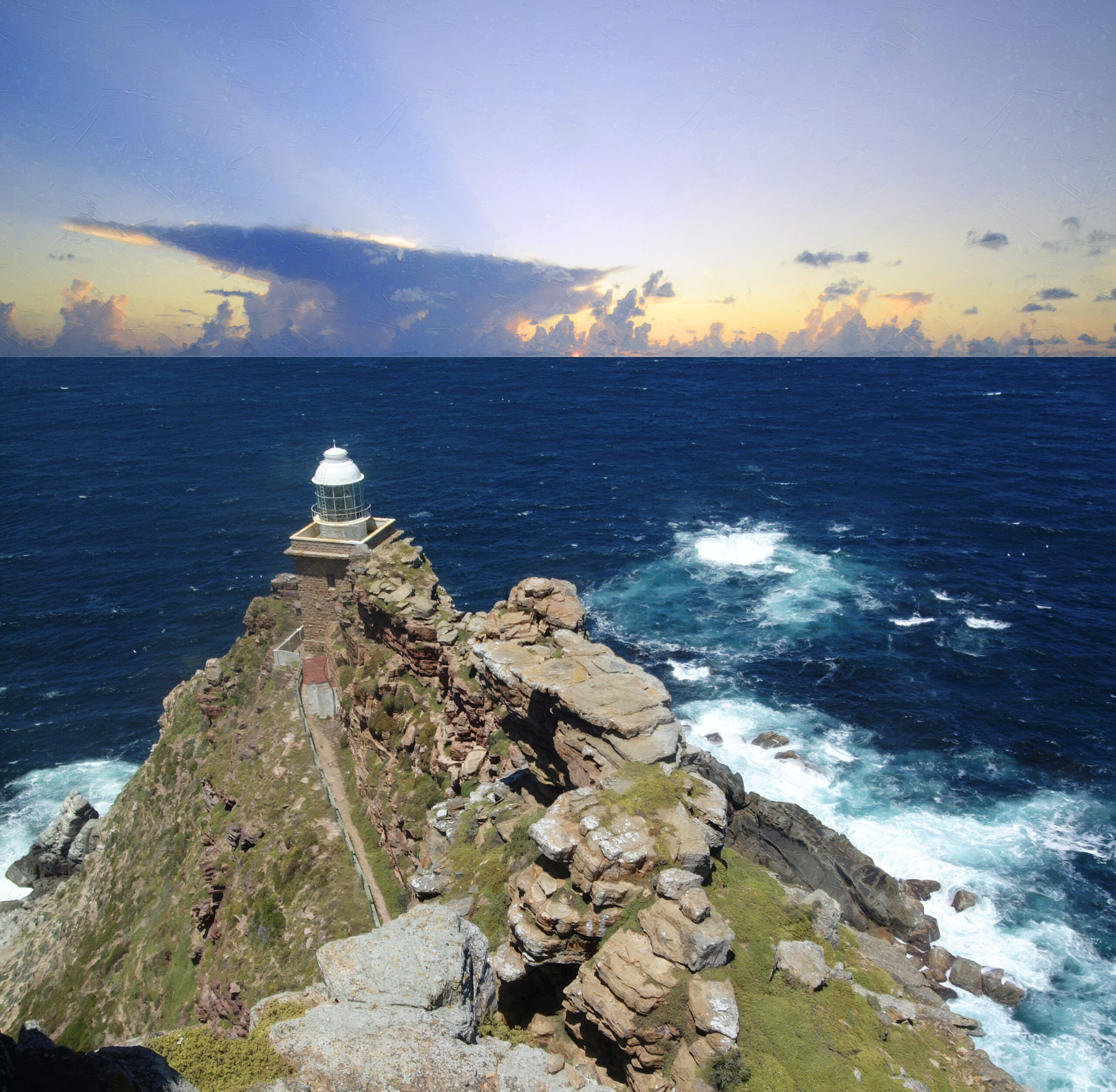
In a world where many artists replicate familiar scenes with predictable strokes, The Cape of Good Hope, South Africa Lighthouse stands apart. This original painting on canvas is not merely a decorative object — it is a carefully considered visual odyssey that captures one of the most dramatic natural crossroads on Earth. Framed for the collector who seeks depth, history, and narrative in every brushstroke, this work reflects a lifetime cultivated through 55 years of artistic practice, refined technique, and a seasoned eye for beauty that resonates beyond the surface.
At the heart of this masterpiece lies its subject: the Cape of Good Hope, a promontory at the western edge of the Cape Peninsula in South Africa’s Western Cape. Known to mariners for centuries, this rugged stretch of coastline marks where the warm Indian Ocean meets the cooler waters of the Atlantic — a dramatic confluence of currents and energies, where seafarers once battled wind and wave to forge new routes around the globe. What was named Cabo das Tormentas, or “Cape of Storms,” by early explorers like Bartolomeu Dias, became known as the Cape of Good Hope — a symbol of optimism and the promise of discovery.
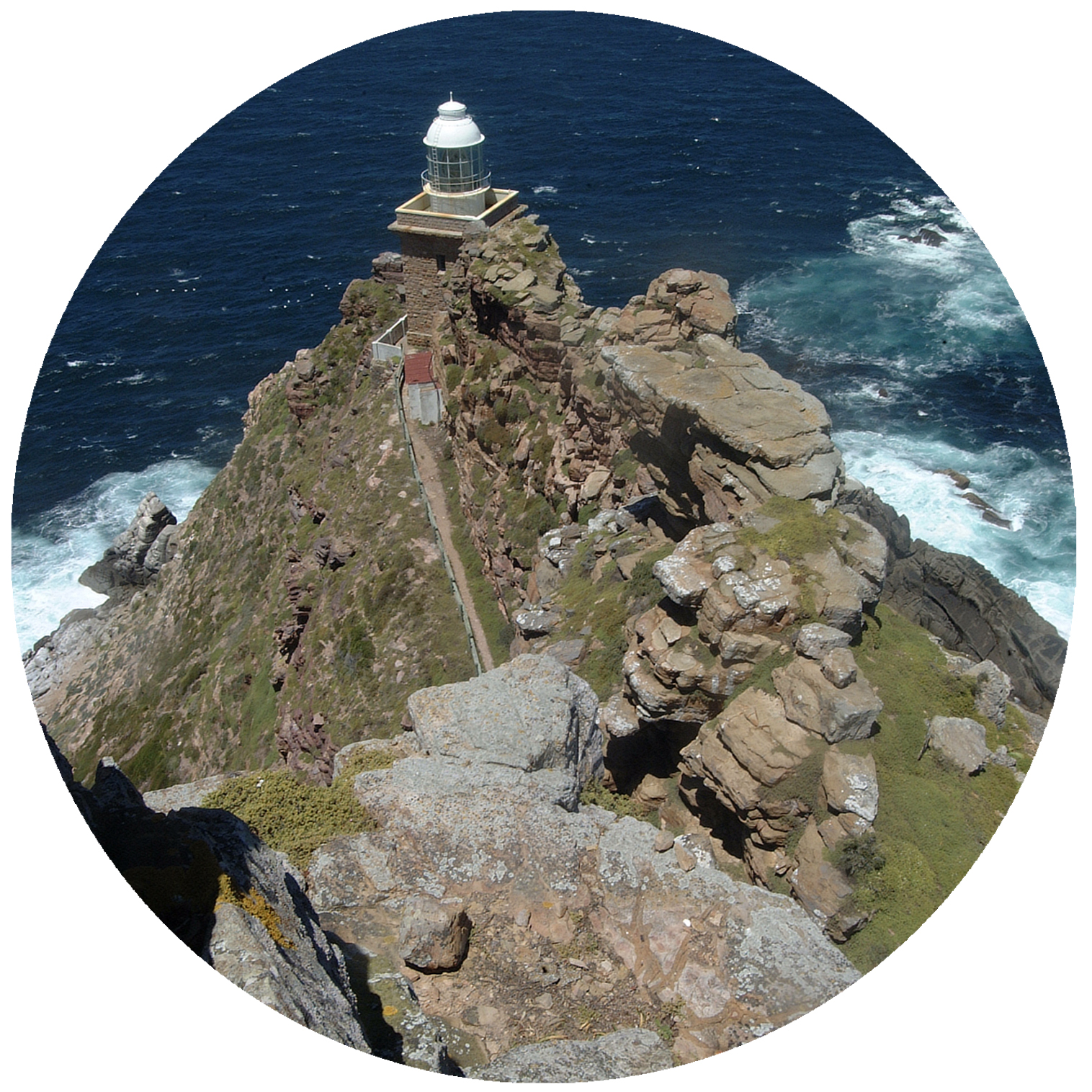
This storied landscape is more than topography; it is a stage on which both history and myth unfold. The lighthouse at Cape Point — the beacon that anchors this painting — occupies a dramatic perch within the Cape of Good Hope Nature Reserve, itself a protected section of Table Mountain National Park. Though the original beacon was constructed in the mid‑19th century atop what became known as Da Gama Peak, its lofty elevation proved ineffective in fog, prompting the establishment of a second, lower light in 1914‑19 that remains one of the most powerful on South Africa’s coast.
For the viewer, this is more than a geographic location; it is a convergence of human aspiration and elemental force. Your painting does not merely document what a lighthouse looks like — it conveys what it feels like to stand where continents, currents, and dreams collide. The viewer is invited into a moment suspended between sky and sea, where the luminous tower radiates assurance amid nature’s vast uncertainty.
Materiality, Color, and Surface: Texture as Experience
Upon first glance, the tactile richness of this work is unmistakable. The canvas, prepared with meticulous layering, reveals a nuanced interplay of texture and light. The painting process begins with a refined foundation designed to support complex rendering — a canvas warmed with powdered underlayers that create depth invisible until illuminated by ambient light.
Your approach to color is both soulful and intentional. The palette balances the cool celadon and slate of the ocean’s edge with the warm ochres of sun‑worn rock. These hues transition to the quiet luminosity of cloud and sky, rendered with a sensitivity that suggests atmospheric movement rather than static depiction. Bristles and palette knives work in concert, leaving visible evidence of artistic deliberation: ridges of paint that catch light differently throughout the day, micro‑variations that reward prolonged viewing.
Then comes the overpainting — a pivotal stage. With water‑based acrylics, layers are applied and reworked in controlled sequences that evoke both immediacy and reverence. Transparent glazes of thinned pigment breathe life into shadows, while thicker, expressive strokes define the lighthouse’s vertical presence. This layered process creates a surface that seems alive — its texture shifting with the viewer’s perspective, revealing new emotional layers with each shift in light.
Finally, a protective glazing seals the work, preserving its tonal richness and amplifying both the vibrancy of the hues and the subtlety of the shadows. This glazing is not merely a protective layer; it acts as a lens, deepening the connection between painting and observer.
A Lifetime of Craft: From Education to Mastery
This painting is grounded in a lifetime dedicated to artistic excellence. Your formal education in art fundamentals laid the foundation, but it is 55 years of continual refinement that elevates this work to its current stature. Over decades you have learned that mastery is not about replicating reality, but about synthesizing technique, observation, and emotional resonance into a unified visual language.
Your education — both academic and experiential — informs every decision in this piece. Long before the brush touches the canvas, the subject is contemplated. What does this place mean to the human spirit? What stories are encoded in its winds, its tides, its shifting light? These questions drive your sketching, your selection of color, and your application of texture. They are what distinguish works that merely depict from those that communicate.
For collectors, this matters. In a market saturated with reproductions and predictable views, owning a painting created with this level of intentionality is to hold a narrative, not a snapshot.
Local Inspiration vs. Global Repetition
Another dimension gives this work its singular voice: the choice to engage with local artistic influence rather than defaulting to generic imagery. By integrating the perspective of a South African locale — not as a postcard, but as a living, breathing environment — this painting avoids the familiar tropes seen in mass‑produced coastal art. It is a testament to the value of place‑based artistic dialogue, where the artist, whether onsite or deeply studied, sees beyond stereotype to the essence of location.
This collaboration with the visual tradition of a specific place — its light, its rock, its sea — produces something the collector will recognize instantly as unique. It is a conscious rejection of the visual “everywhere” and an embrace of the deeply particular.
Conclusion — A Beacon for the Collector
The Cape of Good Hope, South Africa Lighthouse is much more than an original painting on canvas. It is a culmination of history, geography, and artistic mastery — a piece that invites viewers to experience a place as much as see it. With its textured surfaces, harmonious palette, and evocative composition, it speaks to collectors who treasure narrative depth and crafted authenticity.
To bring this work into a private collection is to welcome a visual experience that rewards curiosity, reflection, and emotional engagement — an artwork that continues to reveal itself over time.
cape of good hope lighthouse painting, original canvas lighthouse art, luxury art collector wall art, Michael John Valentine fine art, South Africa coastal art, historic lighthouse art, overpainted acrylic canvas, textured landscape painting, collector quality wall decor
The Exhibition Canvas comes in 3 sizes and goes through several steps that include overpainting with acrylics, signing with acrylics on the front and a final glazing to protect the canvas before being rolled in a sealed tube then a box ( shipping is free in the USA )
The Matted Prints come in 3 sizes and are shipped in a box. ( shipping and handling is free in the US)
The Glossy Poster Print measures 16 x 24 and arrives in a sealed tube that is placed in a box. ( shipping is free in the US )