Abstract art enables the artist to perceive beyond the tangible, to extract the infinite out of the finite.” — Arshile Gorky
The Atlas of the Hidden Sea
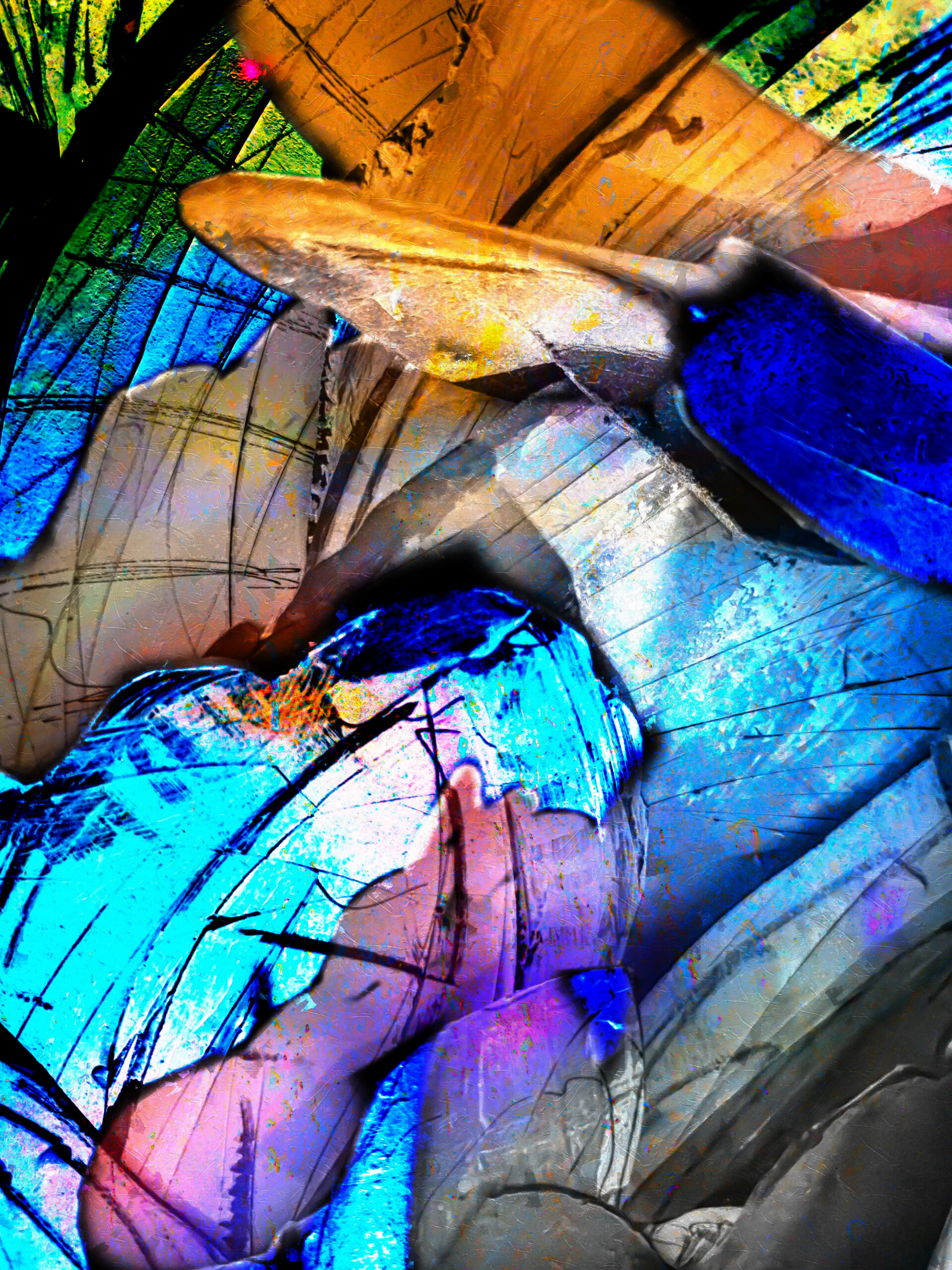
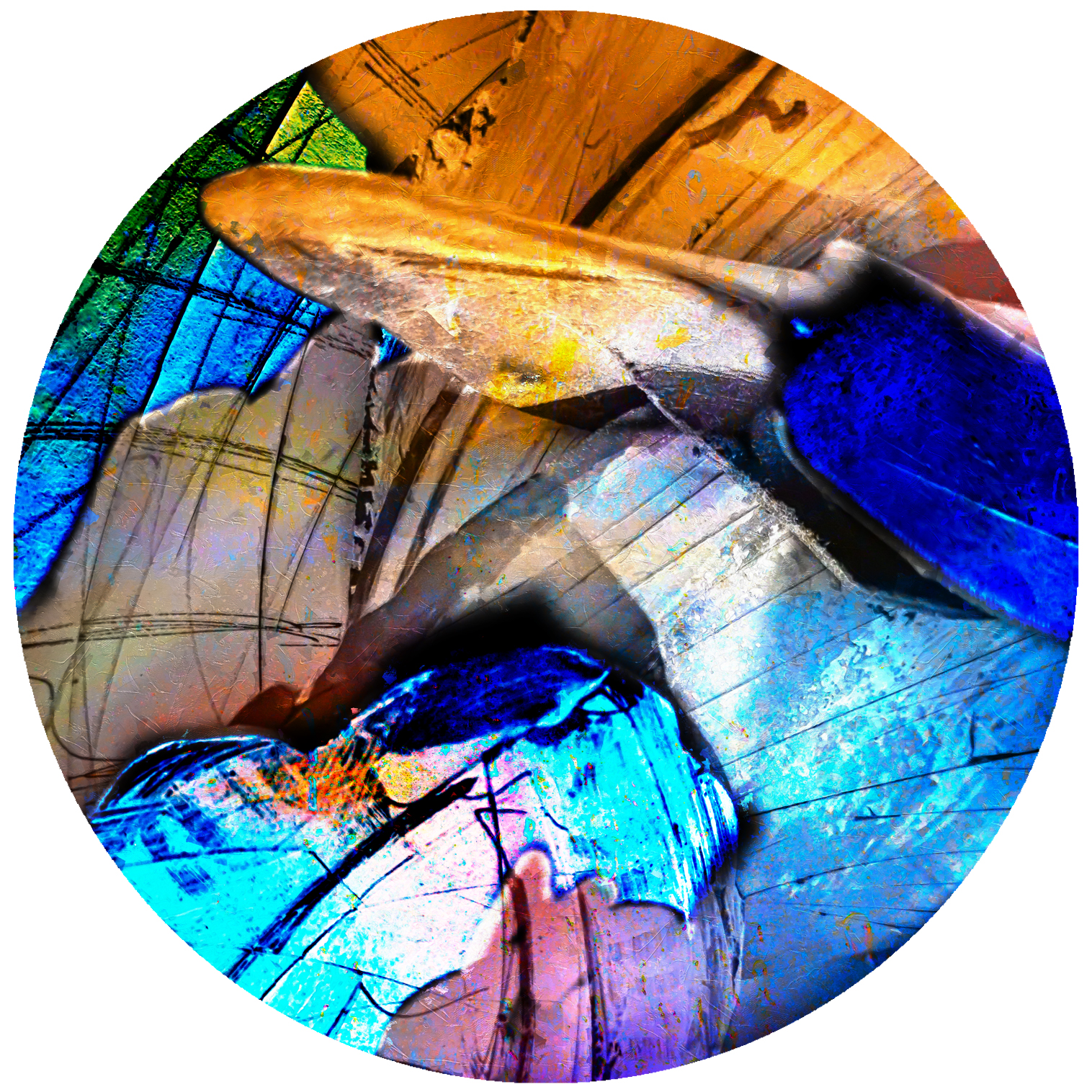
Within the circular boundary of this work, The Atlas of the Hidden Sea, the viewer is invited into a realm where geography dissolves into intuition and the language of maps becomes the language of emotion. The piece unfolds like a mysterious chart drawn not by navigators of land, but by explorers of memory and sensation. Here, the surface is alive with currents—color, texture, and movement converging into a world that feels simultaneously ancient and newly discovered.
The circular form itself is significant. Unlike a rectangular canvas that suggests a window or a framed perspective, the circle evokes wholeness. It suggests a planet, a compass, a porthole into another dimension. The shape immediately implies navigation, as if the viewer is gazing down upon an undiscovered world whose oceans and continents exist somewhere between imagination and reality. In The Atlas of the Hidden Sea, the circle becomes a symbolic globe—yet instead of familiar coastlines and continents, we encounter fractured currents of color and abstract terrains waiting to be interpreted.
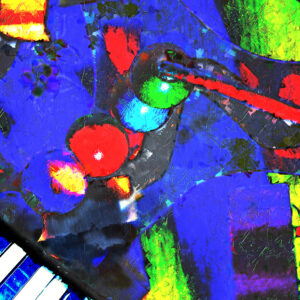
Dominating the composition are sweeping tones of deep cobalt, electric azure, molten gold, and sunlit amber. These colors move through the work like opposing elements in a natural drama. The blues evoke the depth and mystery of ocean waters—cool, vast, and unknowable. The golds and warm tones suggest light breaking across the horizon or the shimmer of sunlight dancing upon waves. Their meeting point creates tension and harmony at once, as if two natural forces are continuously negotiating their boundaries.
At the heart of the composition lies an ambiguous form—organic yet sculptural, almost reminiscent of a marine creature gliding through currents. It suggests movement, life, and transformation. This shape does not declare itself explicitly; instead, it hovers between recognition and abstraction. It could be a fish, a current, a drifting fragment of land, or the shadow of something beneath the water’s surface. This ambiguity is central to the piece’s power. Like the depths of the sea itself, the artwork reveals only fragments, inviting the viewer to complete the story through imagination.
Beneath the flowing forms, subtle lines and scratches weave across the surface like cartographic markings. They recall the delicate tracings found on ancient maritime charts—routes plotted by early explorers who ventured into unknown waters guided only by stars and instinct. These linear gestures suggest the idea of mapping, but they are intentionally fragmented and incomplete. They hint that this atlas is not a finished record of territory but an evolving document of discovery.
In this way, the artwork becomes both map and ocean simultaneously. The viewer stands in the position of the navigator, searching the surface for orientation while recognizing that the true terrain lies hidden beneath.
Texture plays a profound role in this experience. The surface feels weathered, layered, and timeworn, as though the image has emerged from the slow processes of erosion, tide, and geological pressure. Certain areas appear almost crystalline or mineral-like, while others resemble worn wood or sedimentary stone. These tactile qualities reinforce the sensation that this world has existed long before we encountered it—its history embedded in every layer.
Yet despite this ancient feeling, there is also a remarkable vibrancy to the work. Electric blues and luminous golds pulse with contemporary intensity, preventing the piece from feeling nostalgic or static. Instead, the composition feels alive, shifting, and kinetic. It suggests tides in motion, currents colliding, and light refracting across water.
This interplay between timelessness and energy is where The Atlas of the Hidden Sea finds its emotional resonance. The artwork does not merely depict an environment; it embodies the experience of exploration itself. It reflects the human impulse to search for meaning in unknown places—whether across oceans, across landscapes, or within the inner landscapes of our own imagination.
Collectors and viewers alike may find themselves drawn to different aspects of the composition. Some may see a cosmic perspective, as if the piece represents a distant planet viewed from orbit—its oceans swirling with alien light. Others may experience the work more intimately, as though peering through water into a hidden ecosystem alive with unseen movement. This openness of interpretation is one of abstraction’s greatest gifts. Rather than delivering a fixed narrative, it offers a field of possibilities.
The title The Atlas of the Hidden Sea reinforces this sense of discovery. An atlas traditionally represents knowledge—an organized collection of maps that allows us to understand the world. Yet here, the atlas is incomplete. It charts waters that remain concealed, territories not yet fully understood. It acknowledges that beneath the surfaces we believe we know, there are still vast depths waiting to be explored.
In this sense, the artwork becomes a meditation on mystery itself. It reminds us that the most compelling landscapes—both external and internal—are those that resist complete definition.
Standing before this piece, one does not simply observe a composition of color and form. Instead, one participates in a quiet act of navigation. The eye travels across luminous currents, traces lines of movement, and searches for orientation among shifting shapes. Every viewer charts their own course through the work, discovering new passages and interpretations along the way.
Like the hidden seas it evokes, the painting invites endless return. Each viewing reveals another glimmer of light beneath the surface, another subtle current moving through the depths.
And so The Atlas of the Hidden Sea becomes more than an abstract artwork—it becomes a world. A place where color becomes water, texture becomes terrain, and the act of looking becomes a voyage into the unknown.
The Exhibition Canvas comes in 3 sizes and goes through several steps that include overpainting with acrylics, signing with acrylics on the front and a final glazing to protect the canvas before being rolled in a sealed tube then a box ( shipping is free in the USA )
The Matted Prints come in 3 sizes and are shipped in a box. ( shipping and handling is free in the US)
The Glossy Poster Print measures 16 x 24 and arrives in a sealed tube that is placed in a box. ( shipping is free in the US )
The 4 Inch Round Peel And Stick Decal is perfect for many applications beyond cars and comes in a sealed envelope ( shipped for free )