Chromatic Insurrection V: Concrete Frequencies- Available in studio/gallery as a 28 x 10.5 overpainted signed and glazed exhibition quality canvas- shipped in a sealed tube
“The city is not a concrete jungle; it is a human zoo.” — Desmond Morris
Charlotte Neon + Abstract Transformation
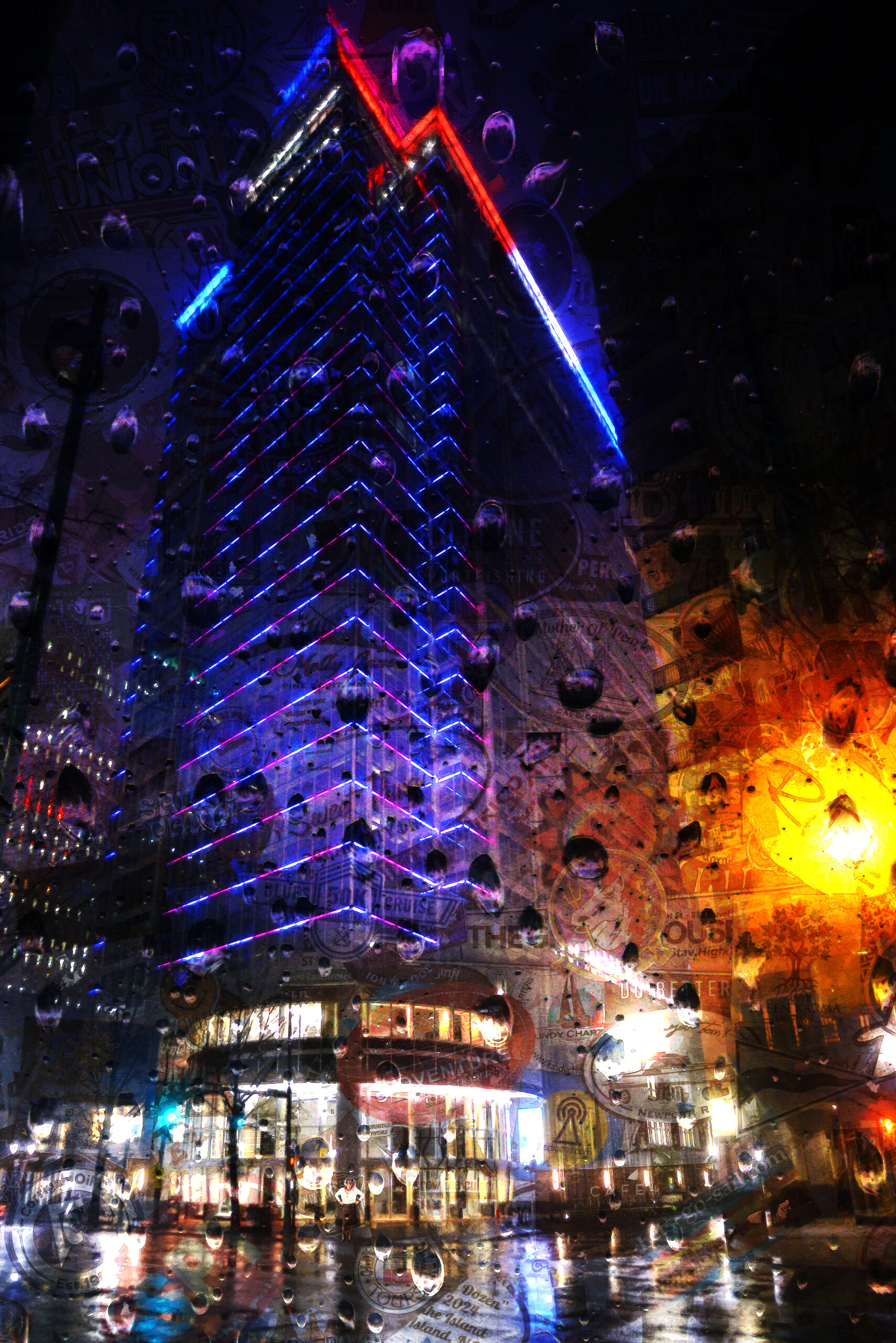
During early morning walks through Charlotte, I photographed rain-soaked streets long before the city awakened — neon reflections dissolving into pavement, turning the urban landscape into shifting fields of light and atmosphere.
This experience merged with discoveries in Key West, where graffiti-covered walls layered with decals and markings revealed a raw, evolving visual language. I combined these two worlds into a single abstract system — transforming city light and street expression into compositional structures designed for overpainting on canvas.
The result is not documentation, but reinterpretation: a controlled collision of reflection, graffiti, and abstraction.
Chromatic Insurrection– Queen City After Midnight l Queen City Midnight Theology l Queen City Neon Rain l Blue Neon Sovereignty l Concrete Frequencies
Cities are never silent.
Even when still, they hum — in the wiring beneath sidewalks, in the vibration of glass against steel frames, in the distant pulse of traffic that never fully stops breathing. What we call “quiet” in an urban environment is simply a lower frequency of chaos.
Chromatic Insurrection V: Concrete Frequencies exists inside that hidden signal.
This work continues the Chromatic Insurrection series as it moves deeper into the structural language of the modern city — not the surface skyline, not the neon reflection, but the invisible rhythm underneath it all. It is an exploration of architecture as vibration, of concrete as resonance, and of urban space as a living system of layered frequencies.
Where earlier works leaned into neon atmospheres and chromatic weather, this piece shifts inward — toward density, structure, and the sonic logic of built environments.
Concrete as Sound, Structure as Signal
In Concrete Frequencies, the city is not viewed — it is heard visually.
The composition is built like an urban waveform: stacked tonal shifts, fractured vertical pressure lines, and compressed horizontal currents that feel more engineered than painted. The surface behaves as if it is transmitting something just below perceptible range.
Grays are never neutral. They are loaded. They carry weight, memory, and infrastructure.
Deep charcoal passages suggest sublevels of architecture — parking structures, tunnels, utility corridors, unfinished foundations. Mid-tone abrasions act like interference patterns, where visual clarity breaks into static. Brighter interruptions appear like signal spikes — moments where the system briefly reveals itself before collapsing back into structure.
The result is not landscape.
It is frequency.
The Philosophy of Urban Density
Modern cities are defined not by emptiness, but by compression.
Space is stacked vertically. Movement is layered horizontally. Sound is absorbed, reflected, and redirected through engineered materials designed to contain human activity within tightly controlled zones.
Concrete Frequencies translates that condition into visual language.
The painting does not romanticize the city. It studies its density.
Every layer of pigment behaves like a built surface: poured, set, fractured, and re-covered. Earlier marks remain partially visible beneath newer structural decisions, echoing the way cities preserve history only through what they fail to fully erase.
Rebar beneath concrete. Brick beneath glass. Memory beneath development.
Chromatic Restraint as Power
Unlike earlier works in the Chromatic Insurrection series, this piece operates with controlled chromatic restraint.
Color is not absent — it is compressed.
When it appears, it feels intentional and disruptive. Small intrusions of muted steel blues, oxidized greens, or faint industrial rust tones break through the dominant grayscale field like residual energy leaking through infrastructure.
These moments are not decorative.
They are structural anomalies.
They function like acoustic feedback in a sealed system — brief exposures of emotional frequency within an otherwise engineered environment.
The restraint itself becomes part of the intensity.
Overpainting and Urban Erasure
At the core of the process is overpainting — a deliberate act of layering, obscuring, and reintroducing surface history.
In Concrete Frequencies, overpainting mimics the lifecycle of urban development:
- demolition and reconstruction
- resurfacing and repurposing
- abandonment and reuse
- preservation through concealment
Nothing is fully removed. It is absorbed.
Earlier compositional states remain embedded beneath the final surface like ghost infrastructure — unseen, but structurally present.
This creates a painting that behaves like a city map with multiple time signatures existing simultaneously.
Past and present are not separated.
They are stacked.
Visual Acoustics and Perceptual Shift
The defining characteristic of this work is its perceptual instability.
From a distance, the composition reads as architectural order — controlled grids, structural weight, and spatial discipline. Up close, the surface dissolves into texture, interference, and layered abrasion.
This shift is intentional.
It mirrors the way cities behave when experienced at different scales:
- from afar: skyline logic, symmetry, identity
- within: noise, fragmentation, human density
Concrete Frequencies exists between those two states — constantly oscillating between macro-structure and micro-disorder.
The viewer does not simply observe the work.
They move through it visually.
Material Language of the Built World
The painting’s surface language draws directly from the material vocabulary of urban environments:
- poured concrete textures
- oxidized metal references
- industrial wear patterns
- compression marks and abrasion fields
- architectural layering systems
These elements are not literal depictions. They are translated behaviors.
The canvas becomes a simulated construction site of perception — a place where material logic is reconstructed through paint, pressure, and layering decisions.
The result is a surface that feels engineered rather than illustrated.
The Three Studio System
As with the broader Chromatic Insurrection series, Concrete Frequencies is developed through a three-stage studio process:
- Foundational Studio Layering — establishes structural rhythm and compositional grid logic
- Interference Studio Work — introduces disruption, erosion, and layered conflict
- Live Documentation Studio — captures the evolving work through real-time recording and audience-facing process material
This system reinforces the idea that the artwork is not a single moment of creation, but a sequence of decisions across time.
The final piece is the accumulation of those temporal shifts.
Certificate of Authenticity and Collector Context
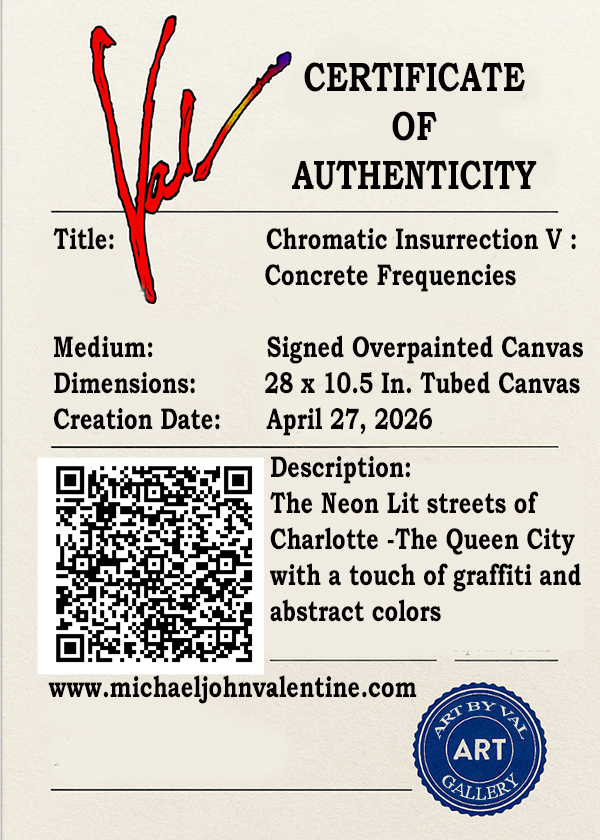
Each work in the series is issued with a Certificate of Authenticity (COA), reinforcing its position as a singular physical artifact within an evolving body of work.
In Concrete Frequencies, authenticity is especially critical — because the work is built on layered erosion and concealed history. The COA validates not just the final composition, but the specific material journey embedded within it.
For collectors, this transforms the work into more than a visual object.
It becomes a documented system of creation — a controlled record of transformation, density, and revision.
Education, Method, and Structural Discipline
The foundation of this piece is grounded in formal study of composition, abstraction, and material behavior, but its execution is intentionally hybridized.
Technical understanding informs the structure:
- spatial balance
- tonal hierarchy
- compositional tension
- layered depth construction
But instinct governs disruption.
The painting evolves through repeated acts of construction and interruption, where structure is constantly tested against instability.
This tension between discipline and collapse defines the final surface.
Final Reflection
Chromatic Insurrection V: Concrete Frequencies is not a depiction of a city.
It is a translation of its internal system.
It captures the modern urban condition not through skyline imagery or neon reflection, but through something more fundamental — the invisible vibration of infrastructure itself.
It is the sound of density made visible.
The rhythm of concrete under pressure.
The frequency of a city that never stops building itself, even in silence.
In the end, the work does not show the city as it appears.
It reveals the city as it operates.
The Exhibition Canvas comes in 3 sizes and goes through several steps that include overpainting with acrylics, signing with acrylics on the front and a final glazing to protect the canvas before being rolled in a sealed tube then a box ( shipping is free in the USA )
The Matted Prints come in 3 sizes and are shipped in a box. ( shipping and handling is free in the US)
The Glossy Poster Print measures 16 x 24 and arrives in a sealed tube that is placed in a box. ( shipping is free in the US )
The 4 Inch Round Peel And Stick Decal is perfect for many applications beyond cars and comes in a sealed envelope ( shipped for free )