Chromatic Insurrection II: Queen City Midnight Theology
Charlotte Neon + Abstract Transformation
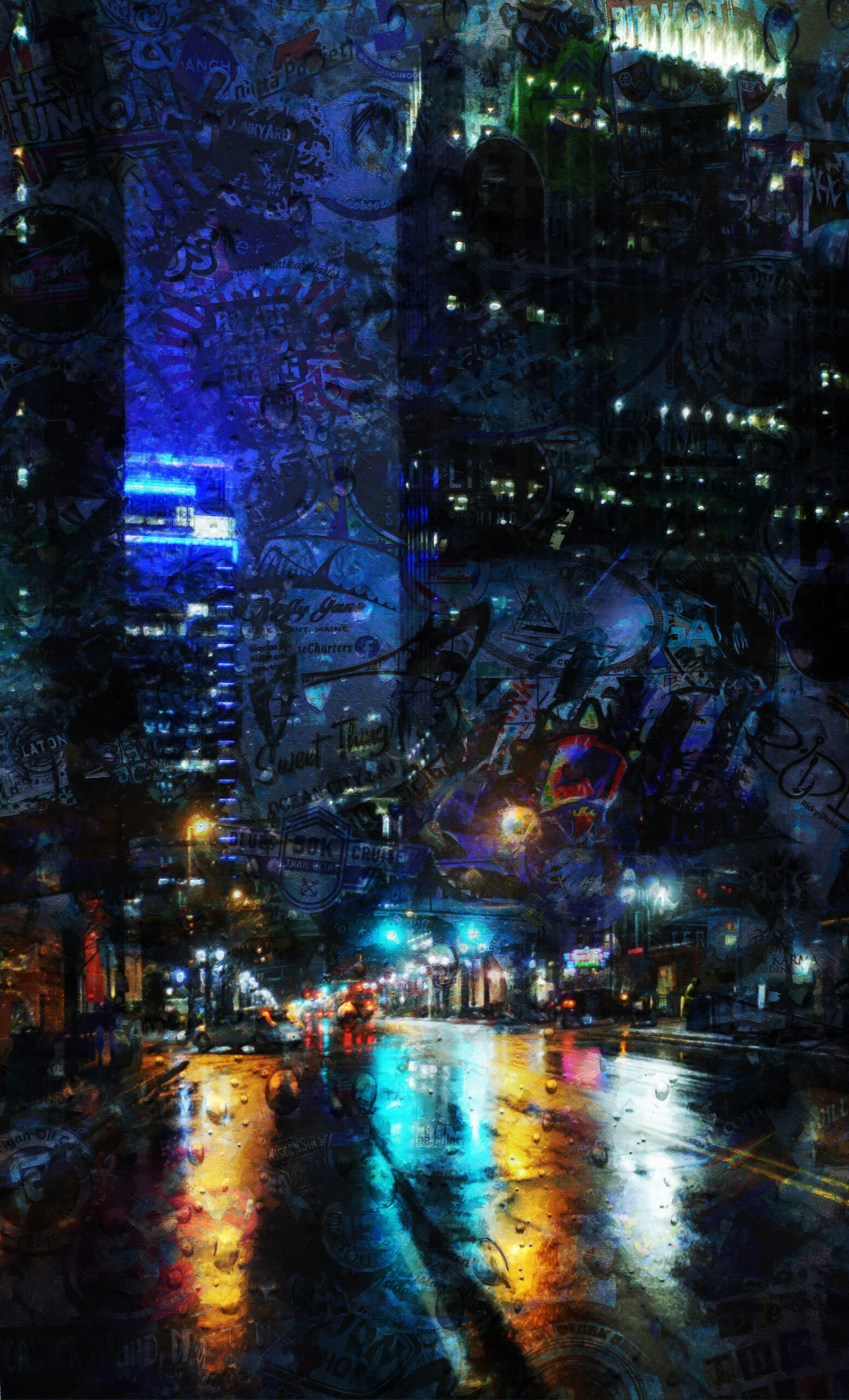
During early morning walks through Charlotte, I photographed rain-soaked streets long before the city awakened — neon reflections dissolving into pavement, turning the urban landscape into shifting fields of light and atmosphere.
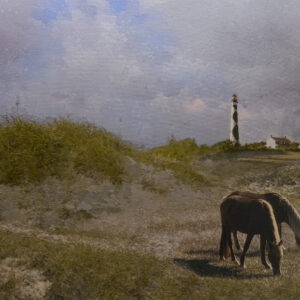
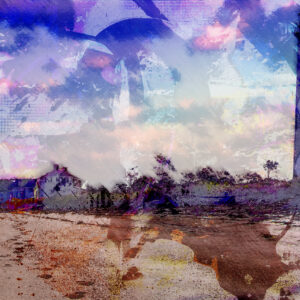
This experience merged with discoveries in Key West, where graffiti-covered walls layered with decals and markings revealed a raw, evolving visual language. I combined these two worlds into a single abstract system — transforming city light and street expression into compositional structures designed for overpainting on canvas.
The result is not documentation, but reinterpretation: a controlled collision of reflection, graffiti, and abstraction.
Chromatic Insurrection– Queen City After Midnight l Queen City Midnight Theology l Queen City Neon Rain l Blue Neon Sovereignty l Concrete Frequencies
“Queen City” — a name born from Charlotte’s origin as a tribute to Queen Charlotte of Mecklenburg-Strelitz — has never truly been just a title. It is an atmosphere. A voltage. A civic myth that still hums through glass towers, rail lines, and the forgotten brick corridors where the city learned how to become itself twice: once in daylight, and once again after midnight.
In contemporary culture, Charlotte is often summarized through a modern refrain — “Charlotte’s got a lot” — a tourism-era phrase that, while unofficial, has become shorthand for a city that refuses reduction. Yet beneath branding and skyline confidence lies something older, more spectral: a city of contrast, commerce and congregation, ambition and anonymity. It is within that tension that Chromatic Insurrection II: Queen City Midnight Theology takes form.
This work is not a depiction of Charlotte. It is an argument with it.
The Insurrection of Color and Silence
Chromatic Insurrection II continues a visual philosophy rooted in controlled disruption — where color is not applied but provoked. The surface becomes a field of conflict: layered pigments colliding like competing belief systems, each asserting dominance before dissolving into the next.
This is not abstraction for decoration. It is abstraction as testimony.
The “midnight theology” within the title speaks to the hour when identity loosens its public contract. Midnight is when the Queen City sheds its civic posture and reveals its unedited architecture — neon reflections on wet asphalt, the hum of distant traffic, and the private solitude of buildings that never fully sleep.
Here, theology is not religious doctrine. It is interpretive survival. A way of reading the city when its official narrative stops speaking.
Composition as City Memory
The composition is constructed as if it remembers Charlotte rather than represents it. Vertical gestures echo the skyline’s insistence; fractured overlays suggest redevelopment zones and erased histories. Metallic undertones reference finance districts and glass façades, while saturated chroma interrupts with the urgency of lived experience — street-level, unfiltered, human.
Each layer functions as an overpainting event: not correction, but confrontation. Earlier marks are never fully erased. Instead, they are absorbed, partially visible, like archaeological strata of emotion and decision.
The work becomes a palimpsest of the Queen City itself — constantly rewritten, never fully resolved.
Overpainting as Philosophy
Overpainting here is not technique alone; it is doctrine.
Each revision acknowledges the impossibility of finality. In Chromatic Insurrection II, no surface is ever finished — only negotiated. What appears beneath is not a mistake but a predecessor. What sits on top is not resolution but interruption.
This methodology mirrors the lived condition of modern Charlotte: historic districts adjacent to rapid development, legacy institutions coexisting with speculative futures, and communities continuously redefined by movement and migration.
The painting behaves the same way. It refuses permanence in favor of presence.
The Role of COA and Authenticity
A Certificate of Authenticity (COA) accompanies the work not as administrative closure, but as institutional witness. It acknowledges that what exists on the surface is not reproducible in intention, only in appearance.
In an era of replication, the COA becomes a counterweight — a quiet assertion that the gestures embedded within the work belong to a specific moment of creation that cannot be duplicated, only referenced.
It is less a document of ownership and more a record of origin.
Education, Method, and Discipline
The foundation of this series is informed by formal education in visual composition, material layering, and contemporary abstraction, but it resists academic containment. The studio process is intentionally hybridized — combining structured study with instinctive response.
Color theory is treated as structural engineering. Composition as narrative pressure. Texture as psychological residue.
The work is developed through iterative decision-making: subtractive abrasion, additive saturation, and controlled interruption. Each pass over the canvas is a negotiation between intention and resistance.
Three Live Studios: The Work as Event
Chromatic Insurrection II is not confined to a single studio environment. It emerges from three interconnected live studio contexts:
- The Primary Studio — where foundational compositions are established, grounded in structure and initial chromatic mapping.
- The Secondary Live Space — where overpainting, disruption, and compositional conflict are introduced in real time.
- The Public-Facing Studio Layer — where documentation, audience interaction, and digital transmission shape perception of the work as it evolves.
This tri-studio system transforms painting into event-based practice. The work is no longer static; it is witnessed in stages, each stage carrying its own validity.
The viewer is not only observing the final surface, but the conditions under which meaning is continuously rewritten.
Midnight Theology: The City as Question
At its conceptual core, Queen City Midnight Theology is not about Charlotte as subject, but Charlotte as inquiry.
What does a city believe about itself when no one is performing for it?
What remains when identity is stripped of daylight narrative?
The answer is not fixed. It is chromatic instability — a shifting field where meaning is never fully settled, only temporarily visible.
The midnight condition reveals the truth of the Queen City: it is not singular. It is plural, layered, and perpetually under revision.
Chromatic Insurrection II as Collection Work
As a collector-level piece, Chromatic Insurrection II operates within the rare intersection of fine art, urban commentary, and material experimentation. It is designed not merely for display, but for sustained viewing — work that changes under different lighting conditions, emotional states, and spatial contexts.
It is not passive art. It is participatory perception.
Collectors engaging with this work are not acquiring an image. They are acquiring a system of tensions: between structure and collapse, history and revision, city and self.
Closing Statement
Chromatic Insurrection II: Queen City Midnight Theology stands as both artifact and argument — a layered confrontation with place, memory, and transformation.
In the end, the work does not attempt to define Charlotte. It behaves more honestly than that. It listens to the city’s contradictions and returns them as color, fracture, and accumulated light.
Not a portrait.
A pressure field.
A midnight record of the Queen City as it continues to rewrite itself in real time.
The Exhibition Canvas comes in 3 sizes and goes through several steps that include overpainting with acrylics, signing with acrylics on the front and a final glazing to protect the canvas before being rolled in a sealed tube then a box ( shipping is free in the USA )
The Matted Prints come in 3 sizes and are shipped in a box. ( shipping and handling is free in the US)
The Glossy Poster Print measures 16 x 24 and arrives in a sealed tube that is placed in a box. ( shipping is free in the US )
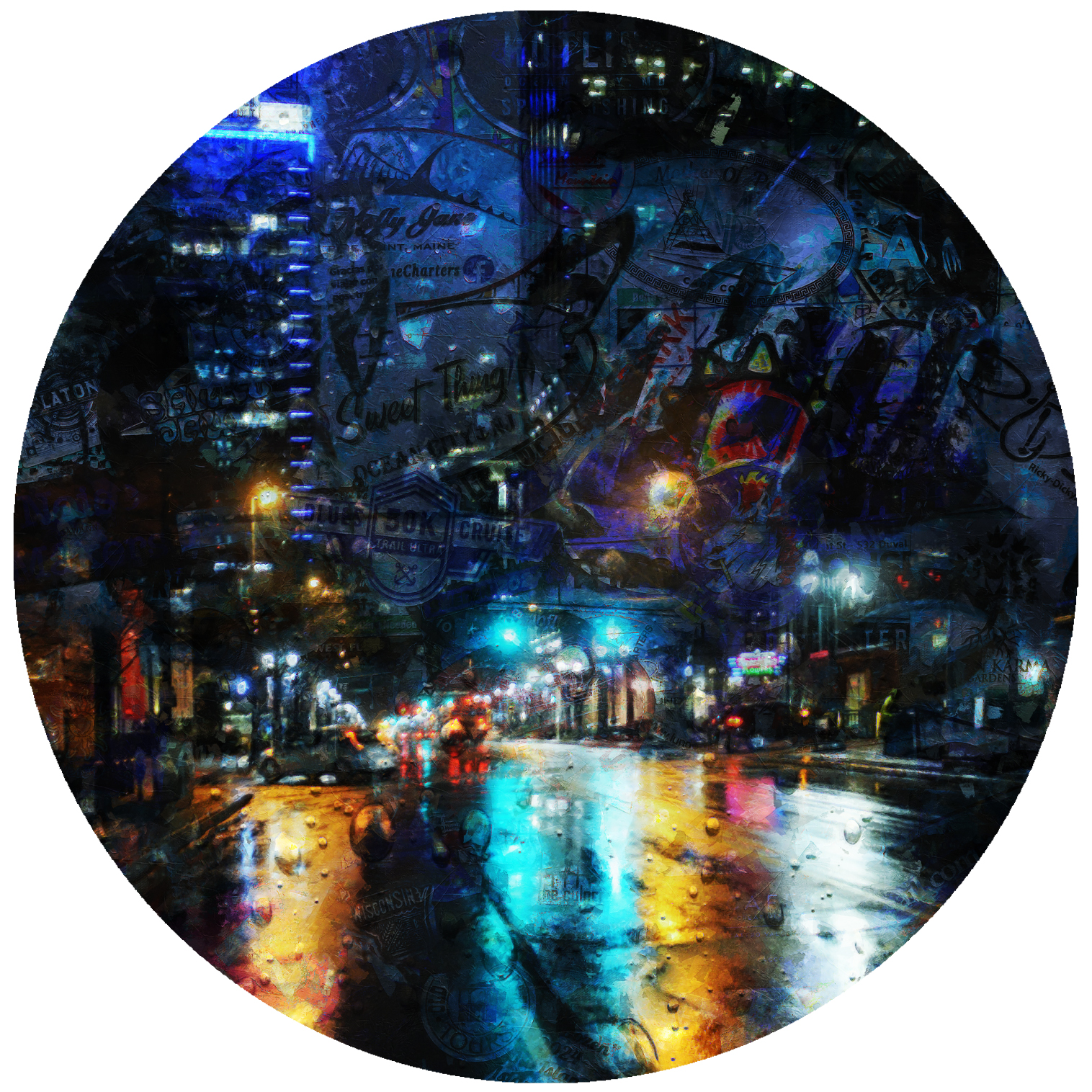
The 4 Inch Round Peel And Stick Decal is perfect for many applications beyond cars and comes in a sealed envelope ( shipped for free )