Havana Graffiti
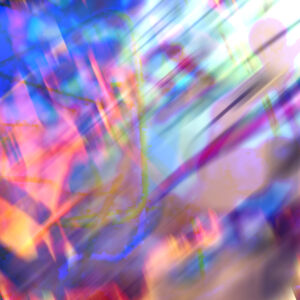
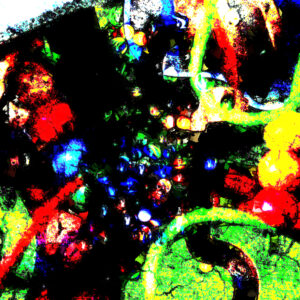
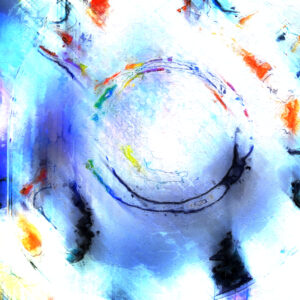
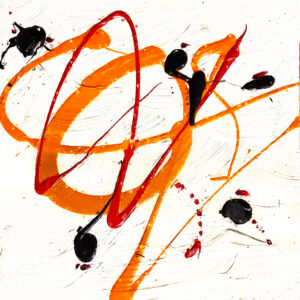
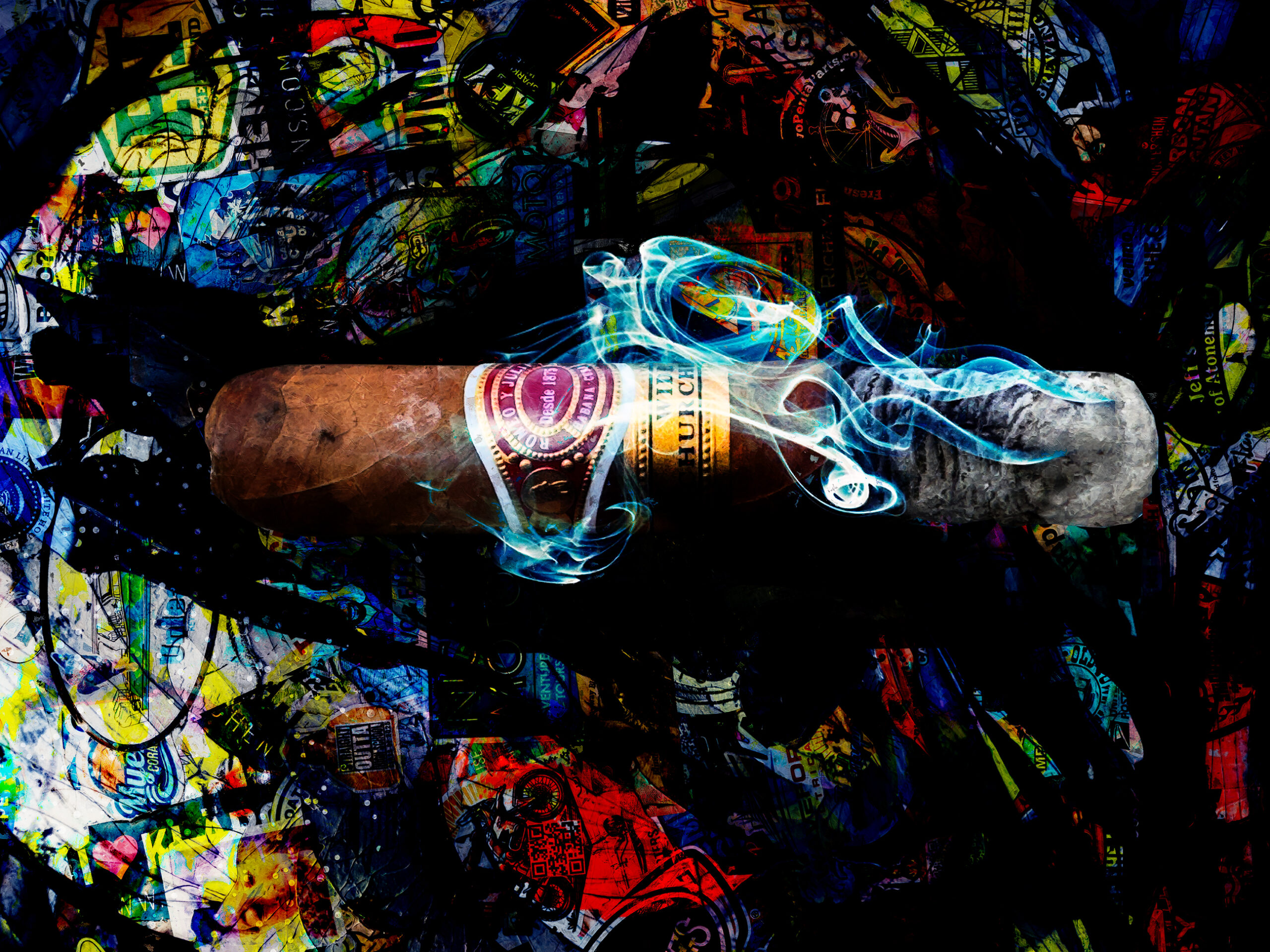
There is something unmistakably alive about graffiti. It does not ask permission. It appears on walls, doors, buildings, bridges, and forgotten corners of cities, transforming ordinary surfaces into declarations of identity. Graffiti is spontaneous, expressive, and unapologetic. It carries the energy of the street—the layered colors, unexpected marks, handwritten gestures, fragments of words, and visual collisions that accumulate over time. Havana Graffiti brings that spirit into the world of fine art, combining the iconic character of the Cuban cigar with the raw visual language of contemporary graffiti.
At the center of the composition is the cigar: a symbol that carries its own history, ritual, and unmistakable visual presence. But here, the cigar is not presented as a traditional still life sitting quietly against a conventional background. Instead, it becomes part of an energetic visual environment. Color, pattern, paint, texture, and graphic elements surround it, creating the sensation that the subject has been pulled directly from the streets and reimagined through the eyes of an artist.
That contrast is what gives Havana Graffiti its personality.
The Cuban cigar has long been associated with craftsmanship, patience, tradition, and the pleasure of slowing down. Graffiti represents almost the opposite impulse—immediacy, movement, disruption, and self-expression. Bringing these two worlds together creates a visual conversation between old and new, tradition and rebellion, craftsmanship and spontaneity.
I wanted Havana Graffiti to feel as though a piece of Havana’s street energy had collided with the world of contemporary mixed-media art.
The surface becomes just as important as the subject. Rather than simply photographing an object and reproducing the photograph, I work with the image as a starting point. Layers of exhibition-quality canvas, acrylic paint, photographic imagery, graphic marks, glazing, and carefully placed details build a surface that rewards a closer look. From a distance, the work has an immediate graphic impact. Move closer, and the layers begin to reveal themselves.
That is an important part of my work.
I have always been interested in what happens when photography stops being photography alone. A photograph can capture a moment, but paint can reinterpret that moment. Texture can change its character. Color can change its emotional temperature. A mark made by hand can introduce something unexpected that could never exist in a purely photographic image.
With Havana Graffiti, those elements come together to create something that feels both familiar and completely transformed.
The graffiti influence also gives the work a sense of movement. There is no expectation that every element should remain perfectly controlled. Instead, the composition embraces the visual vocabulary of the street—bold gestures, layered surfaces, spontaneous marks, saturated areas of color, and the feeling that one image has been painted over another and then rediscovered.
In that sense, Havana Graffiti is about more than a cigar.
It is about attitude.
It is about the moment when an object associated with tradition becomes the centerpiece of something contemporary. It is about taking a subject that might normally be presented with elegance and restraint and giving it a completely different voice. The cigar becomes almost like a character in the artwork—confident, recognizable, and surrounded by the visual noise and energy of the city.
There is also something inherently nostalgic about Havana itself. The word evokes vintage automobiles, weathered architecture, tropical light, music drifting through open windows, and streets filled with layers of history. But rather than attempting to recreate Havana literally, I chose to interpret its spirit through color and graphic expression.
Havana Graffiti is my interpretation rather than a postcard.
That distinction matters.
I am not interested in simply documenting a place or an object. I am interested in transforming what I see into something that has its own identity. Photography provides the foundation, but the finished work becomes something else through the process of painting, layering, editing, and experimentation.
The result is a piece that can work equally well in a sophisticated office, a cigar room, a contemporary living space, a collection of photography-based art, or an environment where bold, unconventional artwork belongs. It has the visual strength to command attention from across a room while offering enough detail and texture to hold that attention when viewed up close.
For collectors who appreciate cigar culture, the imagery will have an immediate familiarity. For collectors drawn to contemporary mixed media and graffiti-inspired art, the visual treatment provides another point of entry. And for someone who simply responds to color, texture, and attitude, the work can stand completely on its own.
That is what I hope happens with Havana Graffiti.
I want the viewer to encounter the piece before they fully understand it.
See the color first.
Feel the energy.
Notice the cigar.
Then move closer.
The longer you look, the more the layers begin to tell their story.
After more than five decades of working with photography and visual art, I continue to be fascinated by the possibilities that emerge when traditional photographic techniques meet paint and experimentation. Havana Graffiti is part of that continuing exploration—a work that takes a recognizable subject and refuses to leave it in its expected form.
It is cigar culture filtered through the language of the street.
It is tradition interrupted by color.
It is Havana imagined as graffiti.
And ultimately, it is a celebration of the freedom that comes when an artist stops worrying about where one medium ends and another begins.
Havana Graffiti is not meant to sit quietly on the wall.
It is meant to make the wall come alive.