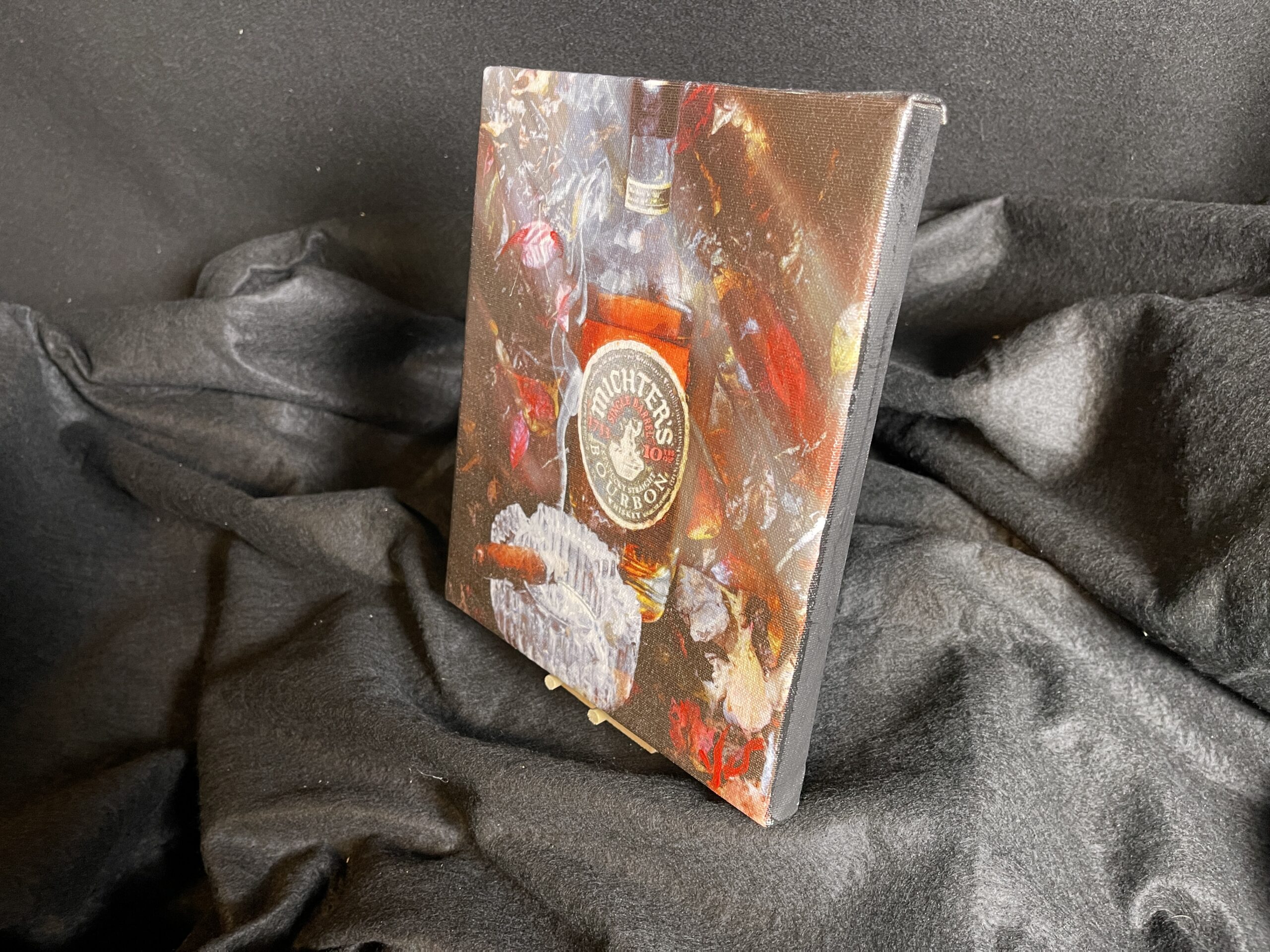
At the intersection of ritual, refinement, and craftsmanship lies an evocative work that transcends mere décor: the 8 × 10 Michter’s Bourbon and Cigar Painting on Canvas by celebrated American artist Michael John Valentine. Far more than a still life, this compact yet infinitely rich tableau embraces the heritage of two of life’s most storied indulgences—Michter’s bourbon and a premium cigar—rendered with a sensibility that elevates the quotidian into the timeless.
An Iconic Pairing Reimagined
In classic still‑life tradition, Valentine brings together objects that evoke warmth, contemplation, and the slow savoring of experience. The subject of the painting—Michter’s bourbon—is more than a label; it is a symbol of American distilling excellence. Michter’s, with its deep amber tones and lineage of small‑batch refinement, stands as a testament to patience and craft. On canvas, the spirit seems to glow from within, resonating with layers of nuance that suggest the oak barrels and long aging that define its character.
Beside it lies the cigar, its presence unassuming yet laden with suggestion. Through delicate brushwork and a visceral command of texture, Valentine captures the supple earth tones of the wrapper, the subtle pattern of seams and veins, and the silent promise of smoke curling into the air. Here, the cigar is not static; it feels as though it has just been set down—awaiting a leisurely return.
The Aesthetic of Quiet Luxury
At just 8 × 10 inches, the canvas may appear modest in scale, yet what it lacks in size it more than compensates for in presence. This is art that demands intimacy: a piece meant to be viewed up close, where light, shadow, and pigment converge in a dialogue with the viewer’s gaze. The warm palette—rich ambers, caramel browns, and deep umbers—recalls the ambiance of a gentleman’s study or a cognac‑stained lounge, inviting reflection and slow appreciation.
What distinguishes Valentine’s work is not merely faithful representation, but an ability to evoke mood. The luminous glow of the bourbon and the tactile realism of the cigar are achieved not through photographic exactitude, but through painterly empathy—an understanding of surface, depth, and the subtleties of light interacting with form. The result is a visual narrative that feels lived‑in, atmospheric, and deeply personal.
Craftsmanship Rooted in Artistic Mastery
This work sits within Valentine’s broader Cigar and Bourbon Art collection, a series driven by an enduring fascination with the rituals that define human pleasure and refinement. By placing these objects—so often associated with celebration, camaraderie, and contemplative stillness—at the center of his compositions, he recontextualizes them as objects of visual reverence.
Valentine’s career spans decades of education and professional practice, informed by a lifetime devoted to visual art. His command of technique—particularly in manipulating acrylics on canvas—imbues each piece with a physicality that resonates long after the first viewing. Every brushstroke, every gradation of color, contributes to a layered experience that rewards prolonged engagement.
The 8 × 10 Michter’s Bourbon and Cigar Painting is a gallery‑wrapped original and includes a handmade mini easel—an elegant presentation that both honors the work’s artistic integrity and invites personal display in a space of distinction. It comes signed, and, although modest in dimension, is unique in that it is the only one available in the studio. This rarity underscores its value as a one‑of‑a‑kind artwork, not merely a production run piece.
A Statement Piece for the Discerning Collector
Collectors of fine art know that power is not always proportional to scale. The allure of this painting lies in its ability to command attention in any setting—whether in a refined home bar, a private library, or a minimalist loft where objects are chosen for resonance rather than ornamentation. Its warmth and tactile realism create a point of visual focus that invites conversation and quiet contemplation.
Moreover, the subject matter itself—bourbon and cigar—speaks to a cultural lineage of tradition, social ritual, and the appreciation of painstakingly crafted goods. Those who choose this painting are not merely decorating a wall; they are asserting an affinity with a lifestyle that values thoughtfulness, heritage, and the unhurried pleasures of life.
Even more compelling is the personal connection that the collector forms with the piece. Unlike mass‑produced prints that flood the market, this original canvas embodies a singular artistic voice—one shaped by decades of dedicated practice and a unique interpretive lens. Possession of this work becomes not just an aesthetic acquisition, but an investment in a moment of artistic intention captured forever on canvas.
Materiality and Presentation
Valentine’s approach to materiality—favoring acrylic on gallery‑wrapped canvas—ensures durability as well as depth. Acrylics, with their vibrant saturation and quick drying time, allow for layered applications that build rich surfaces without compromising clarity or luminosity. The gallery wrap gives the piece a finished, museum‑ready quality, while the inclusion of a bespoke easel elevates it from wall art to a thoughtful objet d’art—ready to stand alone on any shelf, desk, or tabletop.
The certificate of authenticity affixed to the work connects the collector to the artist in a tangible way. It confirms provenance and underscores the painting’s legitimacy as a true original, strengthening the narrative of individuality that sets Valentine’s creations apart.
Conclusion: Timeless Essence in a Compact Frame
In 8 × 10 Michter’s Bourbon and Cigar Painting on Canvas, Michael John Valentine offers more than a still life—he offers an invitation. An invitation to slow down, to engage the senses, and to savor the enduring pleasures that defined moments throughout history: a fine spirit, a premium cigar, and the quiet joy of looking deeply at art that reflects life’s richness.
For collectors who appreciate both visual refinement and the storied rituals of bourbon and cigar culture, this work encapsulates a rare duality: intimate in scale, but grand in meaning. It is not merely decoration—it is a testament to the quiet power of aesthetic discipline, evocative storytelling, and craftsmanship that rewards contemplation long after the brush has touched the canvas.