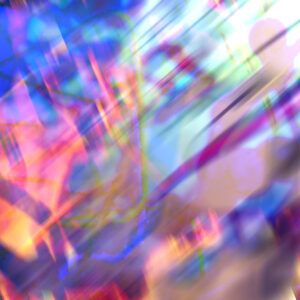
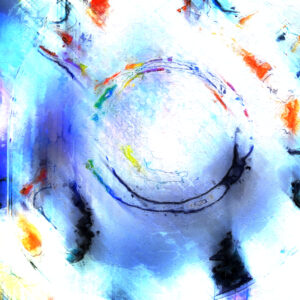
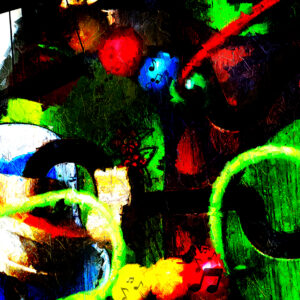
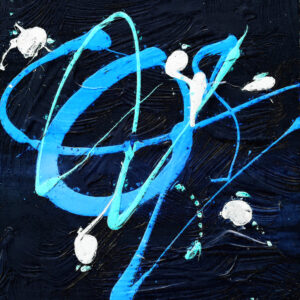
“Art is a way of thinking that allows the eyes to see, the brain to react and the hands to respond with brushes loaded with acrylic paints.”
— Michael John Valentine
In Moon Dance, Michael John Valentine delivers far more than a visual composition. This arresting abstract modern painting invites the viewer into an experiential interplay between perception and emotion, form and void, stillness and rhythm. At once celestial and tactile, Moon Dance embodies Valentine’s belief that art is a way of thinking: a transformative process that trains the senses and the mind to perceive the unseen, hear the unspoken, and feel the intangible. In this write-up, we explore how Moon Dance exemplifies an elevated artistic mindset—where vision, cognition, and gesture converge into sublime expression.
I. Vision Elevated: Seeing Beyond Sight
At first glance, Moon Dance appears as a composition of color and texture—a luminous dialogue of light against shadow, fluidity against form. Yet Valentine’s art demands more than passive observation. It calls for active seeing.
The surface of the canvas is a dynamic field where shapes and tones engage in a silent choreography, much like moonlit reflections on water. There are no literal figures, no discernible landscape, and no strict symmetry. What emerges instead are impressions—echoes of motion, suggestions of depth, and the faint trace of a rhythm that resonates beyond the frame.
This is where Valentine’s guiding principle takes root: the eyes are invited not just to look, but to “see”. True seeing in Moon Dance is a mental act—a conscious decision to engage with abstraction on its own terms, free from the confines of representation. As light flirts with shadow and color dances with negative space, the viewer is drawn into an expanded sensory awareness.
II. Thinking in Abstraction: The Mind’s Journey
The cognitive experience of Moon Dance is as essential as its visual presence. Abstract art, especially at the level Valentine practices, doesn’t simply depict—it evokes and provokes. It prompts an internal dialogue between what is visible and what is inferred.
Valentine’s work operates in the liminal spaces between forms. Here, the brain engages in a process akin to improvisation: constructing meaning from ambiguity, ordering patterns out of flux, and forging connections across color juxtaposition and textured planes. It is an active mental dance—an orchestration of interpretation that mirrors the very title of the piece.
This cognitive engagement is not incidental. Rather, it is central to Valentine’s artistry. By prompting the brain to think—beyond literal narratives and predictable forms—Moon Dance transforms viewing into contemplation. The artwork becomes a mirror for the viewer’s own perceptual rhythms, inviting introspection and creative thought.
III. The Hands Respond: Craftsmanship and Gesture
While Moon Dance captivates the eyes and the mind, it is equally a testament to Valentine’s mastery of craft. The tactile quality of the painting reveals an artist in dialogue with his medium. Each brushstroke, scrape, and layered tint reflects intentionality—a response of the hands informed by a deeper aesthetic sensibility.
Textures rise and recede; surfaces achieve tension and release. Subtle gradations of hue give way to bold sweeps of contrast. These gestures are not random, nor are they purely expressive without discipline. Instead, they are the language of an artist who understands that the hands are translators of thought. What begins as an internal impulse—an intuition about balance, motion, or mood—finds physical manifestation through precise, measured action.
In Moon Dance, each mark is a deliberate contribution to the whole: a visual syllable in a larger, rhythmic sentence. The result is a composition that feels alive with motion—like a sequence of dance steps immortalized in pigment.
IV. Emotional Resonance: A Universal Connection
Despite its abstraction, Moon Dance communicates with striking emotional clarity. There is an inherent lyricism to its forms—an ebb and flow that evokes quiet wonder, fluidity, and a sense of cosmic harmony. The title itself references lunar cycles and motion, suggesting a connection to the celestial or the metaphysical.
This emotional resonance is not imposed; it arises organically from the interplay of visual elements. The painting invites viewers to bring their own experiences into the encounter—yet without dictating a singular interpretation. Some may sense tranquility; others, mystery; and others still, a dynamic energy sustained through balanced contrasts.
In this way, Moon Dance becomes not just an object of aesthetic pleasure, but a vessel for shared human experience—a silent collaborator in the viewer’s emotional exploration.
V. The Painting as Philosophy
Valentine’s statement about art—“a way of thinking that allows the eyes to see, the brain to think, and the hands to respond”—serves as a philosophical anchor for Moon Dance. It reminds us that art is not merely decorative or representational. At its highest calling, art is a transformative encounter: a journey that unites perception, cognition, and embodied creation.
In Moon Dance, this triadic interplay is palpable. The painting does not announce its meaning; rather, it invites discovery. It challenges the viewer to move beyond passive consumption and into active engagement. Here, the act of looking becomes an act of thinking—an exercise of imagination and introspection.
This philosophy situates Moon Dance within a lineage of visionary abstraction, where the canvas is a field of possibilities, and the viewer becomes co-creator. It is a reminder that true art expands consciousness—encouraging us to see more clearly, think more deeply, and respond with heightened sensitivity.
VI. A Collector’s Perspective: Presence and Legacy
For the discerning collector, Moon Dance is not merely an acquisition—it is an investment in cultural presence. Its resonance lies not just in aesthetics but in the thoughtfulness it inspires. This is art for spaces that demand intellectual depth and emotional subtlety. It is suited to environments where viewers are invited to pause, reflect, and engage.
Valentine’s work holds the potential for enduring relevance, transcending fleeting trends to occupy a place in curated collections that value substance over spectacle. Moon Dance is the kind of work that rewards repeated viewings—unfolding new insights with each encounter.
Conclusion
Moon Dance by Michael John Valentine stands as a compelling realization of his belief that art is a way of thinking. Through its harmonious balance of visual intrigue, cognitive challenge, and expressive craft, the painting embodies the full spectrum of artistic engagement: seeing, thinking, and responding.
In experiencing this work, we are reminded that art is not simply something to behold—it is something to become a part of. It is a reflective dialogue between the artist’s intention and the viewer’s perception. And in that dialogue lies the true dance of the moon: quiet, rhythmic, and eternally luminous.