“The beauties of this region are not extravagant, but they are exquisite.”
— John Wesley Powell, explorer of the American West and the Colorado Plateau
Sedona Flowers: An Explorer’s Vision Translated Through Lens and Acrylic
John Wesley Powell’s words feel uncannily written for Sedona—a land that does not shout its grandeur, but reveals it slowly, patiently, to those willing to look deeper. Sedona is not merely scenery; it is an experience layered with time, light, and quiet intensity. Its red rock formations, desert flora, and shifting skies have drawn explorers, settlers, and visionaries for centuries. In Sedona Flowers, Michael John Valentine steps into that lineage—not as a cartographer of land, but as an explorer of perception, memory, and emotional terrain.
Sedona’s history is inseparable from its sense of mystery and reverence. Long before modern exploration, the Sinagua people lived in harmony with this landscape, reading its seasons and shadows with an intimacy that modern visitors still feel upon arrival. Later, pioneer settlers arrived, including Sedona Arabella Miller Schnebly, whose name would become synonymous with the town itself—a poetic choice that reflects how beauty and story have always guided this place. Sedona has never been named for conquest or industry, but for presence, grace, and character.
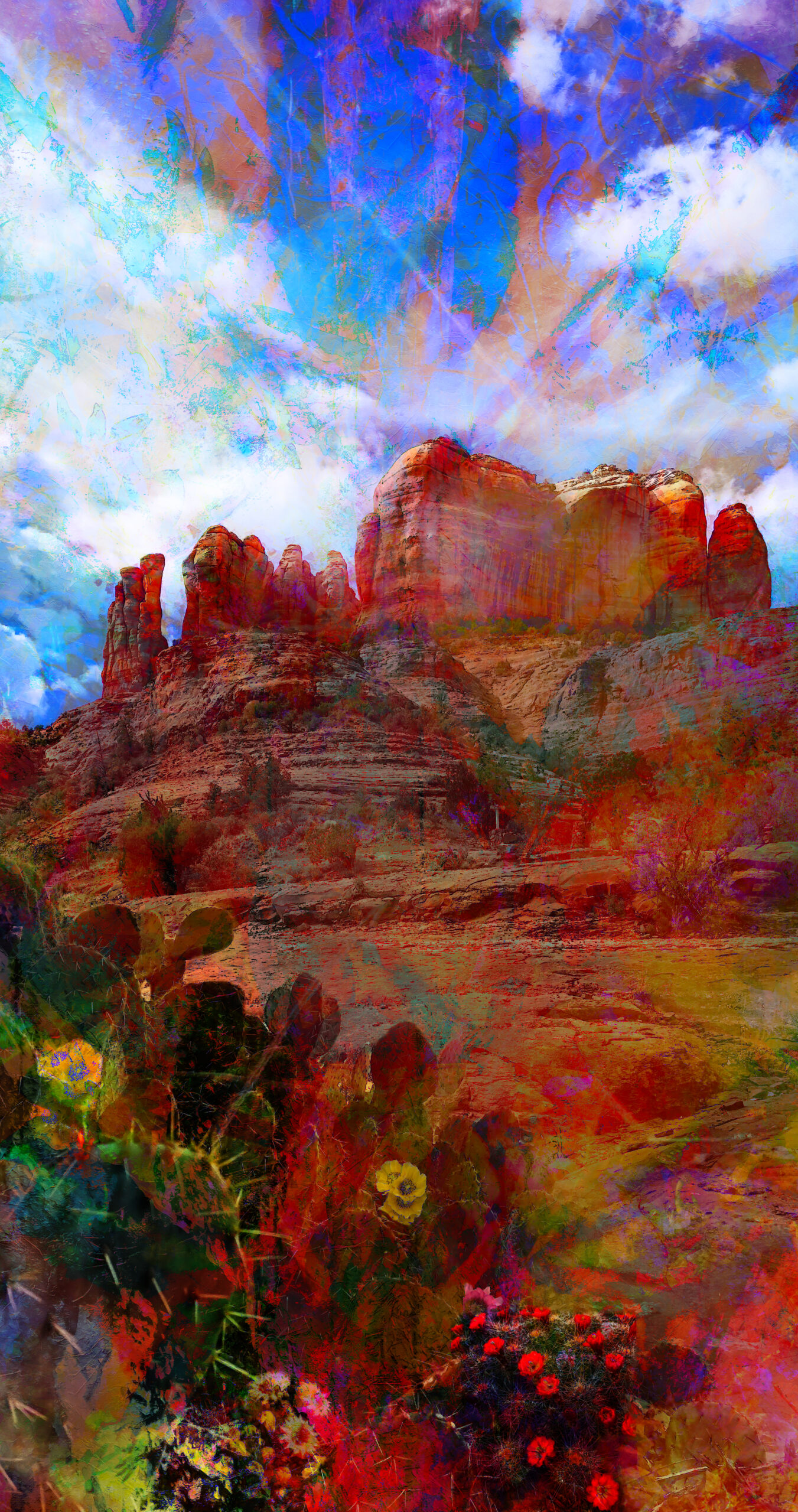
For the contemporary artist, Sedona remains a frontier—not of uncharted land, but of endless visual and emotional possibility. Michael John Valentine approaches it as an explorer armed not with compass and map, but with camera and canvas. His work does not attempt to replicate Sedona’s forms literally; instead, it distills their essence. Sedona Flowers is not a landscape in the traditional sense—it is an abstraction born from lived experience, where observation becomes interpretation and documentation transforms into expression.
At the foundation of this piece lies Valentine’s own photography. Walking the terrain, studying how light fractures against sandstone, how desert flowers punctuate the arid earth with bursts of life, he captures moments that feel fleeting yet eternal. These photographs are not endpoints; they are raw material. Each image holds a fragment of Sedona’s mood—morning warmth, afternoon radiance, or the soft bloom of color as the sun lowers behind the rocks.
The transition from photography to acrylic is where exploration becomes alchemy. Multiple photographic images—often layered and digitally blended—are combined to create a composite memory of place rather than a single viewpoint. This process mirrors how Sedona is actually experienced: not in one glance, but through accumulation. Trails overlap. Light changes. Time stretches. The artist’s digital synthesis stage allows him to collapse these moments into one unified visual language.
From there, the work moves decisively into the physical realm. Acrylic paint, chosen for its immediacy and versatility, allows Valentine to respond instinctively. Bold strokes echo the fractured geology of the red rocks. Translucent layers reference atmospheric depth and desert air. Saturated hues of crimson, gold, and violet recall Sedona’s mineral palette while floral forms emerge not as literal blossoms, but as gestures—suggestions of growth, renewal, and softness within a rugged environment.
In Sedona Flowers, floral abstraction becomes symbolic. Flowers in the desert are never accidental; they are moments of resilience and quiet triumph. Valentine’s treatment of them feels intentional and reverent, as if acknowledging how beauty in Sedona is earned rather than given freely. The painting does not isolate flora from landscape—it fuses them, suggesting that land and life are inseparable.
The final surface of the work bears the marks of exploration itself: layers built, obscured, revealed again. A protective gloss seals the piece, preserving both color and texture, much like sedimentary layers preserve the geological history of Sedona’s cliffs. What remains is not a record of a single place or time, but a lasting impression—an emotional map rather than a geographic one.
For collectors, Sedona Flowers offers more than visual appeal. It offers a sense of journey. It invites the viewer into the role of explorer, asking them to move through color, texture, and abstraction as one would move through canyon paths—slowly, attentively, and with openness. The work rewards contemplation, revealing new relationships and subtleties with each viewing.
In this way, Michael John Valentine aligns himself with explorers like John Wesley Powell—not by charting rivers or naming rock formations, but by translating the ineffable. Where Powell sought to understand the American West through observation and courage, Valentine seeks to understand it through transformation. Sedona Flowers stands as a modern expedition: a testament to how land shapes vision, how photography becomes memory, and how memory ultimately becomes art.
Please e-mail fineartbyval@gmail.com