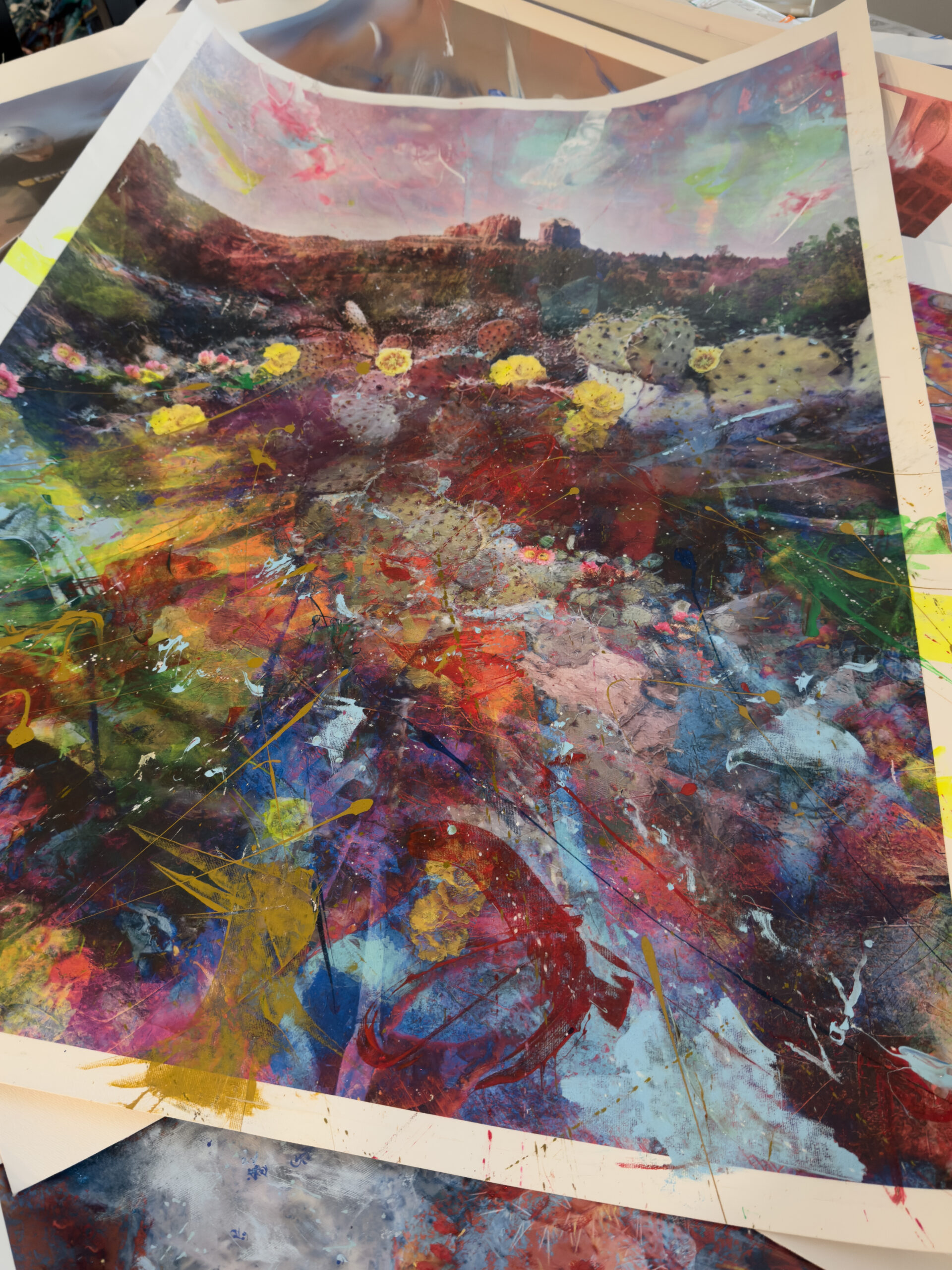
Texture & Visual Presence
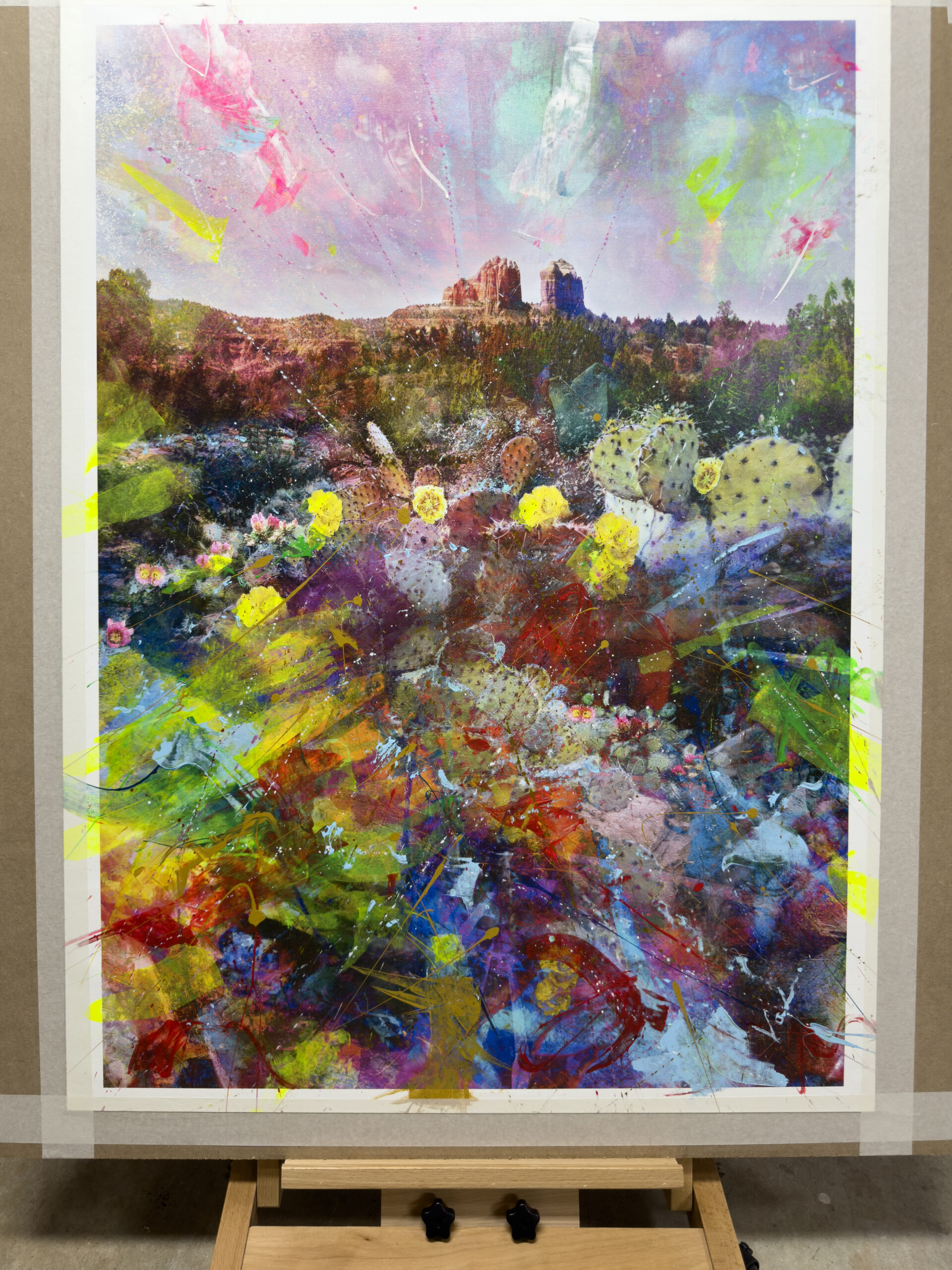
This painting presents a richly layered, tactile surface — the result of an intentional overpainting process that builds depth and presence beyond an initial photographic or sketch reference. On the canvas you can sense the raised ridges, the subtle play of light and shadow: brush-strokes and perhaps palette-knife marks give dimension, letting light bounce off the surface as though imitating the shifting desert sun on cactus spines and arid earth. The final glazing (a glossy protective sealant) imparts a soft sheen that both protects and enhances the surface texture, giving the work a luminous quality — like desert air shimmering at midday.
Because each piece is “overpainted signed canvas,” no two are identical: each conveys its own rhythm of strokes, layers, and glazing. The viewer isn’t just looking at a scene — one can almost feel the arid heat, the rough cactus skin, the dry breeze rustling through desert flora.
Landscape & History of the Region (Sedona, Arizona)
Sedona sits in a unique ecological crossroads — part interior chaparral, semi-desert grassland, Great Basin woodland, where junipers, pines, shrubs and desert flora mingle.
The red-rock geology of Sedona — the iconic buttes and spires like Cathedral Rock — arose over millions of years from ancient coastal sands of a Permian sea, compressed into redbed sandstone.
By capturing cactus forms against a backdrop evocative of Sedona’s red-rock light and desert openness, this painting becomes more than decorative — it is a tribute to the silent sweep of geological time and the fragile resilience of desert life. Each cactus stands like a sentinel, rooted in ancient soil, withstanding sun and drought, echoing the rugged history of the land.
Cactus Flowers — Color & Symbolism
While the painting is abstract, the desert-cactus inspiration evokes memories of the fleeting, delicate blooms cacti produce under the right conditions. In real Sedona-area desert flora, cactus flowers can bloom in vivid bursts — bright pinks, magentas, corals, yellows or fiery oranges — startling against muted greens and earthen reds.
In this abstract work, those bursts of color may translate into vibrant strokes or glazes — symbolic flashes that capture the ephemeral beauty and resilience of desert bloom. It’s not about literal botanical accuracy, but about evoking the spirit of those moments: the starkness of desert life punctuated by unexpected, radiant life.
Certificate of Authenticity & Collector Value
This painting — like other works by Michael John Valentine — comes with a Certificate of Authenticity (COA). As described on his site, after overpainting and glazing, the canvas is signed in acrylic on the front. The painting is then rolled in a sealed plastic sleeve and shipped in a heavy-duty tube to ensure safe delivery.
The COA, the hand-finished overpainting, and the glazing — these all mark the piece as a unique, original creation. For a collector, this is more than wall décor; it is a handcrafted artifact, meant to endure and become part of a personal or curated collection.
Overpainting Process & Artistic Method
Michael John Valentine’s process begins often with photographic references or personal travel images. Then he layers acrylic paints — sometimes using palette knives or brushes, sometimes combining mixed media techniques — to build up the composition.
In this “Abstract Sedona Arizona Cactus Painting,” the overpainting isn’t just decorative — it reinterprets reality through the artist’s vision. Once the layers are complete, a glazing is applied: a glossy coat that both protects the artwork and amplifies depth, contrast, and light-play across the surface. The result is a painting that feels alive, shifting slightly as ambient light changes — much like actual desert terrain under shifting daylight.
The Artist’s Legacy — 55+ Years of Experience
Michael John Valentine brings more than half a century of artistic practice to every canvas: his journey began at age 10 at an art institute in Ohio, culminating in a B.F.A. from Kent State University.
He has long blended photography with painting — an approach that lends his work a dual identity, part captured memory, part creative re-imagining. Over decades he has refined his understanding of light, texture, and mixed media — and with that maturity comes a confidence to push beyond realism into emotional, evocative abstraction.
Owning one of his original overpainted canvases means owning a lifetime of practice, vision, and careful refinement. Each piece carries not just visual impact but the weight of decades of artistic discipline.
Why This Piece Is More Than Decoration — It’s a Collector’s Statement
-
The texture and glazing give the painting a physical presence — it’s tactile, alive, responsive to light.
-
The connection to Sedona’s geological and ecological history roots the work in a sense of place and time — a desert memory re-imagined in pigment and canvas.
-
The cactus-flower colors (whether explicit or implied) evoke fleeting beauty, resilience, and contrast — an emotional echo of desert bloom.
-
The COA, overpainting, and hand-finishing elevate it to the status of fine art, not mass print.
-
And with 55 years of the artist’s experience behind it, the painting becomes part of a legacy — a conversation between personal memory, natural history, and abstract interpretation.