Cape Lookout: A Beacon in Time — Then and Now
Perched at the southern terminus of North Carolina’s Outer Banks, Cape Lookout stands as a testament to both nature’s relentless force and humanity’s enduring resolve. For centuries this stretch of barrier islands — marked on early European charts as Promontorium tremendum, or “horrible headland” due to the hazardous shoals that fan out beneath Atlantic waves — has been a confluence of sea, sky, and storm.
The story of human collaboration with this wild edge of the continent finds its clearest expression in the Cape Lookout Lighthouse, first lit in 1812 after Congress authorized a beacon to protect mariners from the treacherous shoals. That original structure, simple in stature and noble in purpose, was ultimately eclipsed by the relentless shifting of sand, surf, and sea.
In 1859, a new, far loftier brick tower rose — a pioneering architectural answer to Cape Lookout’s unique demands. Standing over 160 feet tall, its walls were engineered with strength and resilience, a double‑wall design that allowed for unprecedented elevation and visibility. Equipped with a first‑order Fresnel lens, a technological marvel of its age, its light pierced up to 19 miles across open water — a lifeline to sailors navigating the notorious “Graveyard of the Atlantic.”
In 1873, long after its light became a sentinel in darkness, the lighthouse received its distinct black‑and‑white diamond daymark — a visual signature that could be read by mariners even in full daylight. This geometric pattern — bold, rhythmic, unmistakable — became more than a navigational code; it became a symbol of Cape Lookout itself, echoing the very geometry of land, sea, and horizon.
The history of Cape Lookout has not been untouched by conflict or adversity. During the American Civil War, the lighthouse was deactivated and its lens removed as strategic forces vied to control the coastline’s guiding lights. Confederate attempts to destroy the aid failed, but the struggle underscored the complex interplay of human ambition and national strife upon this remote shore.
Today, though automated and overseen by the National Park Service as part of the Cape Lookout National Seashore, the lighthouse remains a vibrant imprint of navigational ingenuity and cultural memory — a structure both durable and poetic, where every etched brick and chalked diamond carries the memory of voyages past.
The Abstract Interpretation: A Visual Odyssey
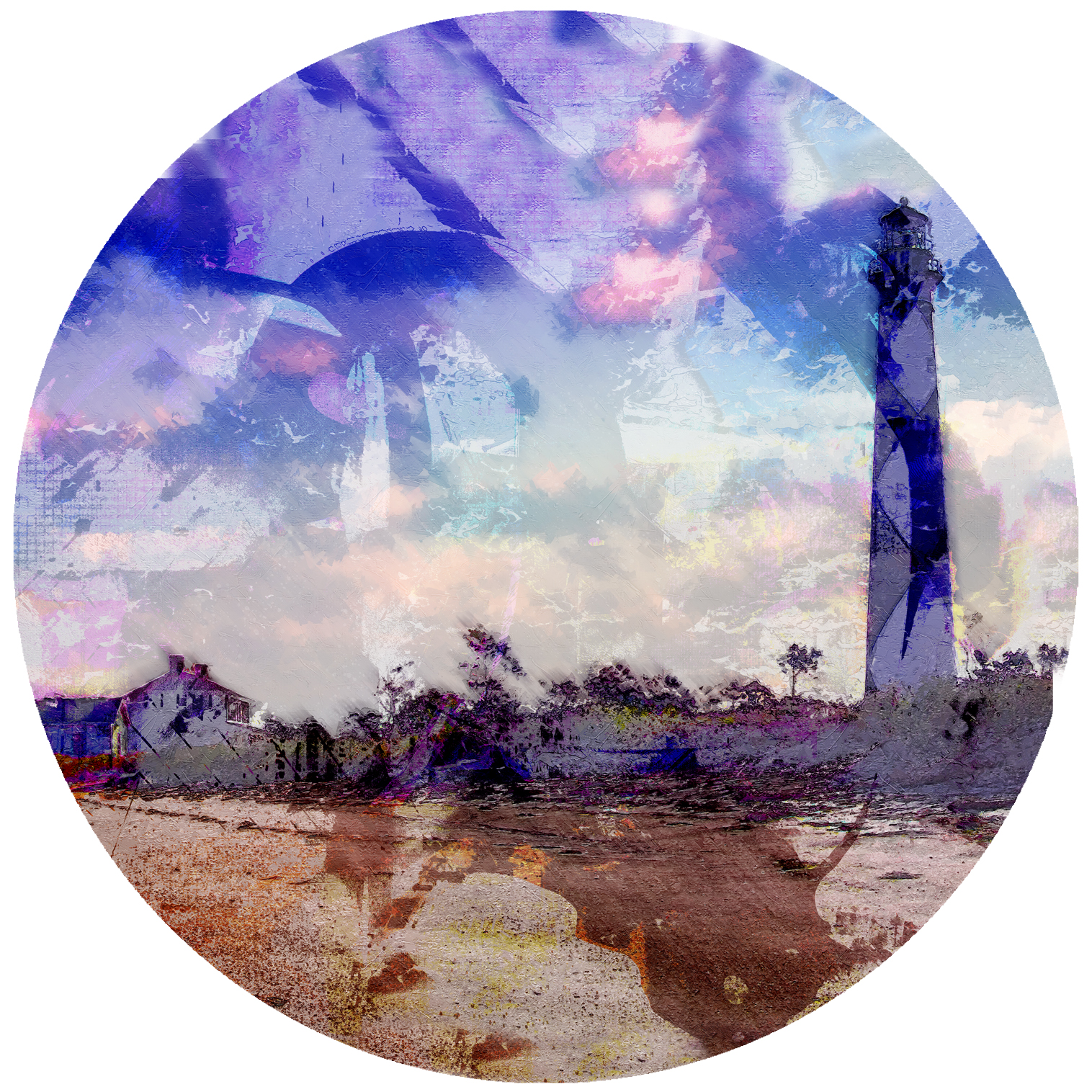
Michael John Valentine’s “Cape Lookout Lighthouse Abstract” is not a literal depiction — it is a reinterpretation of this maritime sentinel’s spirit. Where traditional representations show structure and form, this painting reveals essence and emotion. It transfigures history and place into a visual symphony of gesture, color, and implied motion.
Beyond Representation: The Poetry of Abstraction
At its core, this artwork invites the viewer to move beyond surface details into experience:
-
The Beacon as Memory: Rather than depicting the lighthouse’s precise architectural lines or unmistakable checkered daymark, the composition dissolves structure into rhythm. This abstraction evokes how memory — like light over water — flickers, refracts, and ultimately illuminates our sense of place.
-
Organic Geometry and the Vast Sea: The painting’s interplay of shape recalls the rhythmic patterns of the Outer Banks — the sweep of dunes, the ceaseless motion of tides, and the angular intensity of the Cape Lookout diamond daymark reimagined through bold, intuitive strokes.
-
Atmosphere over Topography: You are drawn not just to what Cape Lookout looks like, but to how it feels: the wind’s whisper, the salt’s tang in the air, the ache of distance between land and horizon.
Craftsmanship and Presentation
Each original canvas is a testament to meticulous technique and artistic devotion. Created with layers of acrylic overpainting, signed with bold acrylic strokes on the front, and finished with a protective glazing, these works are made to endure just as the lighthouse itself endures centuries of wind and water. Whether experienced in intimate small formats or as commanding large canvases, each iteration is a testament to singular artistic vision.
A Beacon for the Contemporary Collector
This piece occupies a rare intersection where maritime history, natural sublime, and abstract expression converge. It is not merely a decoration — it is a narrative anchor, a reflection on time and place that resonates with collectors who seek legacy, emotional depth, and artistry in equal measure.
-
For the discerning collector: this work becomes a portal — a way to hold in your space something as elemental as the wind’s sweep on Cape Lookout’s beaches.
-
For the historian at heart: it is a modern meditation on a structure born of necessity and elevated by symbolism.
-
For the art lover: it embodies how abstraction can deepen engagement with history, distilling centuries into gesture, hue, and compositional poetry.
In every brushstroke, Cape Lookout Lighthouse Abstract does more than recall a beacon. It recreates the light within you — a radiant fusion of nostalgia and imagination.
The Exhibition Canvas comes in 3 sizes and goes through several steps that include overpainting with acrylics, signing with acrylics on the front and a final glazing to protect the canvas before being rolled in a sealed tube then a box ( shipping is free in the USA )
The Matted Prints come in 3 sizes and are shipped in a box. ( shipping and handling is free in the US)
The Glossy Poster Print measures 16 x 24 and arrives in a sealed tube that is placed in a box. ( shipping is free in the US )
The 4 Inch Round Peel And Stick Decal is perfect for many applications beyond cars and comes in a sealed envelope ( shipped for free )