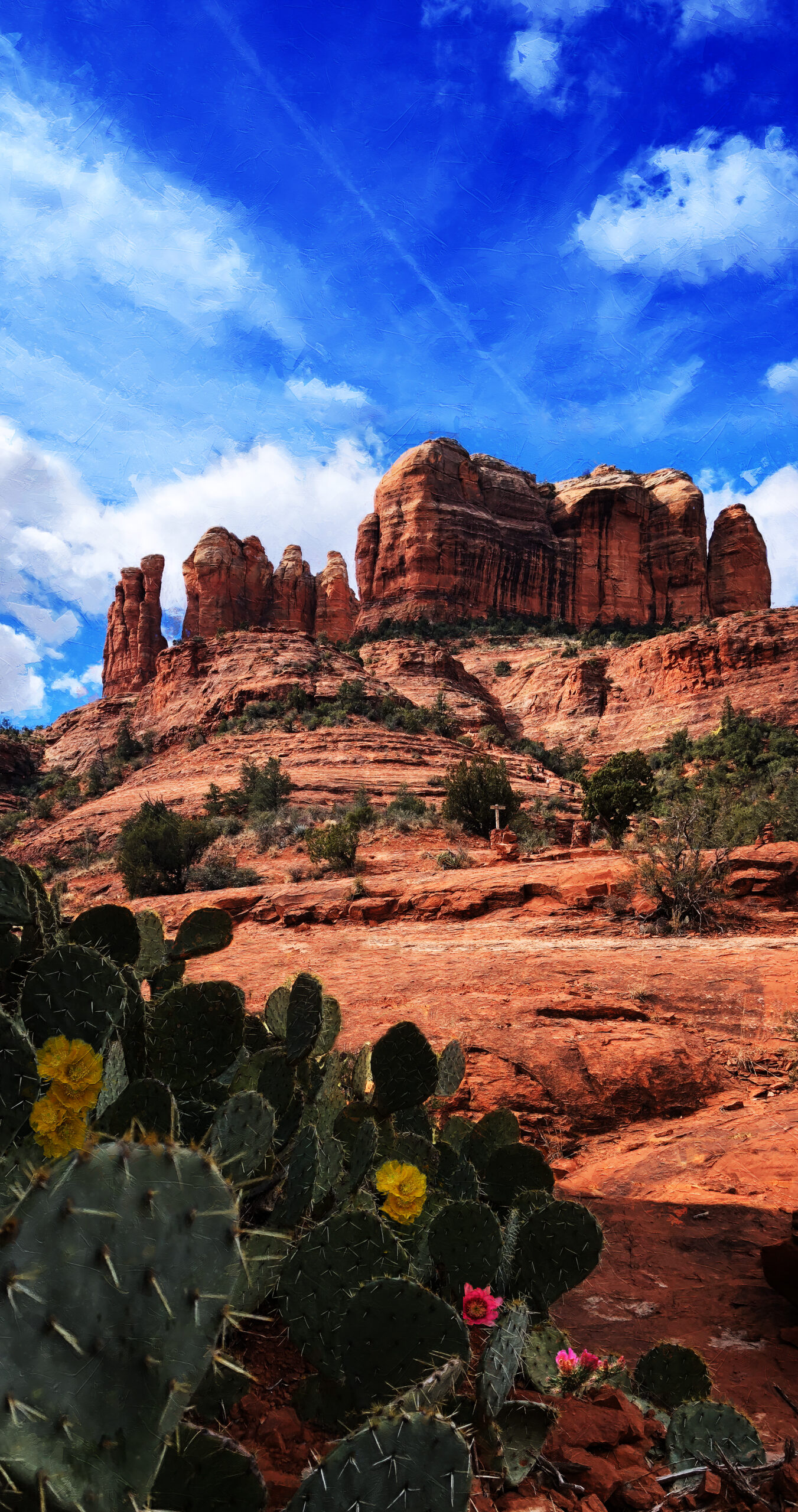

A Tale of Cathedral Rock
Long before sunlight ever kissed the cliffs of the American Southwest, the land that would become Sedona was ruled by ancient forces — wind and water, heat and time — each shaping the earth with a patient hand. In those primordial days, a great sea stretched far inland, its waves whispering secrets to grains of sand along its edges. Over millions of years those sands became stone, baked by the desert sun and rising like a cathedral from the blood‑red earth.
The Native peoples — the Sinagua, the Yavapai, and the Apache — saw not just rock, but living spirit in those monoliths. They told stories of that towering butte with two great spires as the “Twin Guardians of the Vortex” — portals of unseen energy that connected earth and sky, body and soul. They believed the land spoke through these ancient stones, offering clarity to those who listened in silence.
Centuries later, settlers saw only geological wonder: a butte carved from ancient sandstone, glowing vermilion at sunrise and burning gold at sunset. They named it Cathedral Rock, for it appeared like a timeless sanctuary etched against the sky. Today, thousands still make the pilgrimage to walk at its base, to feel the pulse of wind in the canyons, and to stand under its shadow — reminded that true cathedrals are not built of mortar and glass, but of stone and spirit.
Cathedral Rock and Cactus of Sedona – A Painting by Michael John Valentine
Nestled among the sun‑scarred mesas and whispering juniper ridges of northern Arizona, Cathedral Rock rises with a quiet majesty that has inspired generations of artists, poets, and dreamers. In Cathedral Rock and Cactus of Sedona, Michael John Valentine distills this profound natural elegance into a visual symphony of color, texture, and emotion — a painting that not only depicts a landscape, but awakens the spirit tethered to it.
A Landscape Born of Time
Cathedral Rock — a sandstone butte sculpted by millions of years of wind, water, and fire — stands as one of the most iconic natural formations in the American Southwest. Its glowing red cliffs and twin spires are instantly recognizable, measured not only in feet but in feeling. Thousands of visitors flock each year to the Coconino National Forest to stand beneath its shadow, hike the steep Trail #170, or simply watch the sun cast its gilded glow upon its ancient sandstone.
Yet Valentine’s work transcends mere archiving of place. Here, the land is not a backdrop; it is a character with a pulse. Each brushstroke honors the ancient sedimentary layers of the Permian Schnebly Hill formation — the very fabric of the earth that once lay beneath prehistoric seas. This is not an imitation of nature; it is an ode to its relentless creativity.
Harmony of Elements: Rock, Sky, and Cactus
At the heart of this composition is the subtle interplay between the elemental rock and the desert flora that thrives in its careful shadow. The cactus — with its austere silhouette and hardy presence — becomes more than supporting cast. It symbolizes resilience, an echo of the rock’s own geological endurance. In Valentine’s painting, the cactus does not just grow near Cathedral Rock; it shares its essence.
The palette chosen for this piece mirrors the landscape’s inherent drama: deep, earthy reds and siennas for the cliff faces; pale, shimmering ochres and golds where the first light of morning meets sandstone; and cool greens that offer respite from the surrounding warmth. The geology and botany of Sedona are woven together not as separate elements, but as a symphony of survival and beauty.
Mood and Atmosphere: More Than a View
What sets Cathedral Rock and Cactus of Sedona apart from a simple landscape painting is its energy. There is a sense of stillness and reverence — a quality that the indigenous peoples of this land felt long before it was ever painted or hiked. Many visitors even speak of energy vortexes in the area — places where the earth’s unseen forces are said to be concentrated, inviting introspection, transformation, or quiet contemplation.
Valentine’s canvas seems to hold that same quiet tension. There are no tourists, no paths marked by footprints, no signs of human interruption — only the pure resonance between land and viewer. The sky above Cathedral Rock is broad and open, a canvas of possibility that draws the eye upward from the earth’s ancient heart. The viewer is invited to pause here, to breathe, and to feel the silent stories embedded in the stone.
Brushwork and Technique
Valentine’s technique reveals mastery not only of form, but of narrative. His brushwork — rhythmic yet purposeful — captures the rugged textures of layered sandstone and the soft edges of desert vegetation with equal grace. The textured acrylics and glazes create depth that invites the eye to wander across the surface, discovering nuance after nuance as light itself seems to move across the painting.
Through layering, transparency, and careful modulation of hue, Valentine achieves a vibrancy that resonates far beyond the frame. The desert winds feel almost audible, and the heat of the midday sun can almost be felt on the viewer’s skin. His use of color is both bold and reverent — embracing the stark contrasts of the environment while honoring its subtle harmonies.
Emotional Resonance and Interpretation
Cathedral Rock is not merely a destination; it is a mental and spiritual landscape that reflects our own inner journeys. Valentine’s interpretation harnesses this metaphor. There is a resonance here that parallels the painting’s physical terrain with something deeper — the resilience to weather hardship, the courage to rise above challenge, and the grace to stand tall through the quietest storms.
By juxtaposing the monolithic strength of Cathedral Rock with the humble, yet tenacious cactus, Valentine evokes a universal story of endurance and harmony. In this interplay, viewers may find their own reflections — of strength in solitude, of peace in vastness, and of beauty in stillness.
Legacy and Place in Contemporary Art
In an era where the landscape is often represented digitally or through fleeting imagery, Cathedral Rock and Cactus of Sedona stands as a testament to the enduring power of traditional painting. Valentine’s work invites us to slow down, to engage intimately with the world around us, and to find meaning beyond the surface. It captures not just where the land is, but what it feels like to be there.
This painting occupies a unique space where natural history, human emotion, and artistic expression converge. It is not just a rendering of scenery — it is a meditation on place, spirit, and the quiet, persistent poetry of the earth itself.
The Exhibition Canvas comes in 3 sizes and goes through several steps that include overpainting with acrylics, signing with acrylics on the front and a final glazing to protect the canvas before being rolled in a sealed tube then a box ( shipping is free in the USA )
The Matted Prints come in 3 sizes and are shipped in a box. ( shipping and handling is free in the US)
The Glossy Poster Print measures 16 x 24 and arrives in a sealed tube that is placed in a box. ( shipping is free in the US )
The 4 Inch Round Peel And Stick Decal is perfect for many applications beyond cars and comes in a sealed envelope ( shipped for free )