“The deeper the feeling, the stronger the expression.” — Henri Matisse
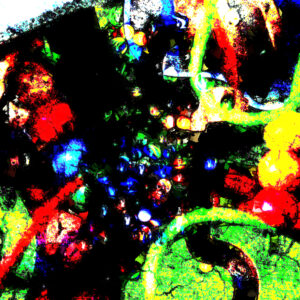
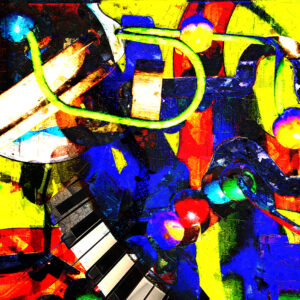
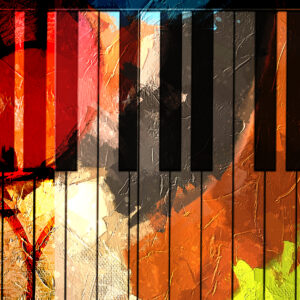
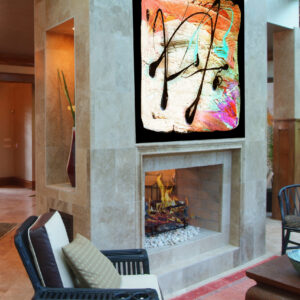
Echo Beneath the Surface-9.75 x 28 signed overpainted and glazed canvas
From the Series: Chromatic Insurrection – inspired by a trip to Key West Florida where visitors place decals and stickers on walls in a rowdy form of art.
Sacred Mechanics l Echo Beneath The Surface l Residual Presence l Riot Architecture l Blue Violet Thesis
“Echo Beneath the Surface” represents a defining moment within the evolution of this work—where intensity gives way to depth, and where the visible becomes secondary to what is felt. This piece does not rely on immediate impact. Instead, it draws the viewer inward, asking for time, attention, and a willingness to engage beyond the surface. It is not art that reveals itself all at once; it is one that unfolds.
At first glance, the composition appears atmospheric—muted, layered, almost submerged. Deep reds and oxidized tones drift through passages of blue, charcoal, and diffused light. The color does not sit on the canvas; it feels embedded within it. This distinction is critical, because it speaks directly to a process. The work is not built on top of itself—it is worked into itself. Each layer becomes part of the structure, not just a surface event.
This is where the overpainting process defines the piece.
The art methodology rejects the idea of a linear progression. Instead of moving from beginning to end, it moves in cycles—applying, removing, obscuring, and rediscovering. Each pass across the canvas alters not only what is visible, but what is possible. Earlier decisions are not erased; they are absorbed, leaving behind traces that continue to influence the final composition. This creates a depth that cannot be manufactured through a single gesture or technique. It must be earned over time.
In “Echo Beneath the Surface,” that accumulated history becomes the subject itself.
There are suggestions of form—faint contours that hint at presence without ever fully resolving into something concrete. These moments feel almost like memory: recognizable, yet just out of reach. The viewer is left to navigate this ambiguity, to project, to interpret. This is where the work becomes personal. It does not dictate meaning; it allows it to emerge.
What distinguishes this approach is the balance between control and surrender. The overpainting process introduces unpredictability—textures shift, colors interact in unexpected ways, and underlying layers push forward at their own discretion. Yet, there is always a guiding hand. Decisions are not reactive; they are informed by a deep understanding of composition, color relationships, and spatial tension. This is where an art degree from Kent State University plays a critical role.
Art training provides the structure that allows for this level of freedom. Without it, the work could easily dissolve into chaos. Instead, it remains cohesive, intentional, and resolved. The composition holds together because it is supported by principles that go beyond instinct alone. This combination of discipline and exploration is what gives this work its authority—it feels both immediate and considered.
Equally important to the identity of “Echo Beneath the Surface” is the environment in which it is created. Three live studios in Cornelius North Carolina are not simply workspaces; they are integral to the process itself, each contributing a distinct dimension to the final piece.
Studio One serves as the foundation. It is where the initial structure is developed—where composition, layering strategies, and directional intent are established. This space is controlled, focused, and deliberate. It allows for precision in the early stages, ensuring that the work begins with a strong conceptual and visual framework.
Studio Two expands that framework into physicality. Designed for oversized canvases and more aggressive techniques and glazing of the final work, it is where the work gains its energy. Here, movement becomes part of the process. The scale demands a different kind of engagement—one that is more gestural, more immersive. This is where the painting evolves beyond control and begins to assert itself.
Studio Three introduces an entirely different element: experience. As a curated smoking lounge, complete with custom-built humidors, a bar, and a refined atmosphere, it transforms the relationship between the work and its audience for an entirely different space with cigar and bourbon art. This is where “The Cigar Art Experience” takes place—where collectors and guests are invited not just to view the work, but to inhabit its environment. The act of smoking, the controlled air system, the intimacy of the setting—all of it contributes to a deeper sensory connection. The artwork is no longer separate from life; it becomes part of it.
This three-studio ecosystem is what sets this practice apart. It is not confined to a single space or method. It is dynamic, multi-dimensional, and fully integrated into both creation and presentation. Each piece carries the imprint of these environments, whether visible or not.
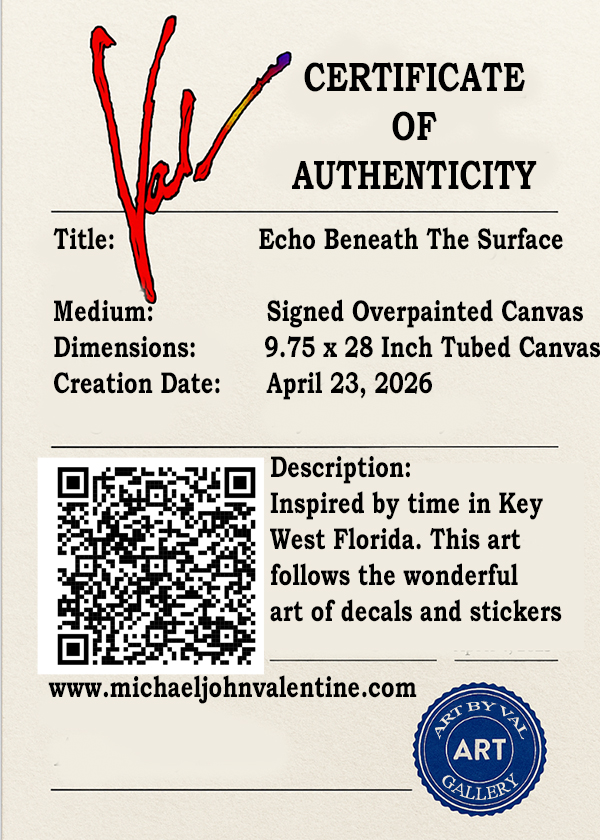
The Certificate of Authenticity (COA) further reinforces the integrity of this process. Each work is accompanied by detailed documentation that captures its origin, methodology, and placement within a broader body of work. The COA is not simply a certificate—it is a record of authenticity and a guarantee of uniqueness. It affirms that the piece is not part of a reproduced series, but a singular creation shaped by time, process, and intention.
For collectors, this level of documentation is essential. It provides confidence, context, and a direct connection to the work’s history. In a market where replication is increasingly common, the COA anchors this work in originality.
“Echo Beneath the Surface” ultimately speaks to what cannot be immediately seen. It is about the accumulation of moments, the persistence of memory, and the quiet force of what remains beneath. It does not compete for attention—it holds it.
And in doing so, it defines not just a piece, but a philosophy—one rooted in depth, process, and the enduring power of presence.
The Exhibition Canvas comes in 3 sizes and goes through several steps that include overpainting with acrylics, signing with acrylics on the front and a final glazing to protect the canvas before being rolled in a sealed tube then a box ( shipping is free in the USA )
The Matted Prints come in 3 sizes and are shipped in a box. ( shipping and handling is free in the US)
The Glossy Poster Print measures 16 x 24 and arrives in a sealed tube that is placed in a box. ( shipping is free in the US )
The 4 Inch Round Peel And Stick Decal is perfect for many applications beyond cars and comes in a sealed envelope ( shipped for free )