
“Geometry is the foundation of all painting.”
— Paul Cézanne
The Geometry of Wonder
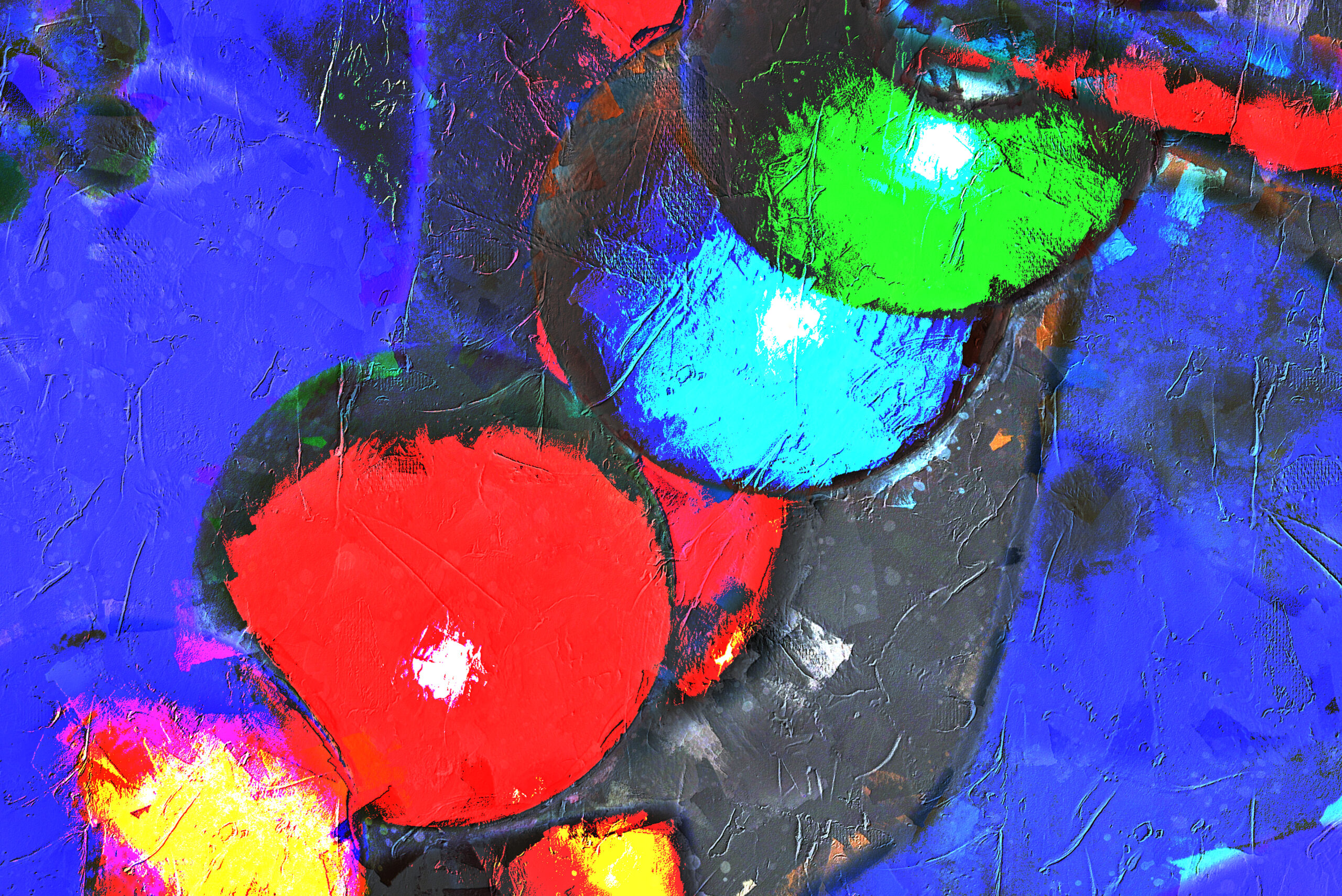
The Geometry of Wonder is an exploration of order and mystery—an abstract meditation on the most elemental language of the universe: form. In this work, geometry is not rigid or mathematical in the cold sense; instead, it is alive, expressive, and quietly poetic. The circular forms that anchor the composition function as both visual architecture and emotional conduits, inviting the viewer into a contemplative space where structure and imagination coexist.
At first glance, the spheres appear deceptively simple—rounded, familiar, universal. Yet their power lies in their repetition and placement, in how they interact with one another and with the surrounding negative space. Circles have long been symbols of unity, infinity, and continuity across cultures and eras. Here, they become vessels of wonder, suggesting planets in orbit, cells in division, or thoughts drifting through the mind. The ambiguity is intentional. Each viewer is offered the freedom to project their own narrative onto the work, making the experience deeply personal and endlessly renewable.
The composition balances precision with intuition. While geometry provides the framework, the execution resists sterility. Subtle variations in scale, spacing, and surface treatment prevent uniformity, allowing the eye to move rhythmically across the canvas. There is a sense of quiet motion—as if the forms are suspended mid-conversation, held in a moment just before alignment or dispersion. This tension between stillness and movement is where the painting breathes.
Color, restrained yet purposeful, plays a crucial role in shaping the emotional temperature of the piece. Rather than overwhelming the forms, the palette supports them, allowing light and shadow to define volume and depth. The hues feel considered and intentional, contributing to a sense of refinement that aligns with the work’s collector-focused presence. Nothing here is accidental; every tonal decision reinforces the dialogue between form and space.
The Geometry of Wonder also operates on a philosophical level. Geometry is often associated with certainty, logic, and rules—the measurable aspects of reality. Wonder, by contrast, belongs to curiosity, awe, and the unknown. By uniting these two concepts, the work suggests that structure and mystery are not opposites but partners. It proposes that wonder does not arise from chaos alone, but from the recognition of patterns we can sense but never fully explain.
There is an architectural quality to the painting, as though the spheres are components of an unseen blueprint. Yet the blueprint is emotional rather than functional. The viewer is not instructed on how to interpret the work; instead, they are invited to linger, to notice relationships, to feel resonance. This openness is one of the painting’s greatest strengths. It does not demand attention—it earns it through quiet authority.
As a contemporary abstract work, The Geometry of Wonder sits comfortably within modern interiors while transcending trends. Its timeless reliance on fundamental forms ensures longevity, both aesthetically and conceptually. This is not a piece bound to a specific moment; it is anchored in visual principles that have fascinated artists from Cézanne and Kandinsky to modern abstractionists. Yet it remains distinctly personal, marked by a sensibility that values restraint, balance, and emotional depth over spectacle.
For the collector, this painting offers more than visual appeal. It offers presence. In a space, it becomes a point of calm focus—a work that rewards repeated viewing. Over time, relationships between the forms reveal themselves differently depending on light, mood, and distance. What initially feels serene may later feel dynamic; what once appeared purely formal may begin to feel symbolic. This evolving relationship between artwork and viewer is the hallmark of enduring art.
Ultimately, The Geometry of Wonder is about perception. It reminds us that even the simplest shapes can hold profound meaning when approached with curiosity. It invites us to slow down, to consider how order shapes our experience of the world, and to rediscover the quiet amazement found in form itself. In a world saturated with noise and excess, this work stands as a refined counterpoint—measured, thoughtful, and deeply resonant.
This is geometry not as formula, but as poetry. A composition that does not explain itself, yet continues to speak. A work that transforms circles into contemplation, and structure into wonder.
The Exhibition Canvas comes in 3 sizes and goes through several steps that include overpainting with acrylics, signing with acrylics on the front and a final glazing to protect the canvas before being rolled in a sealed tube then a box ( shipping is free in the USA )
The Matted Prints come in 3 sizes and are shipped in a box. ( shipping and handling is free in the US)
The Glossy Poster Print measures 16 x 24 and arrives in a sealed tube that is placed in a box. ( shipping is free in the US )
The 4 Inch Round Peel And Stick Decal is perfect for many applications beyond cars and comes in a sealed envelope ( shipped for free )