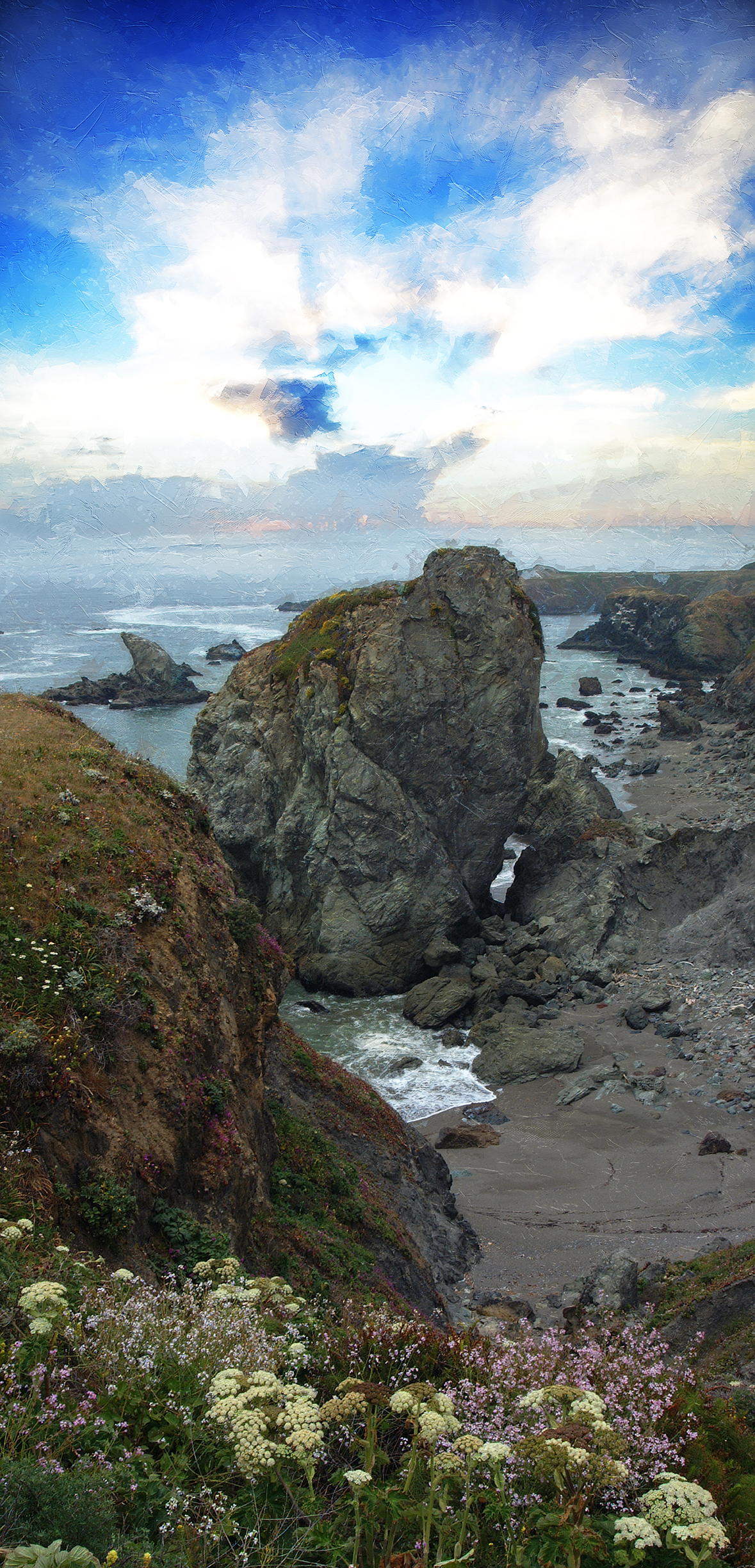

Geological Background: Rocks of the Oregon Coast
The rugged Oregon coastline — spanning nearly 360 miles along the Pacific Ocean — is one of the most geologically fascinating shorelines in North America. Although the painting Oregon Coastal Rocks doesn’t label specific formations, the rocks it evokes and celebrates draw from a rich geologic tapestry that spans hundreds of millions of years of Earth’s history.
Tectonic Setting & Lithology
The Oregon coast sits atop active continental margin geology driven by the Cascadia Subduction Zone, where the oceanic Juan de Fuca Plate dives beneath the North American Plate. This tectonic interaction has uplifted former seafloor rocks, folded ancient layers, and juxtaposed volcanic, sedimentary, and metamorphic units along the coastline — producing a mosaic of rock types that beachcombers and coastal scenes often reveal.
Basalt & Volcanic Origins
Many of Oregon’s coastal headlands and offshore stacks originate from basaltic lava flows that erupted in the early Cenozoic era. For example:
-
Haystack Rock, a famous stack at Cannon Beach, consists of basalt that was once part of a lava flow sourced from the Columbia River Basalt eruptions ~15–17 million years ago. Erosion isolated it from the mainland, leaving a monolithic remnant standing hundreds of feet tall.
-
The Yachats Basalt and other ocean‑floor volcanic rocks now exposed near the coast are remnants of ancient seamounts and ocean‑plate terraces accreted and uplifted onto the continent.
Basalt is tough and dense, often forming headlands and resistant boulders that buttress beaches and influence wave energy patterns.
Sandstone & Sedimentary Features
Contrasting the volcanic rocks, other parts of the coast are dominated by marine sandstone, siltstone, and mudstone, such as those of the Astoria Formation. These units — tens of millions of years old — were deposited in shallow marine settings and often contain fossils and layered sedimentary features.
At places like Cape Kiwanda, sandy sandstone cliffs host tide pools and small erosional features, while remnants of dunes and softer layers speak to the interplay of wind and water over millennia.
Sea Stacks, Erosion & Coastal Sculpting
The dramatic boulders, stacks, and rocky outcrops dotting Oregon beaches are sculpted by relentless marine erosion:
-
Wave action exploits fractures, fault planes, and joints in rock, first carving caves and notches at the base of cliffs.
-
Continued turbulence causes overlying material to collapse, producing arches and eventually isolating columns — the iconic sea stack form.
-
Differential resistance — hard basalt vs. softer sediments — accentuates sculptural relief: robust basalts stay standing longer, while siltstone and sandstone retreat more rapidly.
Beach Stones & Beachcombing
On the beaches themselves, the “rocks” that attract both collectors and artists are products of transport and abrasion: fragments of basalt, jasper, chert, chalcedony, and other lithologies tumbled, polished, and smoothed by wave action and time. Many are rounded from repeated collisions; others exhibit vesicular textures or fossil traces that hint at their deeper geologic past.
🎨 Collector‑Focused Art Analysis & Statement — Oregon Coastal Rocks Original Painting on Canvas
Oregon Coastal Rocks Original Painting on Canvas is more than a depiction of stones on a shore. It is an immersive, contemplative offering that bridges natural history with a finely tuned artistic sensibility — inviting collectors into a dialogue about place, time, and the elemental forces that shape both land and imagination.
I. The Geological Muse: Subject as Narrative
At first glance, the subject may appear simple — rocks along a shoreline. Yet rocks are not inert. They are archives of Earth’s movements, fossils of ancient ecosystems, and markers of time that speak to the dynamic forces of plate tectonics, volcanic activity, marine erosion, and climatic change. By choosing these subjects, the painting embraces geology not as backdrop but as protagonist.
The Oregon coast, with its basaltic remnants of prehistoric lava flows and sedimentary sequences bearing fossilized sea life, offers visual motifs that are both timeless and expressive. Oregon Coastal Rocks taps into this geological depth — presenting form and texture as resonant metaphors for endurance, transformation, and the raw poetry of erosion.
II. Technique: The Alchemy of Overpainting
Crafted in acrylic on canvas, the work’s layered surface mirrors the stratigraphy of rocks themselves. Through successive applications — each glaze, brushstroke, and modulation of tone — the painting evokes the way natural surfaces accumulate history over epochs.
Like geological strata that record volcanic ash, marine sediment, or basalt flows, the artist’s layering is not merely decorative; it is structural. The result is a tactile surface that invites both the eye and the imagination to roam — much as waves meander around boulders, revealing new facets with each encounter.
The final glazing, which protects and unifies the composition, parallels the natural patina of rocks polished by water and wind — a finish earned over time, not applied superficially.
III. Composition: Dialogues of Color, Light, and Matter
The artist’s palette — whether muted grays and umbers recalling basalt and sandstone, or more vivid highlights that suggest sunlit wet stone — captures nuances of coastal light and shadow with poetic precision.
In Oregon Coastal Rocks, contrast becomes structure. Darker, denser areas provide visual “weight,” anchoring the composition like a basalt headland; lighter, silvery passages brighten the field much like wet stone glinting under a low sun. This interplay anchors the piece both emotionally and physically.
Such compositional decisions are rooted in a deep sense of place, informed not only by observation but by an empathetic understanding of how light and weather shape the perception of rock and sea.
IV. Emotional & Intellectual Resonance
This painting does more than present a coastal scene; it evokes the sensory experience of standing on a remote shore — the sound of surf pounding unseen rock, the briny scent of ocean air, the sensation of wind cool against skin.
Yet Oregon Coastal Rocks also resonates intellectually. It invites contemplation of deep time: how lava flows become headlands, how sedimentary layers preserve ancient life, how coastlines are dynamic frontiers that simultaneously reveal and conceal Earth’s history.
Collectors will find in this work both an aesthetic experience and a conceptual depth that rewards repeated viewing. It is not merely decorative; it is contemplative and evocative — engaging both the senses and the intellect.
V. Craftsmanship & Authenticity
Echoing the commitment found in the site’s other works, this original painting is a singular creation — not a reproduction, not a derivative image — but a unique dialogue between artist and landscape. The process, from initial inspiration through layered execution to the final protection of the surface, reflects dedication, mastery, and a refined artistic voice cultivated over decades of practice.
For collectors who value museum‑quality work, Oregon Coastal Rocks delivers rarity, substance, and a narrative richness that transforms a room into a space of reflection and geological wonder.
🏁 Conclusion
From its geological subject — rocks shaped by volcanic forces, marine erosion, and tectonic upheaval — to its execution as a layered, luminous work of art, Oregon Coastal Rocks Original Painting on Canvas is a tribute to both the Earth’s deep time and the poetic vision of the artist.
It stands as a piece that holds time itself, inviting viewers and collectors to explore, discover, and connect — through geology, through aesthetic experience, and through the slow, immersive power of thoughtful art.
The Exhibition Canvas comes in 3 sizes and goes through several steps that include overpainting with acrylics, signing with acrylics on the front and a final glazing to protect the canvas before being rolled in a sealed tube then a box ( shipping is free in the USA )
The Matted Prints come in 3 sizes and are shipped in a box. ( shipping and handling is free in the US)
The Glossy Poster Print measures 16 x 24 and arrives in a sealed tube that is placed in a box. ( shipping is free in the US )
The 4 Inch Round Peel And Stick Decal is perfect for many applications beyond cars and comes in a sealed envelope ( shipped for free )