A good cigar is like a trusted friend—always there when you need it most.”
— Winston Churchill
There are moments in life when ornamentation gives way to substance, when only what has been earned deserves attention. A slow pour of bourbon. The deliberate cut of a fine cigar. Silence that carries more meaning than conversation. Pappy and Padron by Michael John Valentine is born of this understanding. It is not an illustration of indulgence, but a meditation on discipline, patience, and character—the virtues that define both great craftsmanship and the men who recognize it.
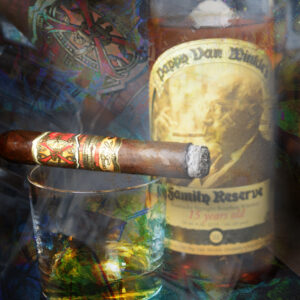
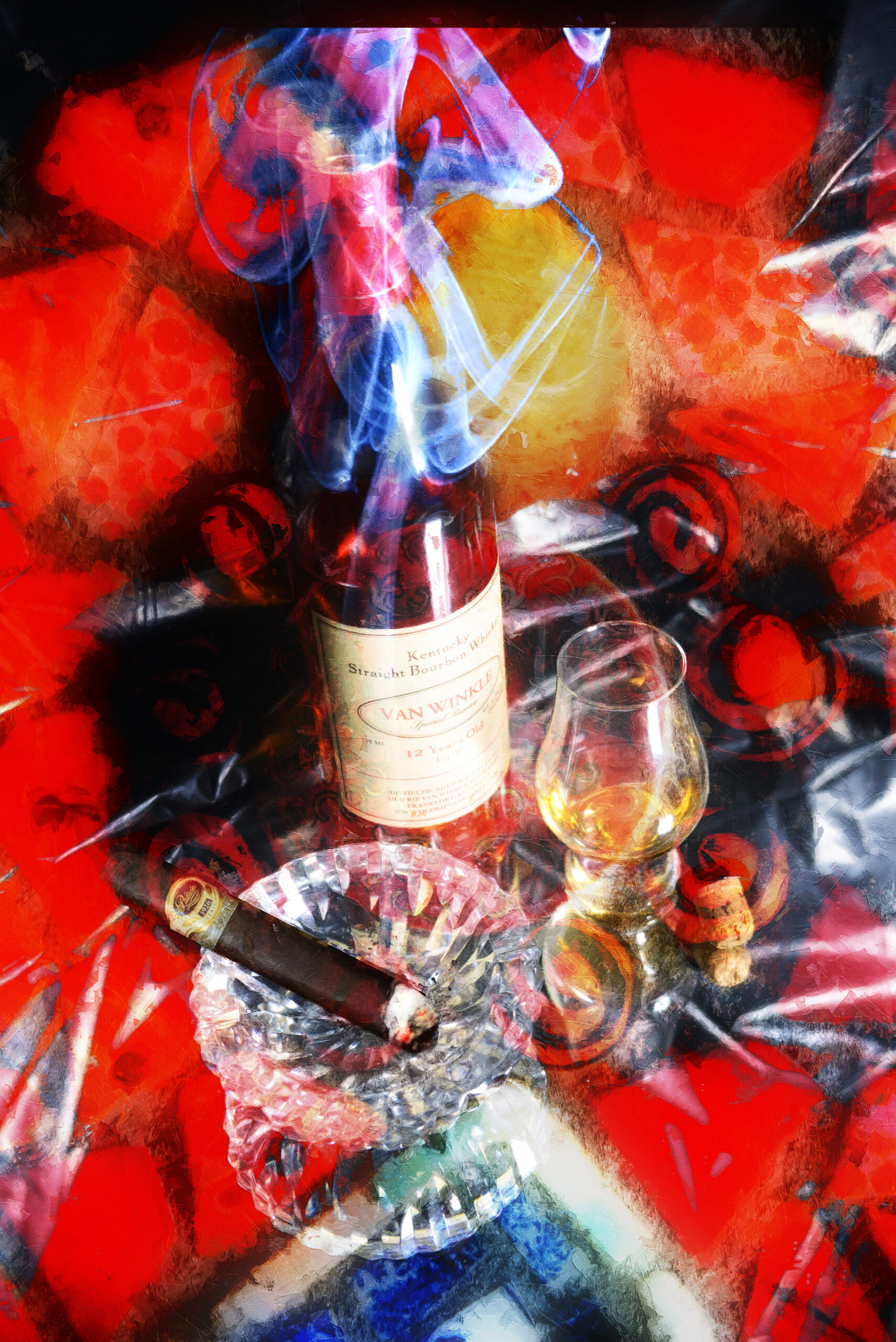
This abstract wall art painting on canvas captures the spirit of two revered icons: Pappy Van Winkle bourbon and the Padron cigar. These are not brands chosen for fashion or trend. They are chosen for legacy. Each carries decades of restraint, refinement, and unwavering standards. Valentine approaches them not as objects to be depicted, but as symbols to be distilled—reduced to their essence and rebuilt through color, texture, and movement.
The composition unfolds in layered tones of deep amber, tobacco brown, ash gray, and softened gold. These hues do not shout; they settle. They move across the canvas the way smoke drifts across a room—slow, confident, unforced. There is weight here, but never heaviness. Light emerges gently, as it does when bourbon catches the edge of crystal or when an ember glows just enough to remind you it is alive.
This is a painting that understands time. Time is the invisible ingredient in both bourbon and cigars, and it is equally present in Valentine’s process. Acrylic layers are built patiently, allowing depth to form organically rather than through excess detail. The abstraction invites the viewer to pause, to lean in, to notice what cannot be rushed. In doing so, the work mirrors the ritual it honors: nothing here rewards haste.
Valentine’s hand is steady and assured. The brushwork carries intention without rigidity, suggesting motion without chaos. Smoke-like forms curl through the composition, not as literal representation, but as memory—an echo of moments spent in quiet contemplation. The suggestion of glass, wood, and flame emerges subtly, rewarding those who give the work time rather than demanding immediate recognition.
As a physical object, the canvas is produced with the same respect for quality as its subject matter. Finished with a glossy protective sealant, the surface catches light with restraint, enhancing depth rather than overpowering it. The painting is delivered unstretched and rolled in a heavy-duty tube, allowing collectors the freedom to select framing that complements both their space and the gravity of the piece. It is an invitation to participate in the final presentation, not merely to consume it.
What sets Pappy and Padron apart is its refusal to explain itself fully. Like a trusted friend, it does not compete for attention. It waits. In a private study, a library, or a well-appointed lounge, the painting becomes part of the environment rather than a disruption of it. Over time, it reveals more—subtle contrasts, quiet movements, and tonal shifts that change with light and mood.
There is a reason cigars and spirits have long been companions to reflection. They slow the pace. They encourage thought rather than distraction. Valentine’s work aligns itself with this tradition. It does not decorate a wall; it anchors a room. It suggests conversation without requiring it. It holds space for solitude as comfortably as it does for company.
In the broader context of contemporary abstract art, this piece occupies a rare position. It respects modern abstraction while remaining deeply human. It avoids the coldness that often accompanies conceptual work, replacing it with warmth, familiarity, and lived experience. The painting does not ask to be interpreted intellectually—it asks to be felt, returned to, and lived with.
Collectors who are drawn to Pappy and Padron tend to recognize something of themselves in it. An appreciation for things made well rather than quickly. A preference for depth over display. An understanding that luxury is not excess, but restraint perfected. This painting belongs with leather worn soft by years of use, with books read more than once, with glasses poured not to impress but to mark the end of a long day well spent.
Ultimately, this work stands as a quiet declaration. That some rituals are worth preserving. That some pleasures improve with patience. That presence, when earned, needs no announcement. Like the cigar Churchill trusted and the spirit poured sparingly beside it, Pappy and Padron endures not because it demands attention—but because it deserves it.