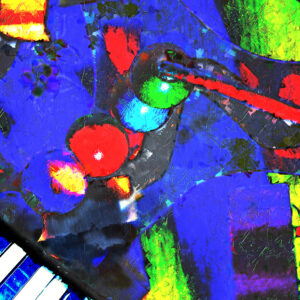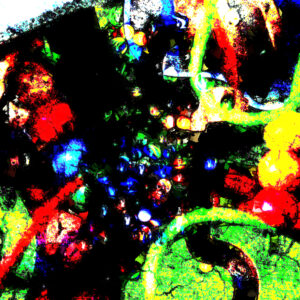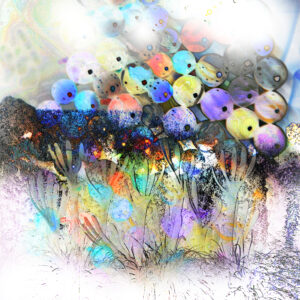
“Shattered Horizon is where certainty ends—not in collapse, but in the realization that what we called stability was only ever a temporary alignment of fractures.” — Michael John Valentine
Shattered Horizon — The Faultlines Series
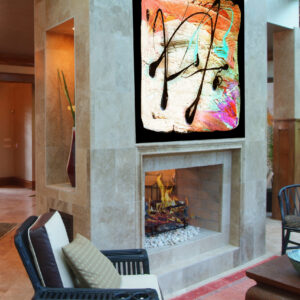
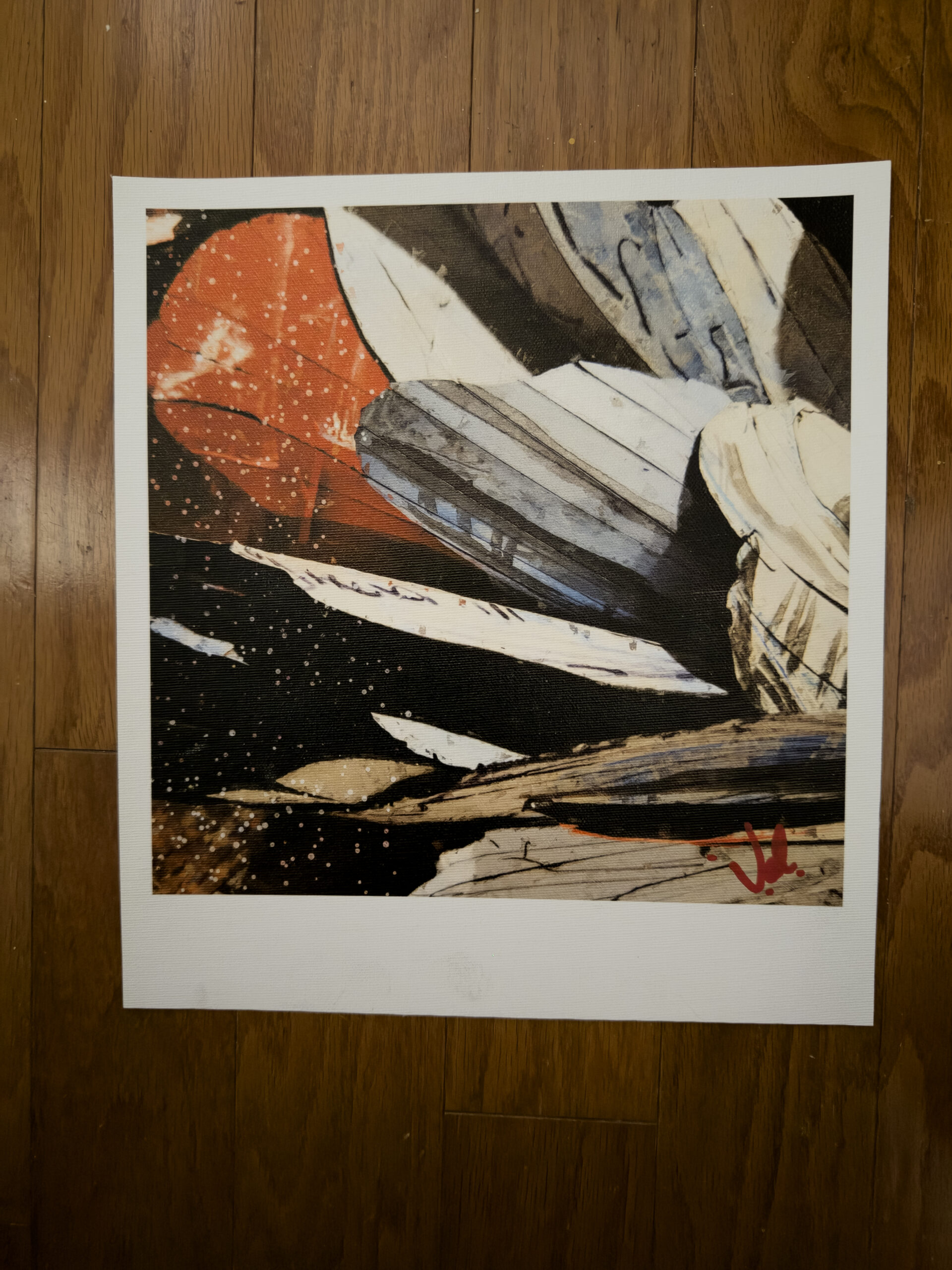
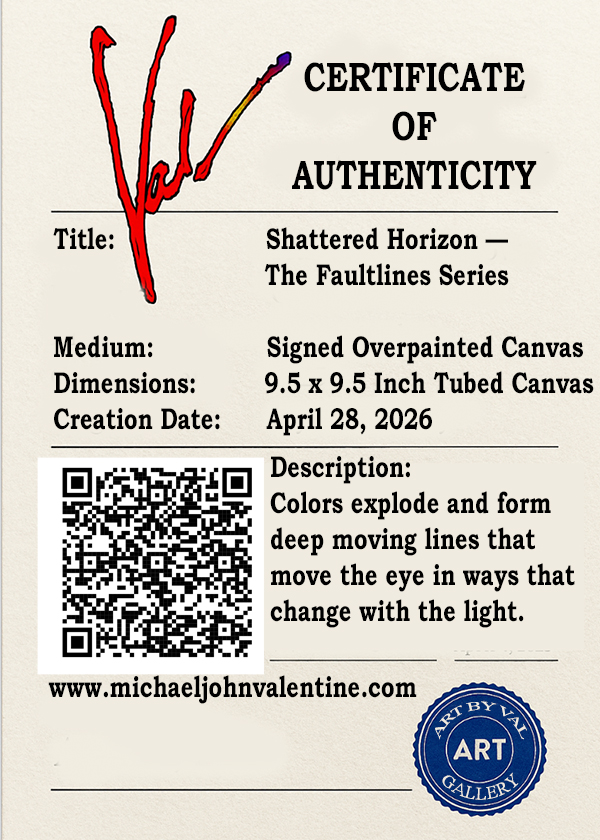
This 9.5 x 9.5 overpainted canvas is signed on the front and features overpainting with acrylics. This is an ideal work of art for a standard frame using matting and glass. ships in a sealed tube
Within The Faultlines Series, Shattered Horizon occupies a pivotal conceptual and visual position. It is not merely a depiction of a broken landscape; it is the moment perception itself fractures. The horizon—traditionally understood as a symbol of orientation, balance, and future possibility—is no longer intact. Instead, it becomes an unstable seam where meaning disperses and reassembles in unpredictable ways.
This work begins with a fundamental challenge to one of the most deeply embedded visual ideas in human experience: the horizon as a fixed point of reference. In Shattered Horizon, that reference point no longer holds. What remains is not absence, but fragmentation—an interrupted geometry of expectation. The viewer is confronted with the unsettling realization that orientation is no longer guaranteed. The world does not simply extend outward; it breaks.
The title itself carries dual implications. “Shattered” suggests violent discontinuity, but it also implies multiplicity—pieces that still exist, though no longer unified. “Horizon” implies boundary, distance, and future. Together, the phrase describes a future that cannot be read in a straight line. Instead, it must be interpreted through fracture, distortion, and layered perception.
Within the broader language of The Faultlines Series, this piece functions as a threshold moment. If faultlines represent invisible pressure systems beneath stability, then Shattered Horizon is the visible consequence of those systems finally surfacing. It is not the earthquake itself, but the landscape immediately after orientation has been lost. The viewer is no longer standing in front of a scene—they are standing inside a disrupted field of vision.
The composition reflects this conceptual instability through deliberate fragmentation. Rather than presenting a continuous spatial logic, the work is structured through interrupted planes, displaced alignments, and fractured transitions of tone and texture. The eye attempts to reconstruct continuity, but is repeatedly denied resolution. What emerges instead is a kind of visual stutter—an experience of perception being forced to recalibrate in real time.
This refusal of continuity is not accidental; it is foundational. The horizon, in its traditional form, offers psychological comfort. It tells the viewer where space stabilizes, where distance begins, and where future becomes legible. By breaking this line, Shattered Horizon removes that comfort. What replaces it is a more honest condition: the recognition that stability is always provisional, and that perception itself is subject to disruption.
Materially, the surface carries this philosophy forward. Layers behave less like additions and more like interruptions. Overpainting becomes a record of interference rather than refinement. Beneath the visible surface, earlier states of the work persist, partially exposed, partially suppressed—like geological strata disrupted by force. The painting does not erase its history; it fractures it.
Color plays a crucial role in establishing this sense of dislocation. Rather than functioning as atmospheric description, it operates as directional force. Shifts in tone feel like sudden changes in terrain, as though the visual field is tilting or folding under pressure. Lighter passages do not necessarily suggest clarity; instead, they often intensify the instability by exposing gaps in the visual structure. Darker regions do not simply recede—they compress, suggesting weight and internal tension.
There is also a psychological dimension embedded within the work’s spatial logic. The shattered horizon is not only external; it reflects an internal state of disorientation. The viewer’s instinct to locate stability becomes part of the experience itself. As the eye searches for continuity, it participates in the construction—and failure—of coherence. In this sense, the painting is not static. It activates perception as a process under strain.
Within your studio methodology, particularly the emphasis on live responsiveness and iterative overpainting, Shattered Horizon carries the imprint of decision-making under pressure. It feels as though each gesture is both an assertion and a correction, each mark responding to the instability of the last. This creates a sense of dialogue within the surface itself—a continuous negotiation between control and collapse.
Conceptually, the work also engages with the idea of future rupture. A horizon typically represents what lies ahead, what can be approached but never reached. In Shattered Horizon, that forwardness is compromised. The future is no longer a singular direction; it is scattered across multiple broken vectors. This introduces a profound shift in how the viewer engages with space. Instead of looking toward something, they are forced to navigate through something already disrupted.
Despite its fragmentation, the work does not descend into chaos. There is an underlying structural intelligence that holds the fracture in place. The composition is not random—it is deliberately destabilized. This distinction is critical. Chaos suggests absence of order; fracture suggests the presence of order that has been interrupted. Shattered Horizon exists precisely in that interruption.
The viewer’s experience unfolds gradually. At first, there is disorientation. Then, slowly, patterns begin to emerge—not as fixed structures, but as temporary alignments. These alignments shift depending on focus, distance, and time. The painting refuses to settle into a single reading, instead offering multiple unstable interpretations simultaneously. This multiplicity is central to its impact.
In the context of The Faultlines Series, the work extends the series’ exploration of invisible pressure systems into visible spatial collapse. If earlier works suggest accumulation beneath the surface, Shattered Horizon reveals what happens when that accumulation reaches the edge of perceptual coherence. It is not simply a rupture in land or sky—it is a rupture in how space is understood.
Ultimately, Shattered Horizon is about the loss of a singular point of reference. It asks what remains when orientation fails, when the line that once separated near and far, known and unknown, present and future is no longer intact. What remains is not emptiness, but multiplicity. Not silence, but fragmented perception.
It is a horizon no longer whole—but still present in its pieces.
The Exhibition Canvas comes in 3 sizes and goes through several steps that include overpainting with acrylics, signing with acrylics on the front and a final glazing to protect the canvas before being rolled in a sealed tube then a box ( shipping is free in the USA )
The Matted Prints come in 3 sizes and are shipped in a box. ( shipping and handling is free in the US)
The Glossy Poster Print measures 16 x 24 and arrives in a sealed tube that is placed in a box. ( shipping is free in the US )
The 4 Inch Round Peel And Stick Decal is perfect for many applications beyond cars and comes in a sealed envelope ( shipped for free )