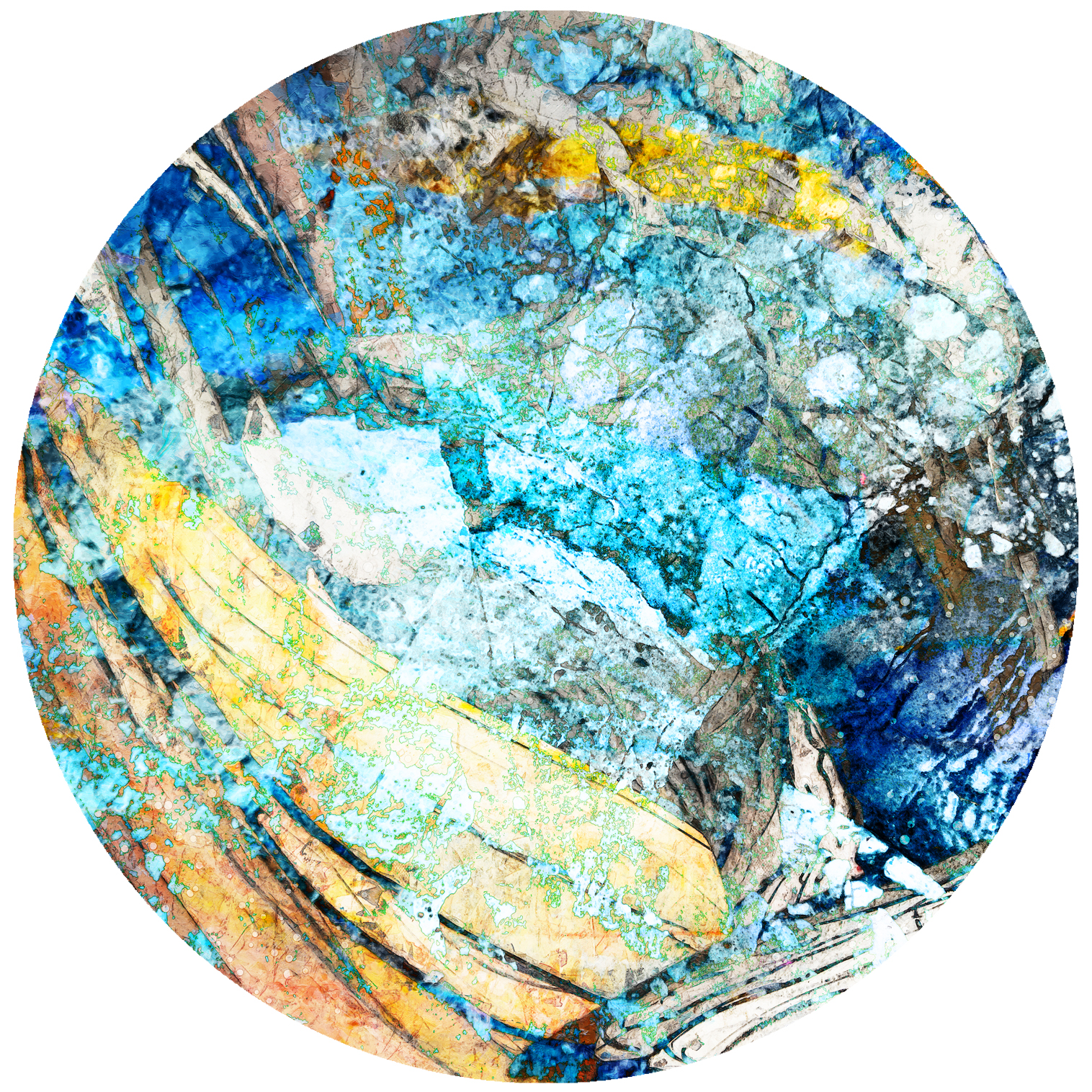
The Earth’s Celestial Tide
“Every act of creation is first an act of destruction.” — Pablo Picasso
There are moments in abstract art when the canvas ceases to behave like a flat surface and begins to feel more like a window—an opening into a world that exists somewhere between earth, water, and light. The Earth’s Celestial Tide is one of those rare works where the boundary between the physical and the elemental dissolves. Within its circular form, the viewer encounters something that feels both geological and cosmic: the fractured memory of oceans, the slow pressure of continents, and the luminous rhythm of tides that have shaped this planet for millions of years.
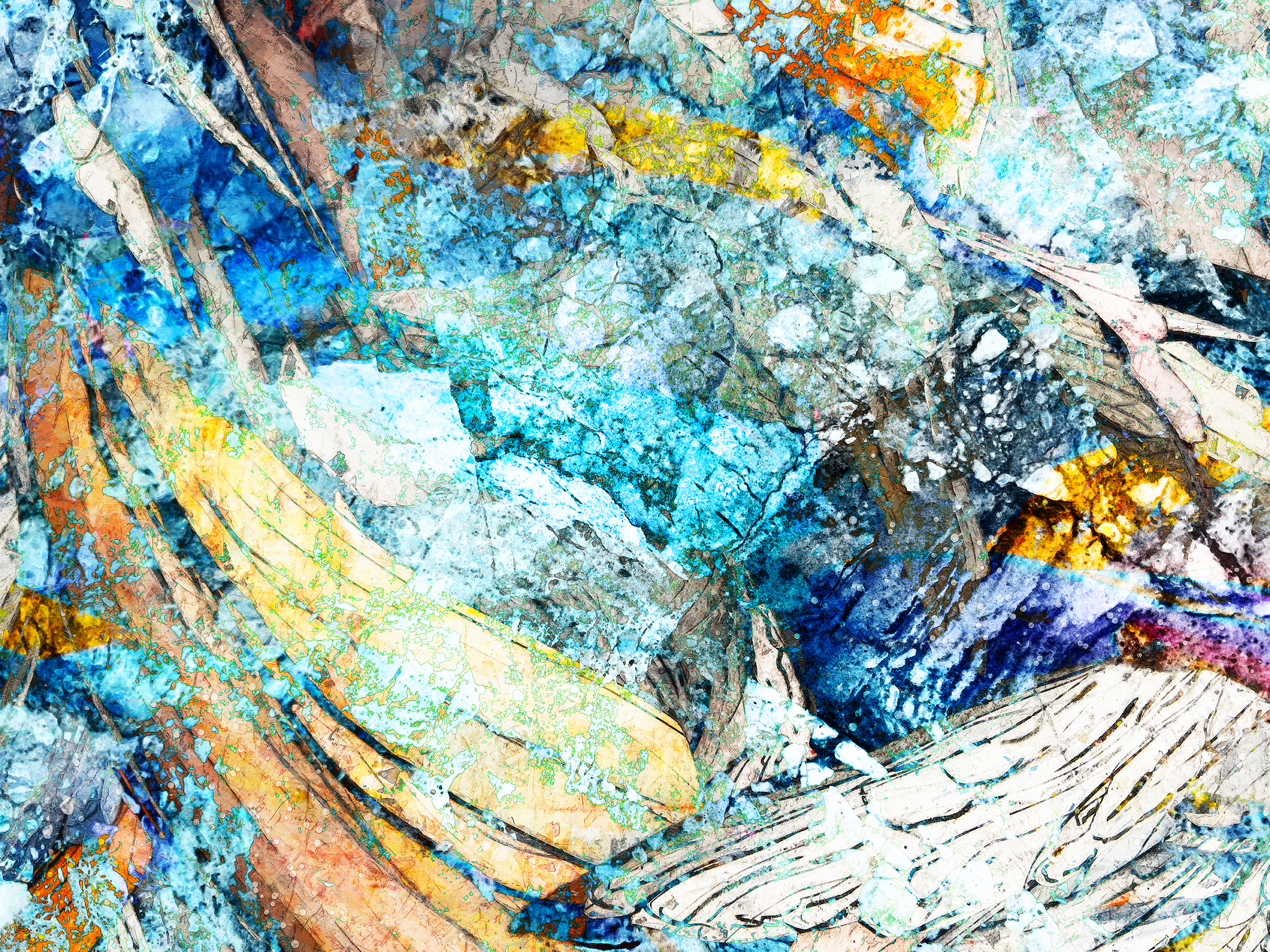
The circular format itself is intentional. A circle has no beginning and no end. It suggests orbit, continuity, the cyclical motion of oceans and planets. In this piece, the round composition becomes a symbolic horizon—like looking through a porthole, a telescope, or an ancient navigational instrument that reveals the hidden movement of the natural world. Blues surge through the painting in layered currents, ranging from deep midnight tones to luminous turquoise. These colors evoke submerged reefs, tidal pools, and the vast breathing body of the sea.
Yet water is only part of the story. Running through the composition are mineral-like fractures, veins of gold and warm earth tones that feel as though the painting has been carved directly from the crust of the planet. These textures resemble weathered stone, eroded cliffs, or the exposed strata of ancient geological formations. The painting becomes a meeting place of opposing forces—fluid water and solid earth, chaos and structure, destruction and renewal.
At the heart of this work lies a process that defines the artist’s approach: overpainting. Rather than building a painting in a single linear progression, this method involves creating multiple layers of acrylic paint over time. Each stage of the painting is allowed to live briefly before being partially covered, broken apart, or transformed by the next layer. Colors are poured, brushed, splattered, and scraped. Surfaces are fractured and then rebuilt. Textures emerge unexpectedly as earlier layers push forward through the newer paint.
This process mirrors the forces that shape the natural world itself. Just as oceans carve into coastlines and tectonic plates reshape continents, the painting evolves through cycles of creation and destruction. Earlier marks are never completely erased; instead, they remain embedded within the surface, like fossils trapped in sedimentary rock. The viewer is not only seeing the final image but also the history of the painting’s evolution.
Because of this overpainting technique, no two works can ever be the same. Even if the artist attempted to recreate the same colors, gestures, or textures, the unpredictable interaction between layers would inevitably produce a different result. Paint flows differently. Pigments react uniquely. Surfaces crack, bloom, or shift in ways that cannot be precisely controlled. Each painting becomes a singular event—an unrepeatable convergence of movement, chemistry, intuition, and time.
In The Earth’s Celestial Tide, this layered approach creates a remarkable sense of depth. Areas of luminous blue appear to drift above fractured stone-like textures, while delicate lines and mineral edges emerge from beneath translucent washes of paint. The surface feels alive, almost as though it is still shifting under invisible tidal forces. Light seems to move across the painting the way sunlight moves across water.
What makes the work particularly compelling is its balance between chaos and harmony. The composition appears spontaneous, yet there is a subtle gravitational pull that guides the viewer’s eye around the circular form. Lines curve like currents. Colors flow like tides. Gold and sand tones anchor the composition, suggesting the meeting point where ocean meets shore.
For collectors, the significance of this piece lies not only in its visual impact but also in its absolute uniqueness. In an era where images can be endlessly reproduced, a painting created through this layered, intuitive process stands apart as something profoundly individual. It is not merely a picture—it is a record of motion, decision, and transformation.
Ultimately, The Earth’s Celestial Tide invites the viewer to contemplate the deeper rhythms that govern both art and nature. Beneath its surface lies the quiet suggestion that the forces shaping a painting are not so different from the forces shaping the world itself: pressure, erosion, light, water, and time.
And just like the tides that inspired it, this work exists as a singular moment in motion—never to occur in exactly the same way again.
The Exhibition Canvas comes in 3 sizes and goes through several steps that include overpainting with acrylics, signing with acrylics on the front and a final glazing to protect the canvas before being rolled in a sealed tube then a box ( shipping is free in the USA )
The Matted Prints come in 3 sizes and are shipped in a box. ( shipping and handling is free in the US)
The Glossy Poster Print measures 16 x 24 and arrives in a sealed tube that is placed in a box. ( shipping is free in the US )
The 4 Inch Round Peel And Stick Decal is perfect for many applications beyond cars and comes in a sealed envelope ( shipped for free )