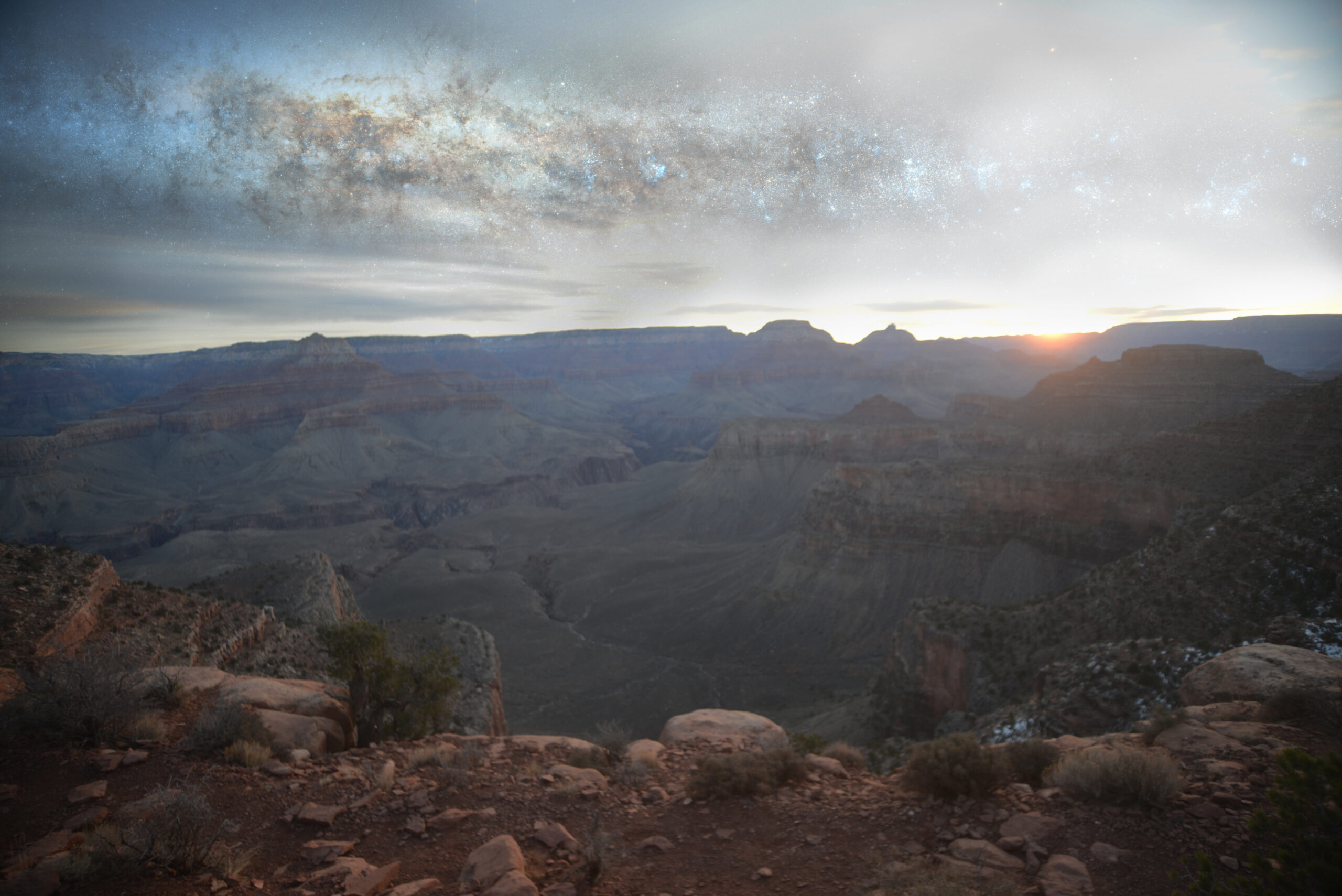

“The wonders of the Grand Canyon cannot be adequately represented in symbols of speech, nor by speech itself. The resources of the graphic art are taxed beyond their powers in attempting to portray its features.”
— John Wesley Powell
This profound observation by the 19th‑century explorer John Wesley Powell captures the paradoxical challenge at the heart of landscape art: how does one give adequate form to something so immense, so ancient, and so ineffably sublime? In a single sentence, Powell acknowledges both the irresistible urge to represent the Grand Canyon and the inherent limitations of that endeavor, whether in language or on canvas. His words set the stage for understanding why artists—from Hudson River School painters to contemporary creators—continue to be drawn to this iconic landscape.
The Grand Canyon in the Artistic Imagination
The Grand Canyon holds a unique place in the history of art—not merely as a subject of natural beauty, but as an enduring symbol of wonder, scale, and the sublime. It was Thomas Moran, one of the great masters of American landscape painting, who helped bring the canyon’s grandeur to the broader world. His towering depictions of the canyon in the late 19th and early 20th centuries became emblematic of the way art could shape public perception of the American West.
Moran once wrote with unguarded passion about the canyon’s visual power:
“Of all places on earth the great canyon of Arizona is the most inspiring in its pictorial possibilities.”
For Moran, color, light, and perspective were not just compositional tools but pathways into the emotional resonance of the landscape itself. In his works—whether in the monumental Grand Canyon of the Colorado River or in smaller, more intimate studies—the canyon becomes both subject and collaborator, a force that shapes the artistry as much as it is shaped by the painter’s vision.
Across the decades, many artists have echoed similar sentiments—even as each brought their own style, technique, and emotional lens to the canyon’s immensity. Some, like David Hockney, embraced modern takes on landscape, interpreting the vast forms through dynamic color and fractured perspective, suggesting that the canyon’s grandeur resists a single, fixed point of view. Other painters have emphasized atmospheric phenomena, ever‑changing shadows, or the interplay between light and rock strata—the canyon as a living, breathing entity rather than a static backdrop.
Yet across eras and styles, a shared thread persists: the canyon is not merely seen—it is felt.
Interpreting “Grand Canyon Sunrise” in that Legacy
With Powell’s words as a starting point, Michael John Valentine’s Grand Canyon Sunrise enters into a long tradition of artists attempting what Powell deemed so difficult: to represent the canyon’s awe through visual form. While Powell argued that art’s “resources … are taxed beyond their powers,” artists like Valentine challenge that notion not by denying it, but by embracing it—acknowledging that no single work can “capture” the canyon in totality, yet believing that each can illuminate a facet of its wonder.
In Grand Canyon Sunrise, the interplay of light and color becomes paramount. Sunrise is itself a moment of transformation—a threshold between shadow and illumination, where the canyon’s layered geology comes alive with radiance. This choice of subject mirrors the broader artistic impulse to seize moments of highest visual poetry, when the canyon nearly speaks through chromatic shifts, atmospheric glow, and the tension between stillness and change.
This canvas is a meditation on presence: the viewer is invited to step into the silent grandeur of morning’s first light, to feel the hush that precedes the day’s warmth. The painting’s brushwork—whether in sweeping washes of color or minute, textural marks—acts as a translator between the canyon’s immense physical reality and the viewer’s internal world of memory and emotion.
In this way, Valentine’s work does what all great landscape painting aspires to do: it bridges the seen with the felt. It doesn’t replace the lived experience of standing at the canyon’s rim (as Powell suggested words and art inevitably fall short) but expands the viewer’s appreciation for what makes that experience so powerfully ineffable.
The Canyon’s Ongoing Dialogue with Artists
What many painters discover—Moran, Hockney, Widforss, and countless others—is that the canyon is less a fixed subject than an ongoing conversation. Gunnar Widforss, known affectionately as “the painter of the national parks,” once reflected that he had “never seen anything that can approach this in majestic beauty,” a sentiment that underscores the canyon’s unparalleled capacity to inspire repeated artistic inquiry.
This dialogue persists in contemporary art as well. Artists working in plein air settings along the canyon’s rim speak about the constantly shifting light, the fleeting interplay of cloud and vista, and the challenge of rendering these dynamics before the sun slips beyond the horizon.
Each of these perspectives reinforces the idea that the canyon is not a single picture, but a multitude of them—each sunrise, each season, each vantage point adds another layer to its ongoing aesthetic and emotional narrative.
Why It Matters
In an age when so much art seeks to interpret the world, a landscape like the Grand Canyon reminds us of art’s oldest calling: to bridge the ineffable and the perceptible. Powell’s insistence that the canyon defies complete representation becomes not a dismissal of art’s capacity, but a challenge to artists—past, present, and future—to continue striving, experimenting, and responding.
Grand Canyon Sunrise stands within this lineage: not as a final word, but as an evocative chapter. It recalls the canyon’s ancient past, its geological magnificence, and its power to stir the human spirit. Through the interplay of light and shadow, color and form, this original painting on canvas invites us to reflect not only on what we see, but on how places of grandeur shape the deepest parts of our imagination.
In that sense, perhaps the greatest tribute to Powell’s insight is not resignation but continued artistic ambition—a suggestion that while the Grand Canyon may forever elude complete capture, it will always reward the artist’s eye and heart with fresh, resonant inspiration.
The Exhibition Canvas comes in 3 sizes and goes through several steps that include overpainting with acrylics, signing with acrylics on the front and a final glazing to protect the canvas before being rolled in a sealed tube then a box ( shipping is free in the USA )
The Matted Prints come in 3 sizes and are shipped in a box. ( shipping and handling is free in the US)
The Glossy Poster Print measures 16 x 24 and arrives in a sealed tube that is placed in a box. ( shipping is free in the US )
The 4 Inch Round Peel And Stick Decal is perfect for many applications beyond cars and comes in a sealed envelope ( shipped for free )