“There is no abstract art. You must always start with something. Afterward you can remove all traces of reality.” — Pablo Picasso
A Moment Without End — Where Time Dissolves Into Light
A Collector’s Meditation on Infinite Perception
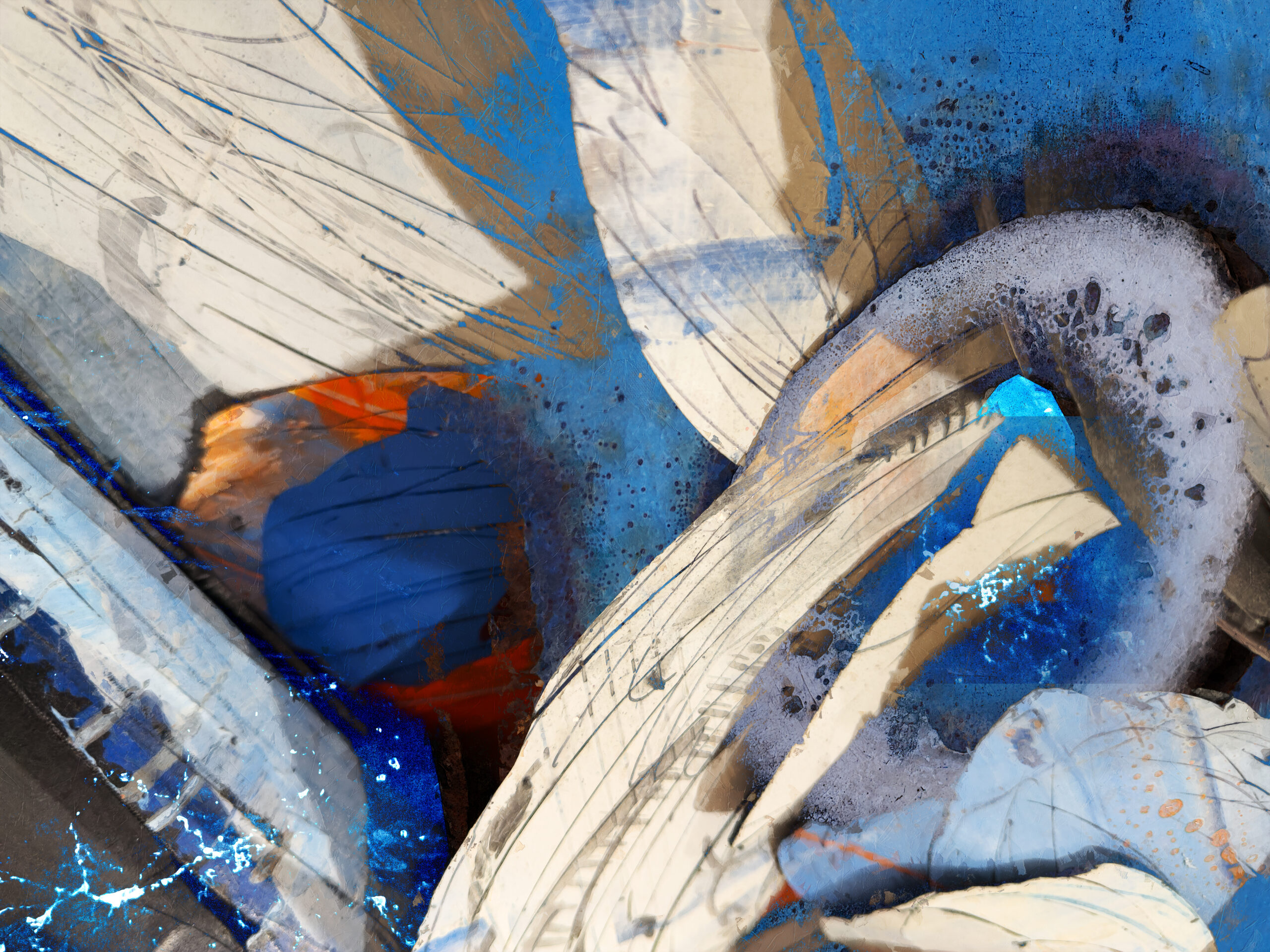
In A Moment Without End, Michael John Valentine presents more than an abstract composition; he offers a suspended experience—an interval where time does not progress so much as it expands. The work belongs to that rare category of contemporary fine art that resists closure. It does not ask to be understood quickly or definitively. Instead, it asks to be entered, lived within, and revisited as one would return to a memory that refuses to remain fixed.
Valentine’s approach to abstraction aligns naturally with Picasso’s assertion that abstraction is never born from nothing. It begins with the real, the observed, the lived moment—and only then is it distilled, refined, and transformed until it becomes something beyond recognition yet still emotionally anchored. A Moment Without End embodies this transformation. It feels grounded in lived sensation, yet liberated from any obligation to describe it literally.
What emerges is not a depiction of a place or object, but of continuity itself—the feeling that a single instant, when fully seen, contains an entire universe of unfolding perception.
The Visual Language of Continuity
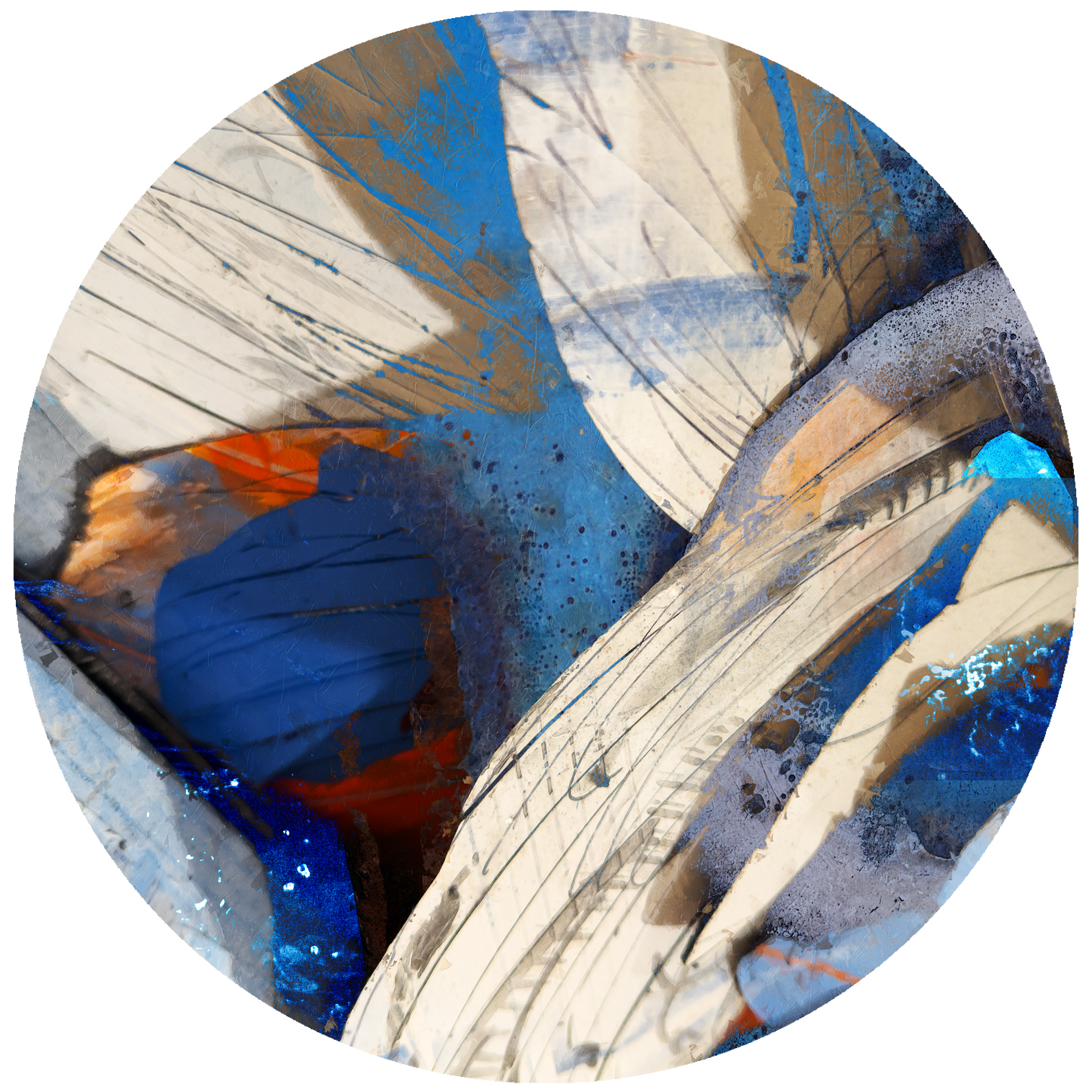
The composition of A Moment Without End can be understood as a dialogue between motion and stillness. Rather than presenting a fixed focal point, the work distributes energy across the surface in a way that encourages perpetual movement of the eye. Color does not sit passively; it flows, overlaps, recedes, and re-emerges in layered intervals that suggest both depth and atmospheric vibration.
There is a sense that the painting is always in the process of becoming. Forms appear as if they are surfacing from memory, only to dissolve again into fields of color and texture. This creates a visual rhythm that feels less like viewing an object and more like witnessing a phenomenon—something atmospheric, almost temporal in nature.
The abstraction operates on a sensory level first. Before the mind attempts interpretation, the body registers movement, temperature, and emotional tone. This is where Valentine’s strength as a contemporary abstract artist becomes evident: he constructs not just images, but environments of feeling.
The Emotional Architecture of Time
What distinguishes A Moment Without End within Valentine’s broader body of work is its relationship to time. Rather than treating time as linear, the piece suggests something more fluid—an emotional continuum where past, present, and anticipation coexist.
The viewer is invited into a psychological space where a single moment expands outward. A brushstroke becomes not just a mark, but a trace of motion that still feels active. Layers of pigment behave like sedimented experience—each one partially revealing and partially concealing what came before it.
In this sense, the work does not represent a moment. It is the unfolding of a moment that refuses resolution.
For collectors, this creates a uniquely immersive relationship. The painting does not exhaust itself after repeated viewings. Instead, it deepens. New pathways of interpretation emerge as light changes, as mood shifts, and as the viewer’s own internal state evolves. The artwork becomes less an object on a wall and more a companion in perception.
Material Presence and Artistic Intention
Valentine’s process is rooted in a disciplined understanding of layered construction. His works are known for their physical depth—built through repeated application, refinement, and overpainting techniques that allow earlier gestures to remain partially visible beneath newer ones.
In A Moment Without End, this material layering becomes metaphor. The surface reads as a record of decisions, revisions, and intuitive responses. Nothing feels accidental, yet nothing feels overly constrained. There is a balance between control and surrender, structure and spontaneity.
This tension is essential to the work’s emotional resonance. It reflects the way human experience itself accumulates: not in clean, separate chapters, but in overlapping impressions that never fully disappear.
The painting, therefore, is not just seen—it is sensed as accumulation.
A Collector’s Perspective: Exclusivity Through Experience
Within the context of contemporary fine art collecting, A Moment Without End occupies a space defined not by decoration, but by presence. It is the type of work that transforms an interior environment—not by dominating it, but by altering its atmosphere.
Collectors drawn to Valentine’s practice often respond to the way his works carry both visual intensity and contemplative stillness. This duality makes the piece adaptable to high-end residential interiors, curated gallery walls, and architectural spaces that prioritize emotional tone over visual noise.
Its exclusivity lies not only in authorship or craftsmanship, but in its experiential quality. Each viewing feels slightly different. Each return reveals something previously unnoticed. This is the hallmark of enduring fine art: it does not conclude its meaning upon acquisition. It continues to evolve alongside the collector.
The Philosophical Undercurrent
At its core, A Moment Without End engages with a quiet philosophical proposition: that a single moment, when fully perceived, is infinite.
This idea resonates throughout the composition. There is no narrative beginning or end, no imposed hierarchy of form. Instead, the viewer encounters a field of relational energy—where everything is connected, yet nothing is fixed.
The work becomes a meditation on perception itself. It asks: if attention is sustained long enough, does time dissolve? Does a moment cease to be singular and become expansive?
Valentine does not answer these questions directly. Instead, he constructs a visual environment in which the viewer experiences them.
Conclusion: The Living Image
A Moment Without End stands as a testament to the enduring power of abstract painting in contemporary fine art. It resists simplification, rewarding instead patience, proximity, and emotional engagement.
In the spirit of Picasso’s insight—that abstraction is born from reality before it transcends it—Valentine’s work carries the residue of the real while opening into something more expansive. It is not an escape from the world, but a deepening of how the world is perceived.
Ultimately, this is not a painting that you finish looking at. It is a painting that continues looking back.
And in that exchange—between viewer and image, moment and memory—it never truly ends.
A Special Modern Abstract Series about time, memory, atmosphere, and fleeting perfection.
The Series Includes the following releases- The Shape Of A Perfect Day, A Day Worth Holding, The Calm After Color, The Day That Found Us, Just Before Evening, Before The Day Breaks, A Sky That Wouldn’t Leave, After The Light Fades, A Moment Without End, The Day That Stayed, The Longest Light, One Fine Day
The Exhibition Canvas comes in 3 sizes and goes through several steps that include overpainting with acrylics, signing with acrylics on the front and a final glazing to protect the canvas before being rolled in a sealed tube then a box ( shipping is free in the USA )
The Matted Prints come in 3 sizes and are shipped in a box. ( shipping and handling is free in the US)
The Glossy Poster Print measures 16 x 24 and arrives in a sealed tube that is placed in a box. ( shipping is free in the US )
The 4 Inch Round Peel And Stick Decal is perfect for many applications beyond cars and comes in a sealed envelope ( shipped for free )