“Color is a power which directly influences the soul.” — Wassily Kandinsky
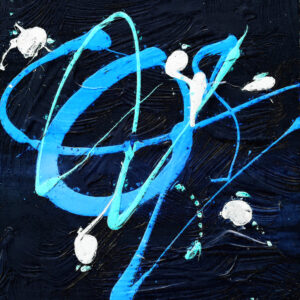
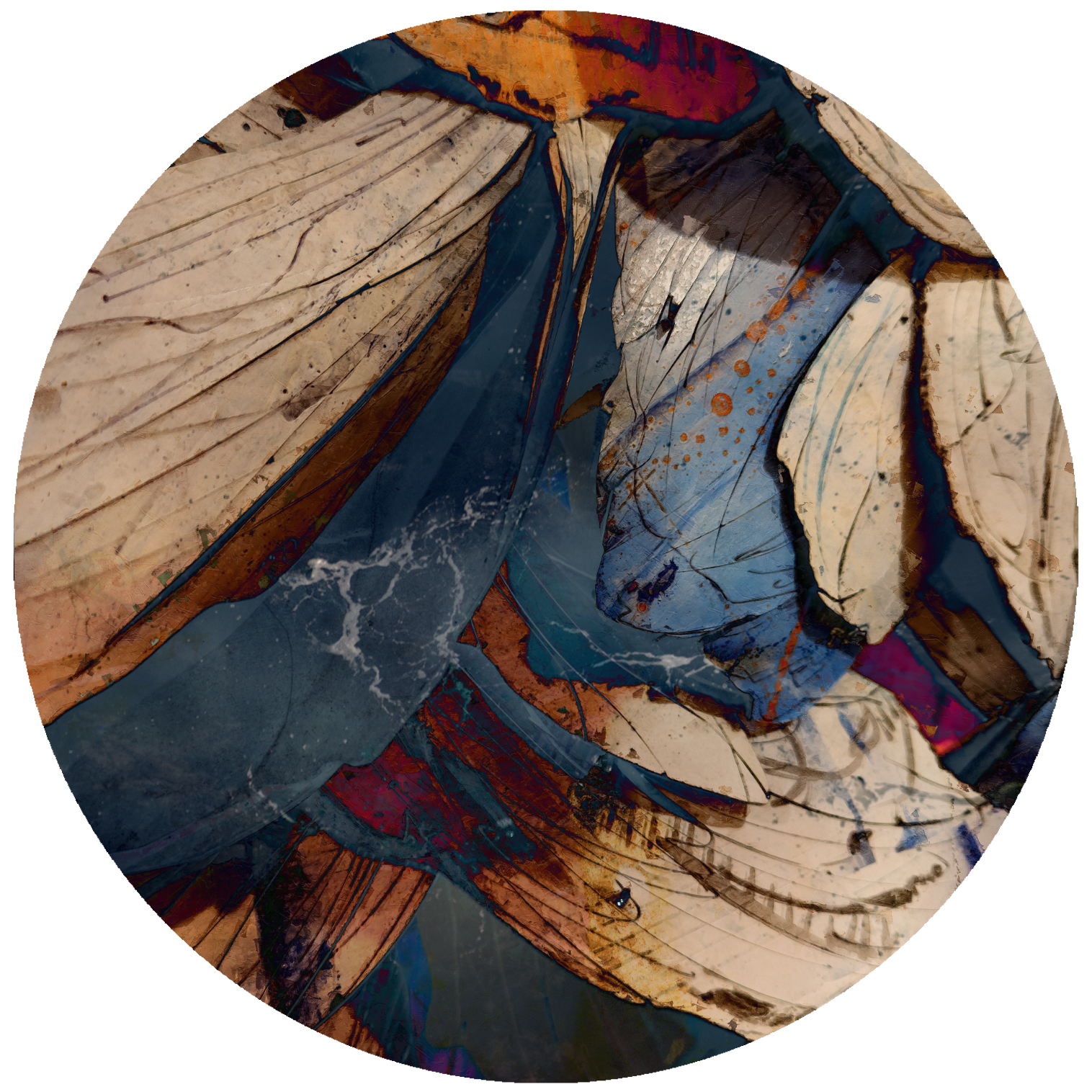
In After the Light Fades, Michael John Valentine explores the moment beyond illumination—the quiet, often overlooked threshold where light withdraws and something deeper begins to surface. This work does not depict darkness as absence, but as transformation. It is within this transition—after brilliance softens, after clarity dissolves—that the painting finds its true voice.
At its core, this piece is an investigation of what remains.
The composition unfolds through a restrained yet emotionally charged palette, where tonal shifts carry more weight than overt contrast. Subtle gradients and layered textures replace immediate visual impact, encouraging a slower engagement. This is not a work that reveals itself instantly; it asks the viewer to stay, to look again, and to allow perception to adjust—much like the human eye adapting after the loss of light.
This sense of gradual revelation is inseparable from Valentine’s signature overpainting process, which serves as both method and meaning within the work.
Unlike traditional approaches that aim for resolution in a single pass, Valentine constructs his paintings through a sustained dialogue with the surface. Each layer is not simply added—it is negotiated. Early compositions establish direction, gesture, and tonal structure, but they are intentionally left unresolved. These initial marks—often energetic and instinctive—are then partially obscured through successive applications of acrylic and mixed media.
Glazes are introduced to soften and unify, allowing underlying elements to remain visible as spectral traces. Opaque passages are applied to assert new forms, only to be reduced or reworked in later stages. Areas of the surface are scraped, redefined, and reopened, revealing fragments of earlier decisions that continue to inform the final composition.
What emerges is a surface that carries visible memory.
In After the Light Fades, this accumulation is particularly pronounced. The viewer can sense the presence of earlier layers beneath the final image—subtle shifts in tone, ghosted lines, and textural variations that suggest a history embedded within the work. These are not imperfections; they are intentional artifacts of process, each one contributing to the painting’s depth and authenticity.
This method ensures that the work exists not as a static image, but as a record of time.
Light interacts with this layered surface in complex and nuanced ways. Rather than reflecting uniformly, it is absorbed, refracted, and released across different areas of the painting. Some passages appear to recede into shadow, while others emerge softly, creating a dynamic interplay that shifts depending on the viewer’s position and the surrounding environment.
This is where the title finds its resonance.
“After the Light Fades” is not about darkness overtaking light, but about the persistence of presence beyond it. The painting captures that fleeting interval where illumination has diminished, yet its influence remains—lingering within color, within texture, within the very structure of the work.
There is a quiet tension here—a balance between what is seen and what is suggested.
Valentine resists the temptation to fully resolve the composition. Forms hover at the edge of recognition, never fully defined, allowing the viewer to engage in a process of discovery. This openness is central to the work’s impact. Each viewer brings their own interpretation, their own memory of light and its absence, creating a deeply personal interaction with the piece.
The overpainting process reinforces this individuality.
Because each layer is applied, altered, and preserved through intuitive decision-making, the outcome cannot be replicated. Variables such as gesture, pressure, timing, and material interaction ensure that every work is inherently unique. In After the Light Fades, this uniqueness is not only visible—it is structural. The painting’s depth, its subtle shifts, and its tonal complexity are the direct result of a process that values evolution over repetition.
For the collector, this distinction is critical.
This is not a reproduced image or a repeatable composition. It is a singular convergence of moments—a physical manifestation of time, intention, and transformation. The visible traces of earlier layers serve as a testament to this journey, reinforcing the authenticity of the work and its place within Valentine’s broader practice.
There is also an emotional architecture at play.
The painting does not demand attention through intensity; instead, it draws the viewer inward through restraint. Its quieter passages hold as much significance as its more defined elements. This balance creates a sense of calm, but not stillness—a feeling of suspended transition, where something has ended, yet something else is quietly beginning.
In this way, After the Light Fades becomes more than an abstract composition.
It becomes an experience of perception itself.
It asks the viewer to consider not just what is visible, but what lingers beyond visibility—to recognize that even as light diminishes, it leaves behind structure, memory, and presence.
And it is within that presence that the work continues to live.
Not in the light—
but in what remains after it.
A Special Modern Abstract Series about time, memory, atmosphere, and fleeting perfection.
The Series Includes the following releases- The Shape Of A Perfect Day, A Day Worth Holding, The Calm After Color, The Day That Found Us, Just Before Evening, Before The Day Breaks, A Sky That Wouldn’t Leave, After The Light Fades, A Moment Without End, The Day That Stayed, The Longest Light, One Fine Day
The Exhibition Canvas comes in 3 sizes and goes through several steps that include overpainting with acrylics, signing with acrylics on the front and a final glazing to protect the canvas before being rolled in a sealed tube then a box ( shipping is free in the USA )
The Matted Prints come in 3 sizes and are shipped in a box. ( shipping and handling is free in the US)
The Glossy Poster Print measures 16 x 24 and arrives in a sealed tube that is placed in a box. ( shipping is free in the US )
The 4 Inch Round Peel And Stick Decal is perfect for many applications beyond cars and comes in a sealed envelope ( shipped for free )