“I found I could say things with color and shapes that I couldn’t say any other way—things I had no words for.”
— Georgia O’Keeffe
In the contemplative space between sight and feeling, abstract art lives. It is here, where the constraints of language loosen and sensory experience ascends, that Abstract Modern Wall Art – Turn To Stone by Michael John Valentine finds its voice. This piece—like O’Keeffe’s profound articulation of artistic expression—embodies an essential truth about abstract creation: that visual language can convey meaning beyond the reach of words.
The Essence of Expression Beyond Words
Georgia O’Keeffe’s insight into the nature of artistic communication doesn’t merely describe a process; it illuminates a philosophy. Her assertion that color and form can articulate what language cannot expresses the very core of abstract art’s power. In abstraction, the artist abandons literal representation and instead engages with the intangible: emotion, memory, rhythm, and the resonance of inner life.
This is the realm into which Turn To Stone invites us. It is not about depicting a recognizable scene or narrative, but rather about evoking a sensation—something elemental, something as ancient and profound as stone itself. This artwork stands not as a picture of stone, but as a meditation on solidity, transformation, and the quiet force that underlies form.
A Dialogue Between Artist and Viewer
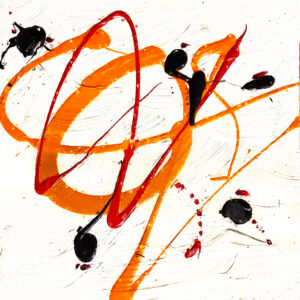
At first glance, Turn To Stone occupies the visual field with the elegant ambiguity that is the hallmark of abstract expression. Its interplay of hues, layered textures, and gestural brushwork work together to create a surface that seems in motion even in stillness. Though the exact composition is unique to this piece, the broader aesthetic aligns with Valentine’s established practice of overpainting select areas to achieve depth and nuance. This technique, repeatedly employed across his abstract works, enhances the sense of layered experience and invites extended contemplation.
But what makes this piece compelling is not simply its visual richness—it is the space it creates for the viewer’s own response. Here, the viewer becomes a participant in a silent dialogue with the work. The shapes and colors do not dictate meaning; they suggest it. In this way, Turn To Stone fulfills O’Keeffe’s vision of art as expressive territory for the unsayable.
Materiality and Presence
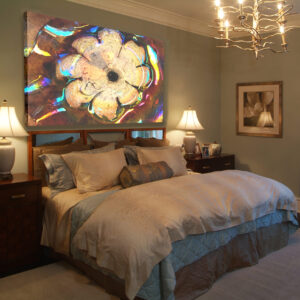
Physically, Turn To Stone is presented on canvas, available in formats ranging from modest decals and prints to large overpainted signed canvases. Each version carries the tactile promise of handcrafted artistry—the surface sealed with a glossy protectant, the accumulation of brushstrokes preserved as a unique testament to the moment of creation.
Valentine’s meticulous attention to presentation reflects an understanding that the physicality of art—the texture, finish, scale, and even framing—contributes to its experiential impact. The rolled delivery and invitation to frame the canvas personally emphasizes that art does not exist in a vacuum, but within the lived environment of the collector. That environment, in turn, frames the meanings we take from the work.
The Language of Abstraction
Abstract art is often described as a translation of experience into visual form. Yet, unlike representational art, it resists precise interpretation. Instead, it opens possibilities. It gestures toward emotion without naming it, invites reflection without prescribing thought, and suggests rhythm without a score. In this sense, the trust between artist and viewer becomes central: the artist trusts that the work will resonate; the viewer trusts their own perceptual responses.
This exchange mirrors O’Keeffe’s approach to her own abstraction. She recognized that certain sensations and ideas cannot be captured in speech, so she turned to color and form as vehicles of expression. Like her iconic Blue and Green Music, which sought to evoke the experience of music through visual rhythm, Turn To Stone evokes a sensory metaphor—the quiet gravitas and enduring mystery of stone—without ever illustrating the object itself.
A Collector’s Encounter
For the dedicated collector, Turn To Stone is an invitation to a nuanced aesthetic encounter. It rewards proximity and repeated viewing: the subtle shifts in hue, the layered application of pigment, and the gentle tension between form and void all reveal new subtleties over time. It is not a spectacle to be consumed in an instant, but an experience to be dwelt with.
Collectors who center their spaces around works like this understand that abstract art functions on multiple registers. It becomes part of the rhythm of daily life—an atmosphere-shaper, a contemplative trigger, a silent companion in moments of introspection.
Art Beyond Description
Ultimately, Abstract Modern Wall Art – Turn To Stone exemplifies the idea that some meanings are best expressed without words. The title itself suggests a poetic transformation: elements become stone; emotion becomes form; sensory impression becomes art. Through this work, Valentine extends an invitation to explore not just what we see, but how we feel what we see.
O’Keeffe’s declaration—that art communicates what language cannot—is not simply a statement about technique. It is a reminder that art reaches into the depths of experience that are otherwise inaccessible. When we stand before a work such as Turn To Stone, we participate in an act of translation: from the visual to the emotional, from form to resonance. In that space, beyond words, we encounter the power of abstraction at its most profound.