“The motion of energy moves like waves of colors across the hidden sky.” – Michael John Valentine
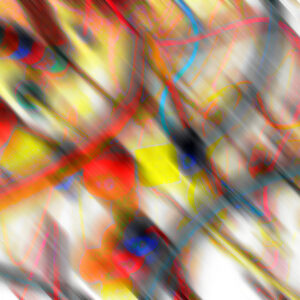
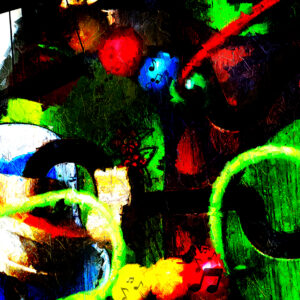
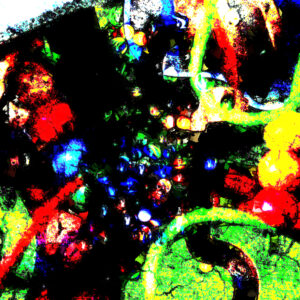
On the Edge of the Universe is more than a visual composition—it is an odyssey of perception, a journey into the unseen architecture of the cosmos and the hidden dynamics of color and form. This work invites the viewer to stand at the precipice of imagination, where the boundaries between reality and abstraction dissolve, and where energy manifests itself in a symphony of visual motion. At first glance, the painting may seem like a chaotic interplay of shapes and hues. Yet, upon deeper examination, it becomes clear that every stroke, every gradient, and every interplay of light has been guided by intention, inspired by the invisible rhythms that pulse through the universe itself.
The title, On the Edge of the Universe, evokes a sense of infinite possibility. It conjures an experience not merely of observation but of immersion—of standing at the threshold of creation itself. The viewer is encouraged to let go of conventional notions of space and time and instead enter a domain where color and form dictate their own laws, independent of earthly limitations. Here, violet collides with amber, cerulean cascades into crimson, and neon green drifts into midnight blue. These interactions of hue are not arbitrary; they are the visible manifestations of energy in motion, the vibrational language of the universe rendered on canvas.
The brushwork is both dynamic and deliberate, balancing spontaneity with meticulous control. Broad, sweeping gestures evoke the motion of cosmic waves, while delicate, intricate details capture the subtle interplays of energy that often go unnoticed. This duality mirrors the very essence of existence: the grand and the intimate, the universal and the personal, the explosive and the ephemeral. It is in this tension between scale and intricacy that the piece achieves its transcendent effect. One is reminded of standing beneath the night sky, feeling simultaneously infinitesimal and connected to something immeasurably vast.
Color is the primary medium of communication in this work. The palette is luminous yet tempered, balancing intense bursts of energy with moments of quietude and reflection. Each color wave is an expression of motion, an attempt to render the imperceptible rhythms of life into a visual language. The eye is drawn along paths of energy that seem to ripple across the canvas, guided by the invisible hand of the artist. There is a sense of perpetual flow, of movement that refuses to be contained—a reflection of the continuous, dynamic forces that shape our universe.
The composition itself feels suspended between order and chaos. It is as if the universe, caught in a moment of creative flux, has been distilled into its essence: energy in motion, forever unfolding. Shapes emerge and recede, colors collide and harmonize, and the viewer is invited to follow the currents wherever they may lead. The absence of a fixed focal point is deliberate; it encourages exploration, allowing each observer to chart their own path through the canvas, to discover personal narratives hidden within the abstract. This interactivity is central to the work’s power: it is not a painting that dictates meaning, but one that coexists with the interpretations of those who engage with it.
Light plays a crucial role in On the Edge of the Universe. Subtle variations in tonal value create depth and dimensionality, suggesting forms that hover between reality and imagination. Highlights emerge like stars against a deep cosmic void, while shadows provide a grounding counterpoint, evoking the interplay of energy and matter, of illumination and obscurity. The effect is immersive, almost cinematic, as if the viewer is peering through a window into a parallel dimension where the laws of physics are dictated by color and motion rather than gravity and mass.
Texture is also an essential element, enhancing the tactile quality of the visual experience. Layers of paint, sometimes thick and expressive, sometimes thin and ethereal, create a multidimensional surface that invites closer inspection. The physicality of the medium becomes part of the narrative: ridges and valleys in the paint surface echo the undulating forces depicted in the composition, further reinforcing the theme of energy in motion. Each viewing angle reveals new subtleties, new interactions between color and form, making the experience of this piece continually evolving.
Beyond its aesthetic appeal, On the Edge of the Universe is a meditation on perception itself. It challenges the viewer to consider how we perceive energy, movement, and space. How do we interpret forces that are unseen but felt? How do colors and forms resonate within our consciousness, evoking emotions that are at once deeply personal and universally shared? In this sense, the painting is not merely decorative; it is contemplative, prompting reflection on the invisible currents that shape our inner and outer worlds alike.
The emotional impact of this work is immediate yet profound. There is exhilaration in the bursts of color, serenity in the harmonious blends, and wonder in the overall sense of cosmic expansiveness. Observers may find themselves caught between awe and introspection, drawn into a dialogue with the painting that unfolds with each viewing. It is a piece that rewards patience and engagement, revealing deeper layers of meaning over time. The edge of the universe is, ultimately, a mirror for the edge of perception itself—a space where imagination and reality converge.
Michael John Valentine’s mastery is evident not only in technical execution but in the conceptual depth of the piece. The work embodies a philosophy of art as a conduit for energy, a channel through which the intangible becomes tangible, and the invisible becomes visible. Every choice—composition, color, texture, movement—is deliberate, yet the painting retains a sense of spontaneity and freedom, reflecting the unpredictable, ever-changing nature of the universe it seeks to portray.
In On the Edge of the Universe, the viewer encounters a rare synthesis of intellect, emotion, and sensory experience. It is an invitation to explore, to lose oneself, and to find oneself simultaneously. The painting embodies a belief in the transformative power of art: that it can illuminate, inspire, and expand consciousness. Here, at the intersection of abstraction and reality, energy and color, motion and stillness, the universe is rendered not as a distant spectacle, but as an intimate, living experience.
Ultimately, this work stands as a testament to the enduring capacity of art to communicate what words cannot. It transcends style and genre, bridging the gap between the tangible and the ephemeral. Each wave of color, each surge of energy, is a reminder that we, too, are part of this vast, ever-unfolding cosmos. We are, like the painting itself, in motion—vibrant, complex, and infinitely interconnected.
On the Edge of the Universe is a declaration of possibility. It is a call to see beyond the familiar, to embrace the hidden dynamics of energy, and to recognize the beauty that exists in motion, in transformation, and in the endless interplay of colors across the hidden sky. It is not merely a painting; it is an experience, an exploration, a journey to the edge of perception and beyond.