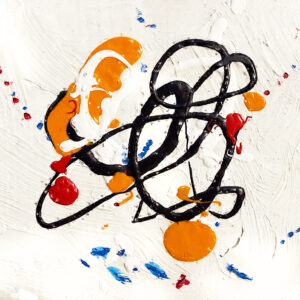
What Do You See — An Original By Michael John Valentine
Abstract Modern Art Original Painting on Canvas
Exhibition-ready, unique, and profoundly evocative
At first glance, What Do You See presents itself not merely as a painting but as an encounter — a visceral invitation into the interior landscape of perception. This original abstract composition by Michael John Valentine stands at the intersection of visual sensation and emotional resonance, a work that resists literal description and instead provokes introspection, curiosity, and an imaginative journey with every viewing.
A Statement of Artistic Vision
What makes What Do You See compelling — and collectible — is its ability to transcend the traditional boundaries of abstract painting. It is not content to sit quietly as decorative wall art; rather, it asserts itself with a presence that engages both the eyes and the mind. The title itself is a question, one that reflects the core ethos of abstract art: it places the viewer at the center of the creative dialogue, encouraging them to project their own interpretations, emotions, and memories onto the canvas.
In What Do You See, Valentine’s mastery of form, texture, and chromatic interplay creates an open field of aesthetic possibility — a space in which personal interpretation becomes part of the art itself. This dynamic exchange mirrors the broader tradition of abstract expressionism and modern abstraction, where the artwork serves as both mirror and catalyst for the viewer’s inner life.
Craftsmanship and Technique
The physical materials of What Do You See articulate the artist’s dedication to craftsmanship and technical refinement. Painted on unstretched exhibition-quality canvas with select overpainting by hand, the piece embodies a tactile richness that only original acrylic applications can achieve. Each brushstroke, ridge of pigment, and subtle variation in surface depth is a record of intentional gesture — the analog signature of the artist’s hand.
This approach places the work within a lineage of abstract painters who emphasize the art of paint itself — its texture, movement, and resonance — over representation. The choice of acrylic medium allows for vibrant color saturation and sculptural surface effects, while the gloss protectant sealant serves both a practical archival function and a visual one, enhancing color depth and infusing the surface with a luminous sheen that captures light differently throughout the day.
The piece arrives unstretched and rolled in a heavy-duty protective tube, enabling collectors to have it custom mounted or framed according to their space, aesthetic, and architectural context. This method of delivery not only ensures its pristine condition upon receipt but also underscores its status as a tailor-made work of fine art — meant to be integrated thoughtfully into a curatorial environment.
Conceptual Resonance and Viewer Engagement
The essence of What Do You See lies in its dialogic impact. Unlike representational art, which guides perception toward a defined image or narrative, this painting opens a field of possibilities. Each viewer is invited into a personal exchange with the canvas — to complete its forms with memory, to sense motion where there is stillness, and to discover meaning through intuition rather than prescribed symbolism.
In this, the work aligns with the highest ambitions of abstract modern art: its meaning is not delivered to the viewer, but co-created with them. The title functions as both prompt and challenge — a question hovering over the composition that echoes the experience of viewing itself. It is an exploration of perception: what shapes, colors, or movements does the eye prioritize? What emotions arise when narrative is withheld? What inner landscapes emerge when form is freed from definition?
This interactive quality situates the work not as a static object but as an evolving experience — one that changes with each moment of engagement, lighting condition, and psychological context. In this respect, What Do You See is not simply observed; it is participated in.
Context Within Valentine’s Artistic Practice
Michael John Valentine’s body of work demonstrates a consistent commitment to bridging the physicality of paint with the conceptual expansiveness of abstraction. Across his abstract pieces — whether in series centered around emotional rhythm, chromatic exploration, or conceptual reference — Valentine treats the canvas as a terrain of possibility. The emphasis on overpainting as a deliberate, layered process reflects his multifaceted approach: visual language is constructed not only through pigment but through gesture, erasure, and reiteration.
This practice situates What Do You See within a broader context of contemporary abstract work that values expressive freedom, technical nuance, and psychological depth. It also reflects influences from modern and post-war abstraction, where artists challenged the viewer’s expectations and reoriented the function of painting toward experiential engagement.
Collectibility and Legacy
As an original painting signed by the artist, What Do You See comes with the reassurance of authenticity and the promise of singularity. Its availability in various exhibition canvas formats — from intimate to monumental — allows collectors to choose a scale that resonates with their environment, while its status as an original ensures that no two versions will ever be identical beyond their shared conceptual origin.
For the discriminating collector, this work represents an opportunity to acquire a piece that is both visually striking and intellectually stimulating. It is suited to contemporary interiors that favor thoughtful, conversation-worthy art as well as to curated gallery spaces where depth of concept and surface presence are valued equally.
Ultimately, What Do You See is more than a painting; it is a contemplative encounter — one that rewards repeat engagement and deepens with time. It stands as evidence of Valentine’s artistic maturity and his ongoing exploration of abstraction as a language of perception, emotion, and meaning.