A Master’s Reflection on Abstract Art
(Channeling the spirit of the great abstract pioneers)
In the panoramic evolution of art, abstraction stands as the highest declaration of artistic freedom — a language beyond literal form, rooted in intuition, emotion, and pure visual thought. Early in the 20th century, artists began dissolving the boundaries of representation, venturing into a dimension where color becomes voice, shape becomes breath, and the canvas becomes an arena of feeling itself.
Vasily Kandinsky, often credited as among the first to make this leap, saw abstraction as a spiritual act — an orchestration of hues and lines that resonates like music, connecting the outer world with the inner psyche. Kandinsky believed that pure form and color have the power to express inner necessity, inviting the viewer not to see something, but to feel something.
This was echoed through the generations: from the lyrical expanses of Helen Frankenthaler, who spoke of painting as an event that “happens at once,” emphasizing immediacy and intuition, to the structural purity of Ad Reinhardt, whose reductive black canvases distilled color into essence and concept.
In the words of Frank Stella, “What you see is what you see” — abstraction need not allude to recognizable forms; its truth lies in the direct encounter between material and perception.
In this lineage, abstract art becomes more than decoration — it becomes a lived experience.
Fire and Flowers: A Collector’s Narrative
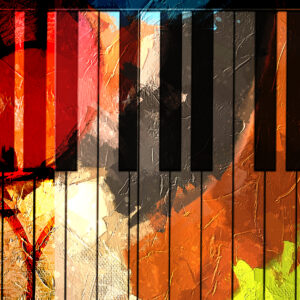
“Fire and Flowers Modern Abstract Fine Art Original Painting on Canvas” by Michael John Valentine is a compelling meditation on the language of abstraction — one that operates both visually and emotionally at the highest artistic registers. This original signed work, rendered on exquisite exhibition canvas and finished with a protective glossy seal, stands not merely as a painting but as a sculpted moment in time, space, and sensation.
The Alchemy of Vision
From the moment one encounters Fire and Flowers, the canvas radiates a palpable tension — a fusion of elemental energy and organic grace. The title itself suggests duality: the raw, instinctive force of fire juxtaposed with the delicate, transient beauty of flowers. But this is not a literal juxtaposition; it is a metaphorical resonance, one that captures the tension between strength and vulnerability, chaos and harmony.
In classical tradition, flowers might symbolize beauty or ephemerality. Here, transformed through abstraction, they become chromatic firestorms — luminous forms that breathe, pulse, and ignite the viewer’s imagination. This is abstraction not as a retreat from reality, but as a deepened engagement with it.
Technique as Intuition
Valentine’s mastery is evident in every gestural sweep and layered application of pigment. Drawing upon a lifetime of artistic practice that began over five decades ago and includes formal training at Kent State University, his technique marries confidence with exploration.
The painter employs acrylics with a palette knife and brush in a way that suggests both control and surrender — smooth transitions of tone where delicate hues flutter like ephemeral petals, juxtaposed with bold, impassioned strokes that explode into spatial dynamics. The canvas pulses with energy, inviting viewers to move with it, not just look at it.
Yet underlying this apparent spontaneity is a rigorous compositional architecture. Valentine’s work does not rely on accident alone but on an attuned sense of balance — color relationships that resonate, kinesthetic rhythms that guide the eye, and layered surfaces that suggest depth beyond the picture plane.
A Dialogue with Form and Color
In many ways, Fire and Flowers can be seen as a contemporary echo of the lyrical expressionists — artists who saw abstract form not as an absence of content, but as a new realm of communication. Like Joan Mitchell, whose canvases were vast emotional topographies shaped by memory and feeling, Valentine’s composition engages the viewer in a silent dialogue.
Each viewer brings their own interpretive lens. One might see phoenix‑like structures rising through the canvas; another might sense floral crescendos that defy definition yet evoke the breath of life. This openness is precisely the strength of masterful abstraction — it does not dictate meaning but enables experience.
Sensory Impact
The surface of the painting — lush yet volatile — harnesses light like a living skin. At certain angles, hues enliven and radiate warmth; from others, a cool undercurrent emerges. These shifting perceptions make Fire and Flowers a dynamic presence in any space — a visual heartbeat that changes with viewers, time of day, and ambient light.
This is not decoration: it is conversation, provocation, reflection. In an age where static imagery saturates our everyday experiences, a work like this demands attention without aggression — it invites contemplation.
Significance for the Collector
Owning Fire and Flowers is to hold an art piece that is both a personal encounter and a collector’s treasure. The painting arrives with a Certificate of Authenticity — a testament to its status as an original signed work by an artist whose practice spans decades.
For the discerning collector, this work occupies a rare position. It is not derivative of past abstract trends but synthesizes them into a contemporary vision — rooted in technical mastery, enriched by emotional complexity, and compelling in its visual mystery.
Whether installed in a refined residential interior, a corporate collection, or a curated exhibition space, Fire and Flowers anchors its environment — not through familiarity, but through evocation.
A Legacy in Abstraction
Abstraction, in its highest form, transcends mere figuration. It speaks to the ineffable. It resonates with the same psychological depth as music and the same emotional nuance as poetry. In Fire and Flowers, Valentine asserts this lineage — placing his work among the ongoing dialogue of modern art, where intuition and intellect converge.
This painting does not merely hang; it lives.
It is not simply viewed; it interacts.
And for those who invite it into their world, it becomes a perennial companion — revealing new layers of interpretation with each encounter.