“Abstract art is not the creation of another reality, but the true vision of reality.” — Piet Mondrian
The Calm After Color — A Study in Resolution, Memory, and Luminous Stillness
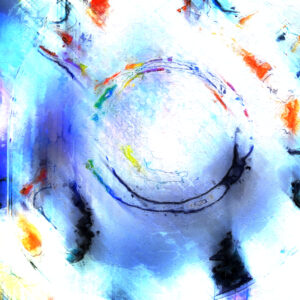
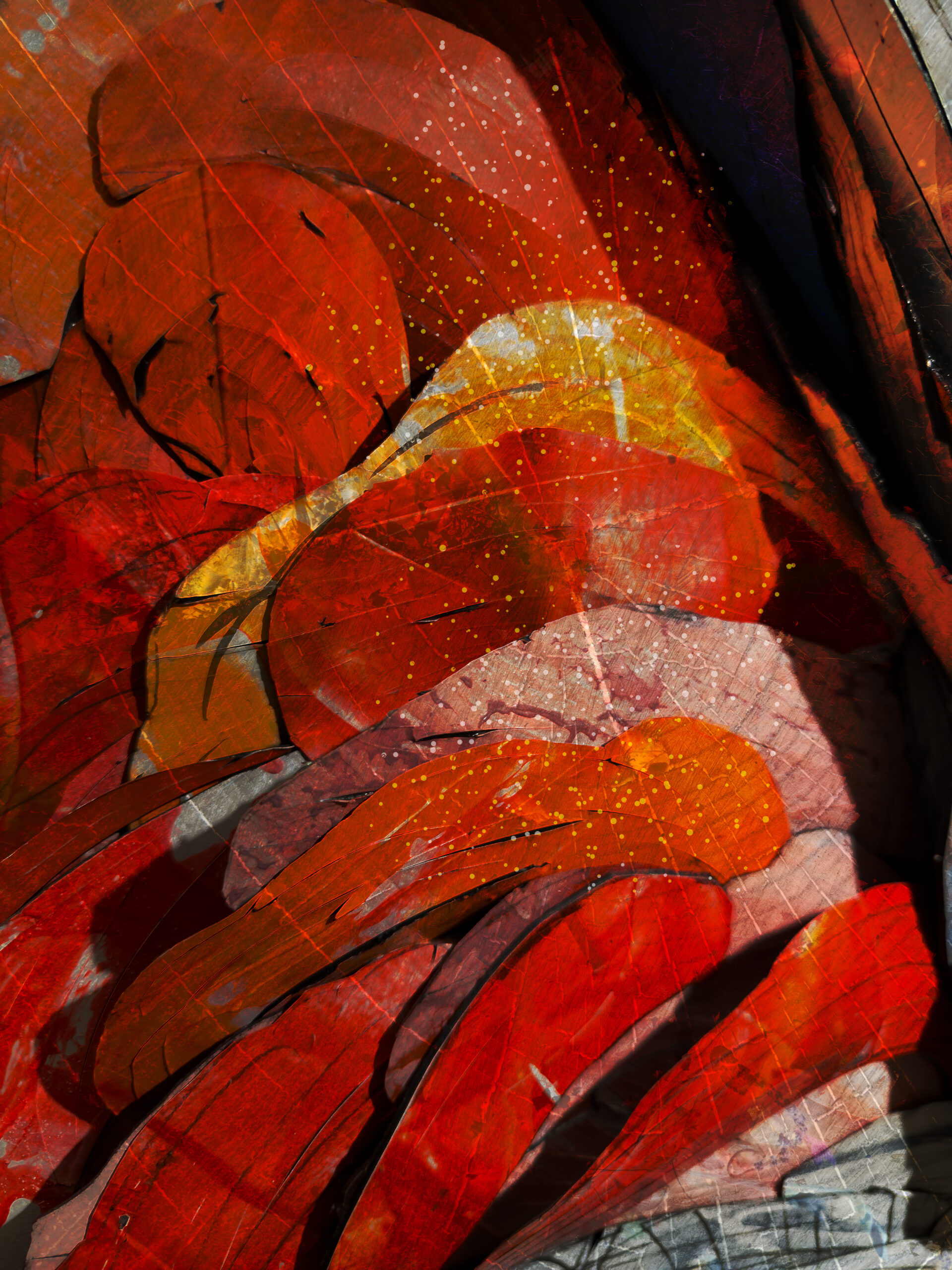
In The Calm After Color, Michael John Valentine presents a moment of visual and emotional exhalation—a suspended state where intensity gives way to reflection. The work feels like the aftermath of movement: not silence, but a softened resonance of what has already passed through the surface. It is a painting defined not by absence of energy, but by its transformation into stillness.
Rather than functioning as a static image, the work operates as a perceptual field. Color does not simply occupy space—it settles, lingers, and recedes, as though it is remembering its own motion. This sense of residual energy is central to Valentine’s practice, where abstraction becomes less about depiction and more about the lived experience of transition.
Overpainting as Accumulated Memory
At the core of Valentine’s process is his signature overpainting method, a disciplined yet intuitive system of layering that builds both visual and emotional depth. Each painting begins with an initial compositional structure, often derived from photographic reference or gestural abstraction. This foundational layer is not treated as a final statement, but as an early state of perception—something provisional and open to transformation.
From there, Valentine constructs the surface through successive applications of acrylic paint. Each layer partially obscures what came before it while simultaneously preserving its presence beneath the surface. In The Calm After Color, this results in a complex stratification where earlier gestures remain faintly visible, like echoes embedded in the material itself.
This process gives the work its defining characteristic: time made visible. The painting does not represent a single moment, but a sequence of decisions, revisions, and refinements. Overpainting becomes a form of visual memory, where nothing is fully erased and everything contributes to the final emotional tone.
As layers accumulate, the painting begins to shift from image to environment. Forms lose rigidity, edges soften, and spatial relationships become fluid. What emerges is not a depiction of calm, but the construction of calm through accumulated experience.
Glazing and the Soft Architecture of Light
Once the layered structure reaches its intended complexity, Valentine introduces glazing—a critical phase that unifies and refines the entire surface. Thin, translucent applications of pigment and medium are carefully applied to modulate tone, deepen atmosphere, and control the interaction between light and color.
In The Calm After Color, glazing functions as the defining atmospheric intelligence of the work. It dissolves harsh transitions between forms, allowing color fields to breathe into one another. Light appears to move through the painting rather than reflect off it, creating a sense of internal luminosity.
This stage is not about finishing in a conventional sense; it is about integration. Glazing brings coherence to the accumulated layers without flattening their complexity. Instead, it allows earlier passages to remain active beneath translucent veils, ensuring that the painting retains a sense of depth and interiority.
The result is a surface that behaves almost like weather—subtle shifts in tone and perception depending on angle, distance, and ambient light. The viewer is not looking at a fixed image, but an evolving optical experience.
Mixed Media as Unified Perceptual Language
Although Valentine’s practice is grounded in mixed media, it avoids fragmentation. Instead, it functions as a unified perceptual system in which photography, painting, layering, and glazing are all stages of a continuous transformation.
In The Calm After Color, this unity is expressed through balance: between intensity and restraint, structure and dissolution, presence and absence. At times, bold chromatic gestures emerge with clarity; at others, they recede into atmospheric ambiguity. This oscillation creates a rhythm that mirrors the natural cycles of perception itself.
The painting does not ask to be understood instantly. It requires duration. It rewards sustained looking by gradually revealing relationships between layers that are not immediately visible. In this way, the work becomes less an object and more a temporal experience.
Color as Emotional Residue
The title The Calm After Color suggests a shift in state rather than a cessation of activity. Color here is not abandoned—it is absorbed. Its energy persists, but in a transformed condition. Rather than asserting itself, it settles into balance.
Valentine’s handling of color reflects this philosophy. Hues interact not through contrast alone, but through gradual modulation. Vibrations between warm and cool tones create subtle tensions that never fully resolve, yet never collapse into chaos. The result is a controlled emotional field—complex, layered, and intentionally unresolved.
This restraint is essential to the painting’s psychological effect. It evokes the feeling of standing after an emotional or sensory peak, when experience has not disappeared but has shifted into reflection.
The Discipline of Stillness
What distinguishes The Calm After Color is its ability to hold stillness without emptiness. The calm it presents is not absence of movement, but the integration of movement into memory. Every layer contributes to this equilibrium, where past intensity becomes present quietude.
Valentine’s overpainting process is crucial to this effect. Because earlier marks are never fully removed, they remain embedded in the structure of the work. The calm, therefore, is not imposed—it is built from within. It is the result of accumulated decisions rather than a single gesture.
Glazing reinforces this condition by softening boundaries and creating continuity across the surface. It transforms complexity into coherence without diminishing depth.
A Painting That Breathes After Intensity
Ultimately, The Calm After Color exists in a rare emotional register: the moment after transformation, when everything has shifted but nothing has been lost. It is a work about absorption—how experience becomes internalized rather than expressed outwardly.
Through overpainting, Valentine constructs a history of gestures. Through glazing, he transforms that history into atmosphere. Together, these processes produce a painting that feels alive with quiet memory.
Piet Mondrian’s insight that abstraction reveals a deeper reality resonates strongly here. In Valentine’s work, that reality is not static or rigid—it is fluid, layered, and responsive. It is the reality of perception itself, continually forming and reforming in time.
In The Calm After Color, what remains is not silence, but continuity—the lingering presence of everything that came before.
A Special Modern Abstract Series about time, memory, atmosphere, and fleeting perfection.
The Series Includes the following releases- The Shape Of A Perfect Day, A Day Worth Holding, The Calm After Color, The Day That Found Us, Just Before Evening, Before The Day Breaks, A Sky That Wouldn’t Leave, After The Light Fades, A Moment Without End, The Day That Stayed, The Longest Light, One Fine Day
The Exhibition Canvas comes in 3 sizes and goes through several steps that include overpainting with acrylics, signing with acrylics on the front and a final glazing to protect the canvas before being rolled in a sealed tube then a box ( shipping is free in the USA )
The Matted Prints come in 3 sizes and are shipped in a box. ( shipping and handling is free in the US)
The Glossy Poster Print measures 16 x 24 and arrives in a sealed tube that is placed in a box. ( shipping is free in the US )
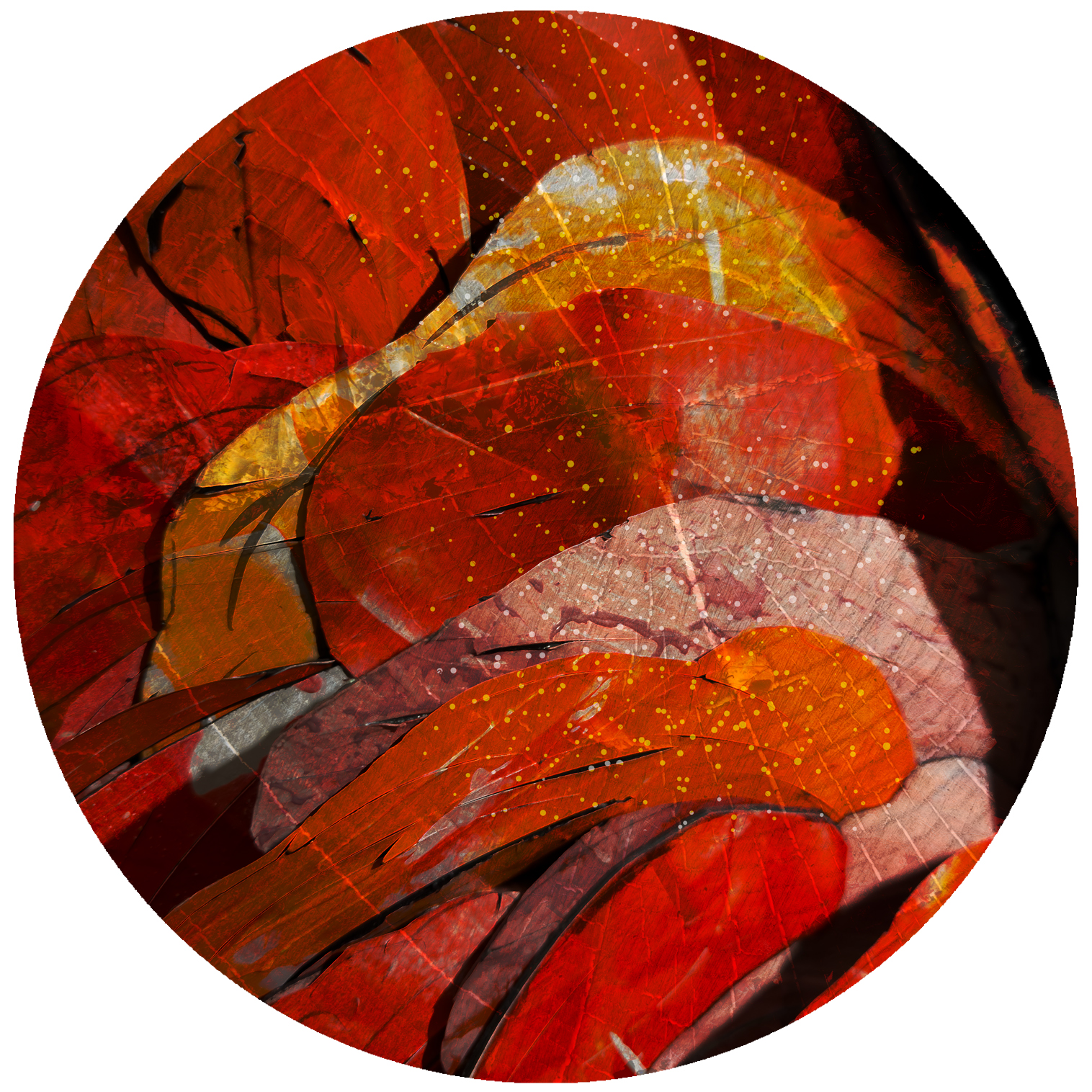
The 4 Inch Round Peel And Stick Decal is perfect for many applications beyond cars and comes in a sealed envelope ( shipped for free )