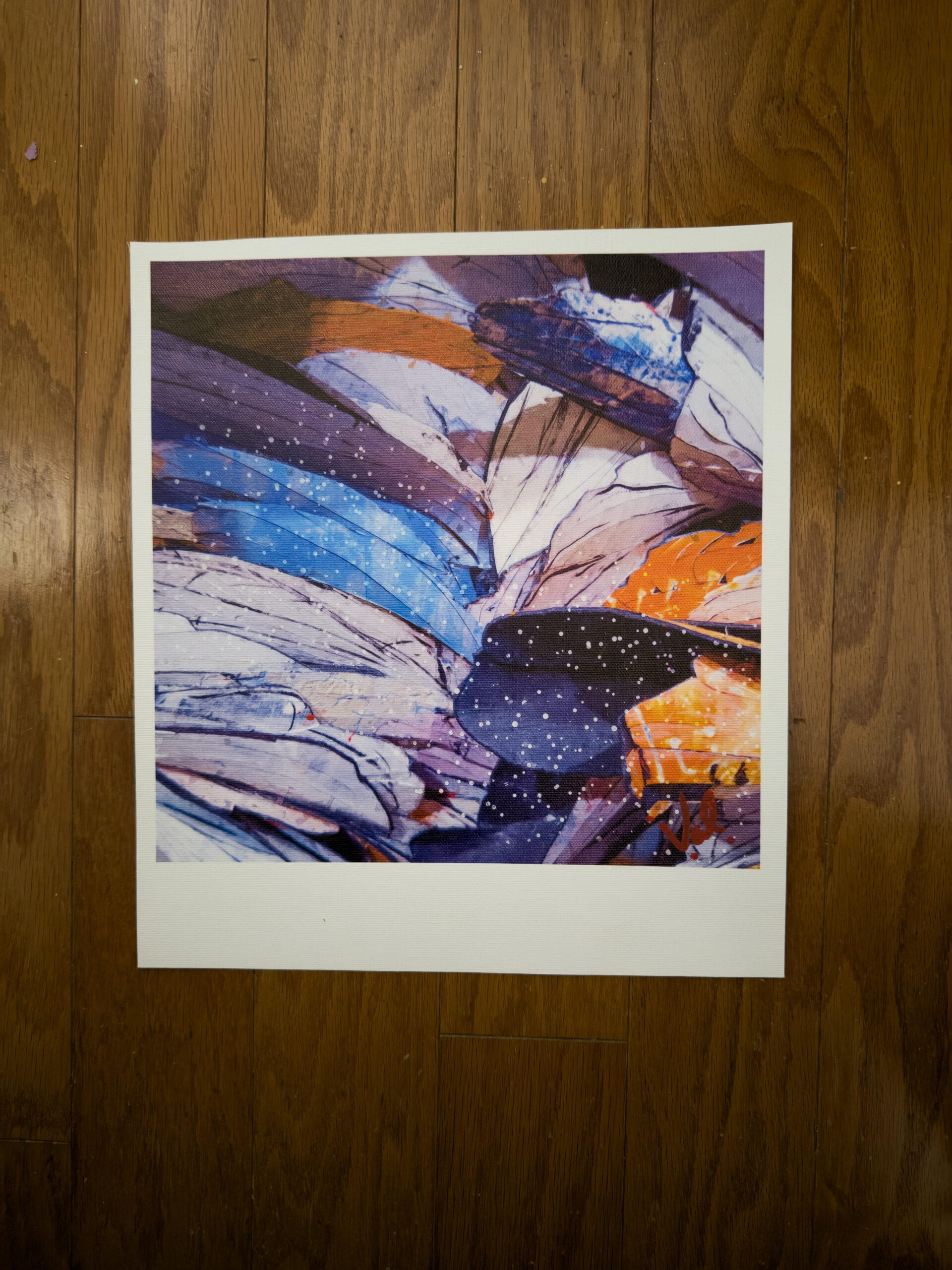
“Ultraviolet Tempest is what happens when silence finally fractures into light we were never prepared to name.” — Michael John Valentine
Ultraviolet Tempest — The Faultline Series
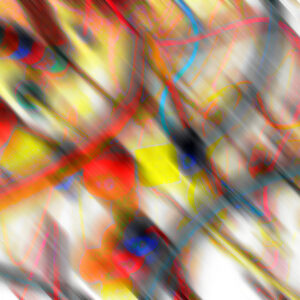
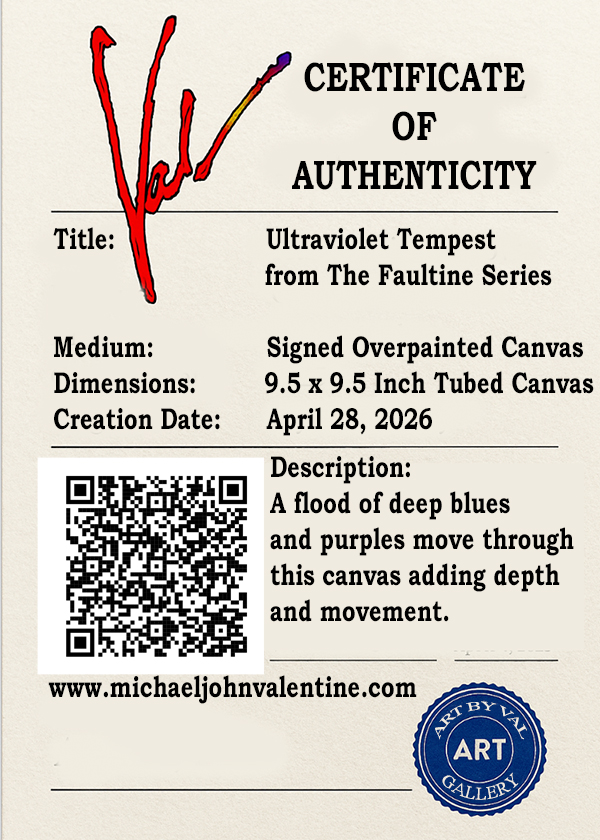
This 9.5 x 9.5 signed overpainted canvas is ideal for a standard frame with matting . It works well with or without glass but should be dry mounted at your framing store. Comes in a sealed tube
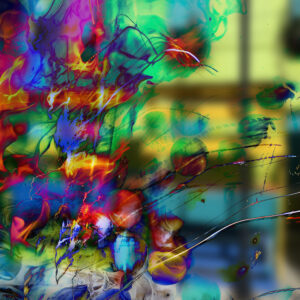
Within The Faultline Series, Ultraviolet Tempest stands as one of the most volatile and psychologically charged works in the collection—a convergence point where atmospheric violence, emotional rupture, and chromatic extremity collide. It is not simply a depiction of a storm; it is the condition of instability itself rendered visible. The piece operates as both event and aftermath, capturing the exact moment when internal pressure becomes external spectacle.
At its core, Ultraviolet Tempest is built upon contradiction. The word “ultraviolet” suggests radiation beyond human perception—light that exists just outside the visible spectrum, powerful yet intangible. “Tempest,” on the other hand, is immediate, physical, and uncontrollable. When fused together, the title implies a phenomenon that cannot be fully witnessed, only experienced through its effects. This tension defines the work: something unseen driving something overwhelming.
Unlike traditional storm imagery, this piece refuses narrative clarity. There is no horizon that offers stability, no fixed point that anchors the viewer’s eye. Instead, the composition behaves like a pressure system in flux. Forms emerge and dissolve within the same visual breath, as though the painting is continuously rewriting its own atmospheric conditions. It does not represent weather—it performs it.
The Faultline Series is grounded in the idea that emotional and geological systems are not separate, but parallel. Just as tectonic pressure builds invisibly beneath the earth’s surface before release, emotional thresholds accumulate beneath perception until rupture becomes inevitable. Ultraviolet Tempest exists at that threshold. It is the instant before collapse and the echo after it simultaneously.
Color in this work is not decorative—it is structural force. The ultraviolet register introduces an unnatural luminosity that resists realism, pushing the viewer into a perceptual in-between state. It suggests energy that cannot be fully contained within naturalistic palettes. Against this charged field, darker tonal masses behave like gravitational anchors, pulling the composition into depth while simultaneously threatening to swallow it. The result is a constant visual instability: expansion and collapse happening at once.
The surface of the work carries the evidence of this tension. Layers are not applied with the intention of finality; they accumulate as decisions under pressure. Overpainting becomes a record of correction and escalation, where each layer responds to the one beneath it rather than replacing it. This creates a geological sense of time—compressed, fractured, and exposed. The viewer is not looking at a single moment, but at multiple moments pressed into one surface.
There is also a deliberate resistance to resolution. In many works, composition seeks equilibrium—a place where visual forces settle. In Ultraviolet Tempest, equilibrium is denied. Instead, the painting sustains tension as its primary state of being. This refusal to resolve is what gives the work its psychological charge. It mirrors the human experience of emotional thresholds—those moments where clarity is suspended and all internal systems are recalibrating in real time.
Within your studio methodology, particularly the use of live, responsive painting processes, this work carries the energy of immediacy. It feels as though it was not constructed but negotiated. Each gesture appears to respond to invisible counterforces, as if the canvas itself were resisting closure. This dynamic introduces a sense of unpredictability that is essential to the work’s impact. Nothing feels preordained; everything feels contingent.
The idea of the faultline is crucial here. A faultline is not visible from above—it is only understood through its consequences. Earthquakes do not originate on the surface; they are the result of accumulated pressure along invisible boundaries. Ultraviolet Tempest translates this geological truth into a visual language. The painting becomes a map of invisible stress rendered legible only through rupture.
Emotionally, the work operates in a similar register. It suggests states that are difficult to articulate: tension without release, intensity without resolution, clarity interrupted by overload. Yet it avoids descending into chaos for its own sake. There is structure beneath the turbulence, a compositional intelligence that holds the instability in suspension. This is what prevents the work from collapsing into disorder—it is controlled volatility, not randomness.
Light in the piece behaves almost like a presence rather than an effect. The ultraviolet quality suggests illumination that does not originate from a single source but from within the material itself. It feels as though the painting is generating its own atmospheric field. This internal luminosity destabilizes the boundary between surface and depth, making it difficult to determine where the painting ends and the space within it begins.
In the broader context of The Faultline Series, Ultraviolet Tempest functions as a peak intensity moment—a climactic pressure event within the conceptual landscape. If other works in the series explore accumulation, tension, or pre-fracture states, this piece embodies rupture itself. Yet even in rupture, there is a strange order. The storm is not chaos—it is systemized energy finding release.
The viewer’s experience of the work is not passive. It requires adaptation. The eye searches for stability and finds none, forcing a recalibration of perception. Over time, patterns begin to emerge, but they are unstable—always shifting under continued observation. This creates a viewing experience that mirrors the subject matter: perception under pressure.
Ultimately, Ultraviolet Tempest is not about depicting a storm in the sky. It is about the internal architecture of collapse and transformation. It asks what happens when systems exceed their thresholds, when containment becomes impossible, and when unseen forces finally make themselves visible through rupture.
It is a work that does not describe the storm.
It is the moment the storm realizes it has already begun.
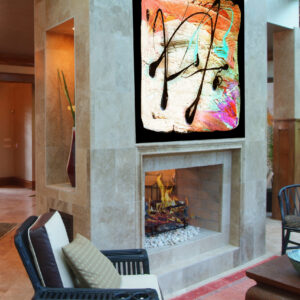
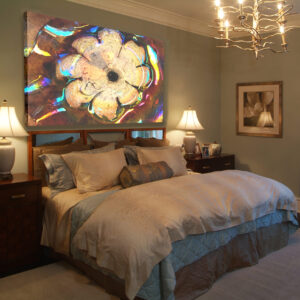
The Exhibition Canvas comes in 3 sizes and goes through several steps that include overpainting with acrylics, signing with acrylics on the front and a final glazing to protect the canvas before being rolled in a sealed tube then a box ( shipping is free in the USA )
The Matted Prints come in 3 sizes and are shipped in a box. ( shipping and handling is free in the US)
The Glossy Poster Print measures 16 x 24 and arrives in a sealed tube that is placed in a box. ( shipping is free in the US )
The 4 Inch Round Peel And Stick Decal is perfect for many applications beyond cars and comes in a sealed envelope ( shipped for free )