“Art is not what you see, but what you make others see.” — Edgar Degas
In The Day That Stayed, Michael John Valentine moves from atmosphere into memory—into a space where abstraction begins to brush against the figurative, and where gesture carries the weight of something deeply human. This work stands as one of the most intimate expressions within the series, not because it reveals more, but because it suggests more—inviting the viewer into a moment that feels both personal and enduring.
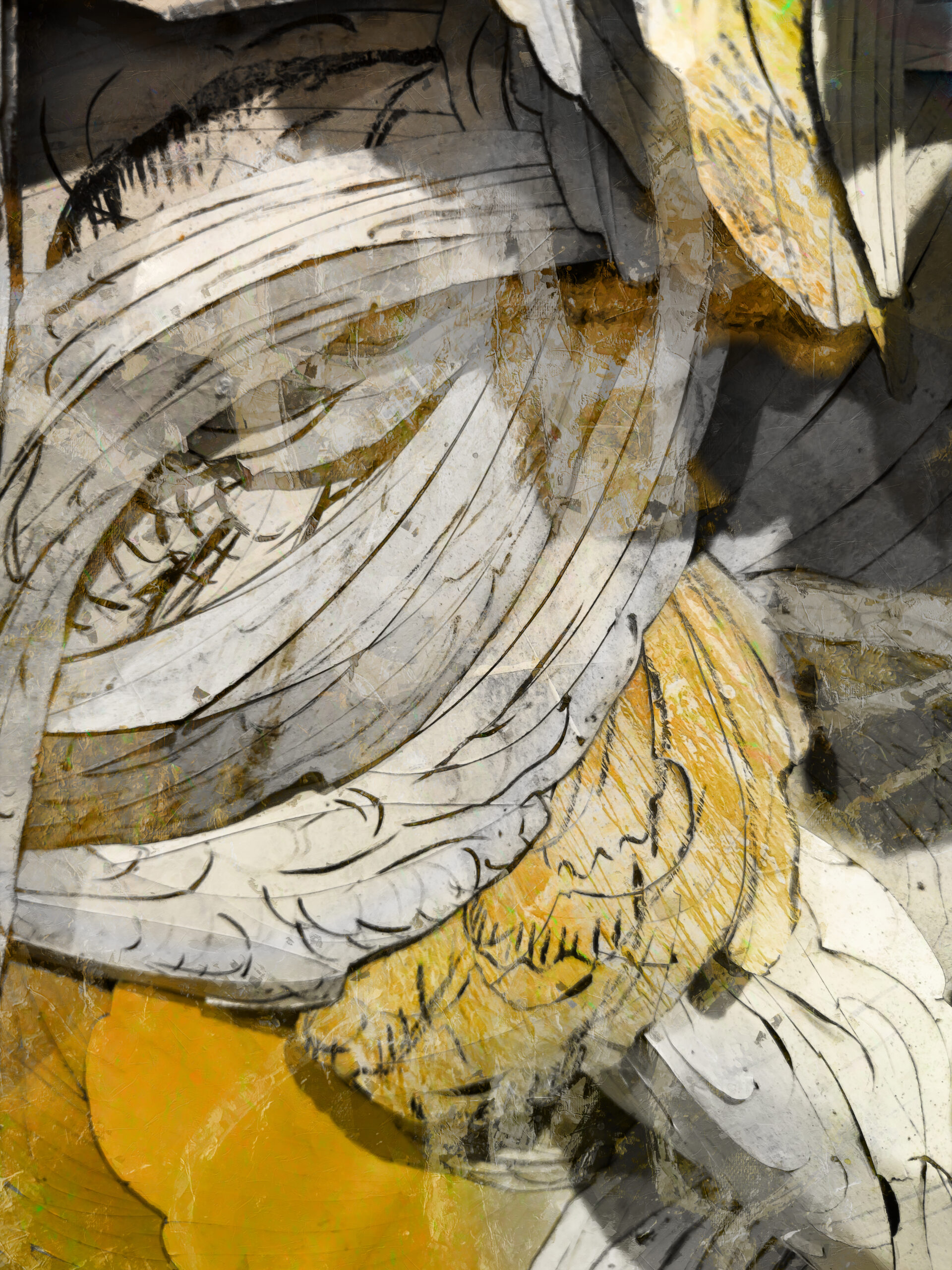
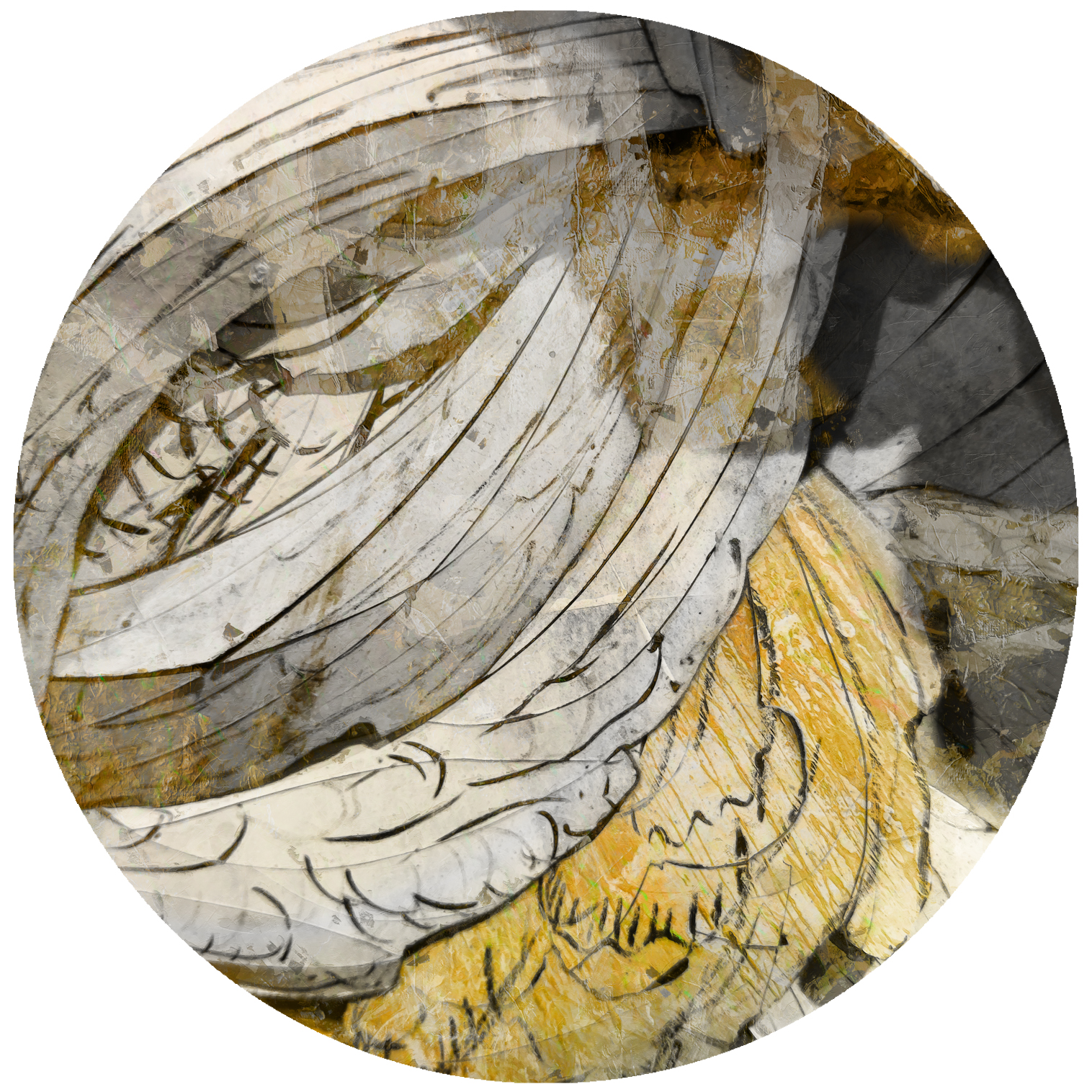
At first glance, the palette establishes a tonal departure. Warm ochres, muted golds, and soft ivory tones dominate the composition, grounded by charcoal-like linear markings and shadowed passages of gray. These colors evoke a sense of age and material history—reminiscent of weathered surfaces, aged parchment, or fragments of something once whole. Unlike the cooler expanses of earlier works in the series, this piece feels tactile, almost archival, as though it has been uncovered rather than created.
And yet, it is far from static.
Sweeping, ribbon-like forms arc across the composition, their movement both fluid and deliberate. These gestures suggest drapery, wings, or the contours of a figure in motion—never fully defined, but unmistakably present. Beneath and within these forms, fine linear markings emerge—sketch-like, instinctive, and raw. They appear as remnants of an earlier language, partially obscured yet intentionally preserved.
This is where Valentine’s overpainting process becomes essential—not just as a technique, but as a narrative device.
The painting is built through successive layers of acrylic and mixed media, each phase contributing to a visual dialogue between concealment and revelation. Early gestural drawings—spontaneous, searching—are laid down as a foundation. These marks carry an immediacy, a sense of the artist thinking through movement. Rather than being erased or fully covered, they are allowed to remain, partially visible beneath subsequent layers.
Over these initial marks, Valentine introduces fields of pigment—thin washes of warm tone that settle into the surface, followed by thicker applications that create structure and weight. Certain areas are softened through glazing, allowing underlying forms to glow through; others are scraped back, exposing earlier decisions and creating a surface that feels excavated rather than applied.
The result is a painting that holds time within its surface.
Every visible line, every softened edge, every fragment of texture contributes to a layered history. The viewer is not simply looking at a final image, but at a sequence of moments—each one preserved, each one interacting with the next. This accumulation creates a depth that is both visual and emotional, transforming the work into something that feels lived-in.
Light interacts with this surface in subtle, shifting ways. The warmer tones absorb and diffuse illumination, creating a soft, ambient glow, while lighter passages—particularly the whites and pale creams—reflect it gently, guiding the viewer’s eye across the composition. Unlike more dramatic contrasts, the light here is restrained. It does not announce itself; it lingers.
This restraint is part of what gives The Day That Stayed its emotional resonance.
There is a sense of quiet persistence within the work—a feeling that something has been held onto, carried forward, and ultimately preserved. The title itself speaks to this idea: not a fleeting moment, but one that refuses to disappear. A day that, for reasons perhaps unknown, remains.
The subtle suggestion of figuration enhances this effect. The curved forms and underlying linework hint at presence—at the possibility of a figure, a gesture, or an interaction. But Valentine resists resolution. He allows the image to hover at the edge of recognition, ensuring that it remains open to interpretation.
This openness is where the viewer enters.
Each collector will see something different—fragments of memory, echoes of movement, traces of something familiar yet undefined. The painting does not dictate meaning; it invites it. And in doing so, it becomes deeply personal.
Equally significant is the uniqueness inherent in the work. The overpainting process, with its continuous adjustments and intuitive decisions, ensures that no element can be precisely replicated. Each layer introduces variables—gesture, pressure, timing—that shape the final outcome in ways that cannot be reproduced. What remains is a singular object: one moment, one process, one result.
For the collector, this distinction elevates the work beyond aesthetic appeal. It becomes a record of creation itself—a physical embodiment of time, intention, and transformation. The visible traces of earlier layers serve as evidence of this journey, reinforcing the authenticity and originality of the piece.
The circular format further intensifies the experience. Without corners or edges to anchor the composition, the viewer’s eye moves continuously, following the sweeping gestures and subtle transitions. This sense of continuity mirrors the conceptual core of the work—the idea of something ongoing, something that does not end.
Ultimately, The Day That Stayed is not about a specific moment, but about the act of holding onto one. It captures the essence of memory not as a fixed image, but as a layered, evolving presence—something that shifts, softens, and deepens over time, yet never fully fades.
It is not simply observed.
It is remembered.
A Special Modern Abstract Series about time, memory, atmosphere, and fleeting perfection.
The Series Includes the following releases- The Shape Of A Perfect Day, A Day Worth Holding, The Calm After Color, The Day That Found Us, Just Before Evening, Before The Day Breaks, A Sky That Wouldn’t Leave, After The Light Fades, A Moment Without End, The Day That Stayed, The Longest Light, One Fine Day
The Exhibition Canvas comes in 3 sizes and goes through several steps that include overpainting with acrylics, signing with acrylics on the front and a final glazing to protect the canvas before being rolled in a sealed tube then a box ( shipping is free in the USA )
The Matted Prints come in 3 sizes and are shipped in a box. ( shipping and handling is free in the US)
The Glossy Poster Print measures 16 x 24 and arrives in a sealed tube that is placed in a box. ( shipping is free in the US )
The 4 Inch Round Peel And Stick Decal is perfect for many applications beyond cars and comes in a sealed envelope ( shipped for free )